Algorithm analysis is the practice of measuring how much computing resources — time and memory — an algorithm uses, as a function of its input size. It lets you compare algorithms abstractly, before any code is written, by counting basic operations rather than running the program with a stopwatch.
The result of analyzing an algorithm is a time function : the number of basic operations the algorithm performs on an input of size . From you typically extract a Big O bound that describes the function’s growth rate.
Axioms of basic operations
The standard set of “basic operations,” each assumed to take constant time:
- Memory access — fetching or storing an integer takes or . So
y = x + 1takes . - Arithmetic and comparison — add, subtract, multiply, divide, compare integers, all constant.
y = y + 1takes . - Function calls — call and return are constant (, ). Passing an integer argument is one fetch.
- Array subscripting — computing the address of
a[i]takes constant time , not including the time to computeior to fetch/store the element. - Memory allocation — for analysis purposes,
mallocis treated as constant (excluding initialization). In realitymallocis only amortized constant, and only under specific allocator assumptions. A free-list allocator can hit the slow path when a request needs to grow the heap (mmap/sbrk syscall, possibly hundreds of microseconds), and an arena allocator’s resize-and-copy fallback is worse. The constant-time assumption is fine for big-O but breaks down once you care about latency tails or real-time behavior.
To simplify, set all these to 1 clock cycle: . Then the time function counts the number of basic operations.
Frequency-count method
Count how many times each statement executes, multiply by its per-instance cost, sum up.
Example: sum the elements of an array.
int sum(int a[], int n) {
    int s = 0;                   // 1 store    → 1
    for (int i = 0; i < n; i++) {   // n+1 compares → n+1
        s = s + a[i];            // n iters    → n
    }
    return s;                    // 1 fetch    → 1
}
Total: .
The dominant term grows linearly with , so .
Worst case, average case, best case
For algorithms whose running time depends on the contents of the input, not just its size, three quantities matter:
- Worst case : the maximum running time over all inputs of size . Usually what we care about.
- Average case : the expected running time over a random input. Often more informative for practical performance.
- Best case : the minimum. Usually less interesting except as a sanity check.
Example: searching for a value in an unsorted array. Worst case: scan the whole array, . Best case: the value is in position 0, . Average case: scan half the array, (still linear).
Worked example: find maximum
int FindMaximum(int a[], int n) {
    int result = a[0];                       // line 3
    for (int i = 1; i < n; ++i)              // line 4
        if (a[i] > result)                   // line 5
            result = a[i];                   // line 6
    return result;                           // line 7
}
Counting per line:
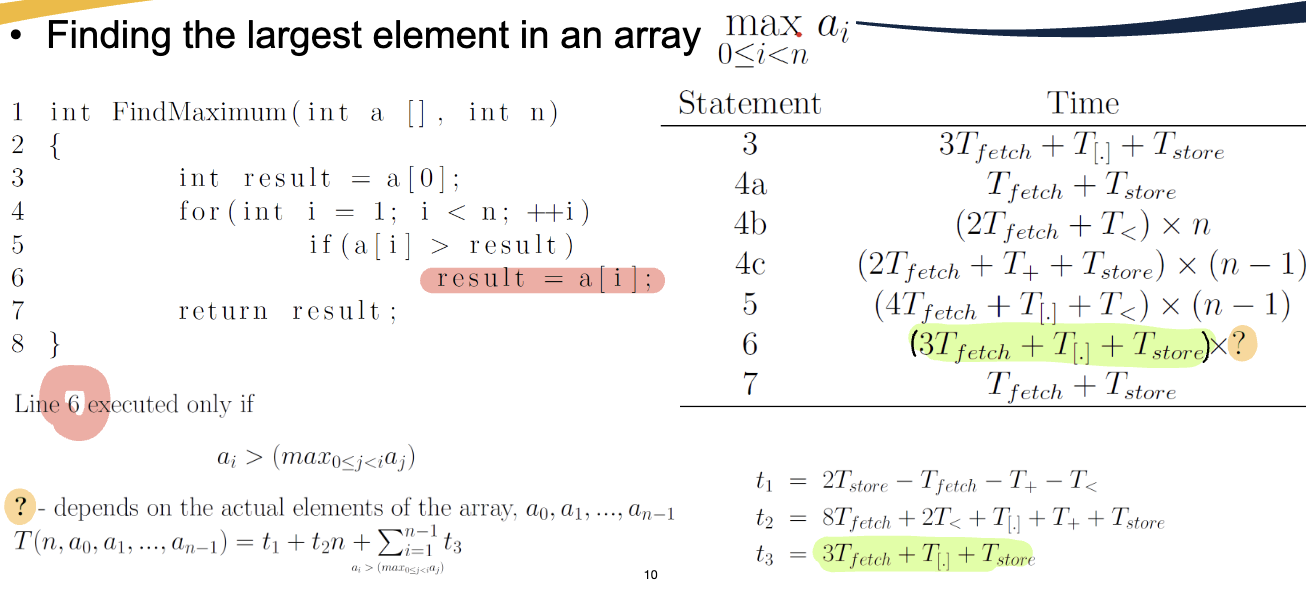
The wrinkle: line 6 only executes when — depends on the actual data. So has a data-dependent term that varies between best, worst, and average cases.
For average case on random inputs: the probability that is the largest seen so far is . Summing across all gives:
The harmonic sum is , so the average case is dominated by the term: still .
For worst case: line 6 always fires (input is sorted ascending). .
For best case: line 6 never fires (the first element is already max). .
All three are — the constant differences don’t affect the asymptotic class.
Why we don’t track exact constants
For comparing algorithms, exact constants don’t matter — they’re determined by the hardware, the compiler, the workload. What matters is how the running time scales with input size. An algorithm will eventually beat any algorithm, no matter how generous the quadratic algorithm’s constants. We use Big O notation to capture this scaling and ignore constants.
For the formal Big O machinery, see Big O notation. For the cost models specific to each algorithm, see the individual algorithm notes.