A bounce diagram is a graphical method for tracking voltage and current waves bouncing back and forth on a Transmission line when a transient (DC step, pulse, or other non-sinusoidal signal) is applied. It’s the time-domain counterpart to the standing-wave analysis used for sinusoidal steady state.
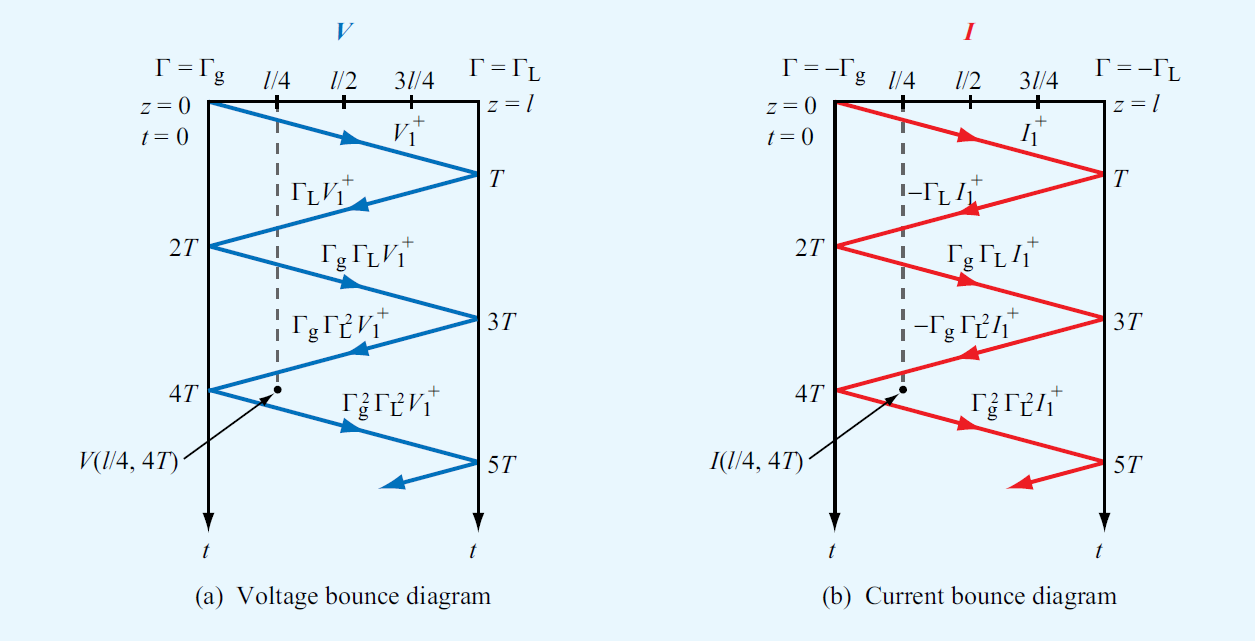 Bounce diagrams: voltage (left) and current (right). The line at is the generator end, is the load end. Time flows downward. Diagonal lines show waves bouncing between the two ends with reflection coefficients and at each reflection.
Setup
A transmission line of length , characteristic impedance , connected at to a generator with source impedance , and at to a load .
Define one-way travel time:
Reflection coefficients at each end (treating the source and load as terminating impedances):
These tell you what fraction of an incident voltage bounces back from each end.
How the diagram works
Time goes downward on the vertical axis; position along the horizontal. The line traces out the trajectory of each wavefront:
-
At : the switch closes and the source launches a forward wave at . During the first transit (), no reflection has yet returned from the load, so the source sees only the line’s characteristic impedance , not . The launched amplitude is the voltage divider between and : This formula is valid only for at the source end, before the first reflection returns. After that, the source sees a superposition of the incident wave it’s still launching and the returning reflected wave.
-
Forward wave travels at : it arrives at at .
-
At : the load reflects. Reflected amplitude is . This wave travels back.
-
At : the reflected wave reaches the source. Some fraction reflects again (at the source mismatch): . This launches a new forward wave.
-
At : reaches the load. Reflects: .
And so on. Each “bounce” multiplies the amplitude by another factor of or .
Reading voltage at a specific point
To find for a given :
- Locate the point on the bounce diagram.
- Sum the amplitudes of all forward and backward waves that have passed over that point before time .
Each wave contributes its amplitude (positive or negative depending on sign of ). Once a wave passes, it stays “contributing” — it doesn’t reset. The voltage at any point is the sum of all incident-plus-reflected waves through that point at that time.
Worked example
A line with Ω, length , generator , load . Switch closes at with DC source .
Reflection coefficients:
Initial launched wave:
Wave amplitudes over time:
- (forward, launched at ).
- (reflected from load at ).
- (re-reflected from source at ).
- (reflected from load at ).
- …
After many round-trip times, the voltage on the line settles to a steady-state DC value determined by the resistive divider:
This must equal the sum of the geometric series of bounces:
The bounce diagram is an alternative way of summing this infinite series. Good for visualizing the transient, but the algebraic geometric-series approach gives the answer directly.
Pulse propagation
A rectangular pulse of duration launched from the source becomes two step-shaped wavefronts: one rising step at , one falling step at . Each independently bounces on the diagram. Their sum at any point gives the actual voltage.
For : the pulse fits within one transit time and arrives at the load as a distinct pulse, then reflects.
For : the pulse is partially on the line and partially still being launched when the reflection arrives. The front of the pulse is reflecting from the load while the back is still being launched.
This is the basis of time-domain reflectometry (TDR): send a pulse down an unknown line, observe the reflections to characterize impedance mismatches, faults, or load impedances. Reflection arriving at time pinpoints a discontinuity at .
In context
The bounce diagram is for the time domain what the Smith chart is for the frequency domain. Same physics, different problems:
- Bounce diagram: transient response to step/pulse inputs. Useful for digital signaling, switching circuits, lightning surge analysis.
- Smith chart: steady-state response to sinusoidal inputs. Useful for RF matching, antenna design, microwave components.
Both rely on the same underlying reflection coefficient , applied to different problems.