The conduction angle is the fraction of each input cycle (expressed as an angle ) during which the diode in a Peak rectifier actually conducts. In a well-smoothed supply it’s small: the diode is off for most of the cycle and turns on only in a brief burst near each peak. That small angle is why the peak diode current is many times the DC load current, and it sets the diode’s current rating.
Deriving the conduction angle
The capacitor holds the output near , drooping by the Ripple voltage to a minimum of just before the next peak. The diode only conducts while the rising input sinusoid is above the capacitor voltage. Conduction begins when the input, (measuring time from the peak, so describes the descent and the symmetric rise), has fallen to the capacitor’s minimum:
where is the conduction half-angle. Solve for the cosine:
The angle is small (a few degrees), so use the small-angle expansion . Substituting :
The 1’s cancel; rearrange:
A small ripple makes the conduction angle tiny: the better you smooth, the shorter the diode is on.
Why this gives huge diode currents
All the charge the load drained from the capacitor over the whole cycle has to be put back during that short conduction window. Charge in must equal charge out per cycle, and a short window means a tall current pulse. Working the charge balance through gives the average and peak diode currents during conduction:
is the DC load current, the peak, the ripple. These are the full-wave peak-rectifier expressions (the capacitor is refilled twice per cycle); a half-wave peak rectifier refills only once per cycle and draws a correspondingly larger pulse. The square-root factor is large (it’s the reciprocal of the conduction angle up to a constant), so both currents run much larger than . With V and V, , so , a peak diode current over 40 times the load current.
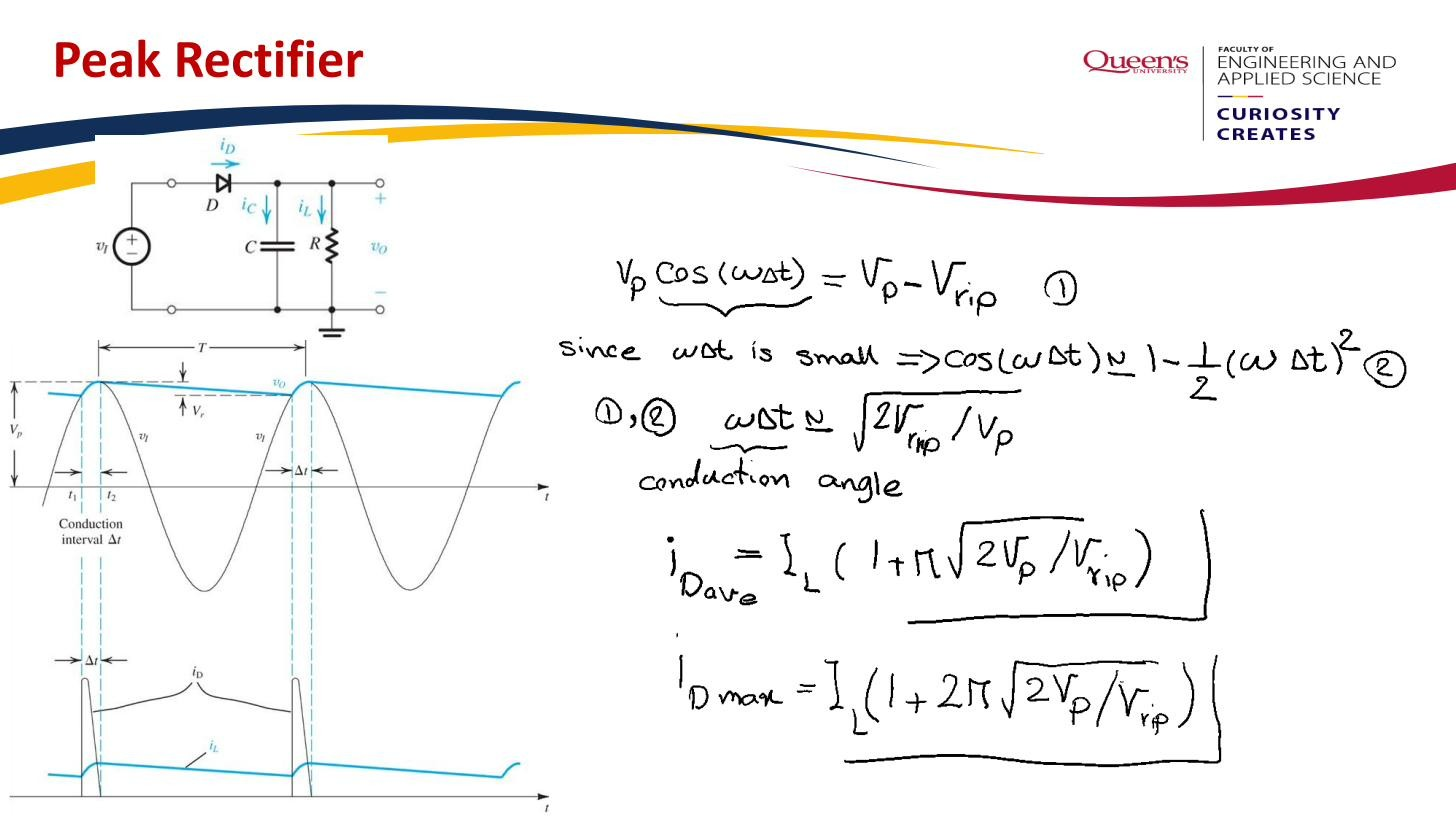 Conduction angle ; average/peak diode currents far exceed because charge is replenished in a short burst.
The design constraint people forget: smoothing a supply harder (smaller ) shortens the conduction angle and raises the peak diode current, so the diode and the transformer must be rated for surge currents far above the modest DC load. Ripple voltage and conduction angle are two views of the same trade-off, designed together.