Integral of a complex function along an oriented curve in . The complex-analytic analog of the vector line integral.
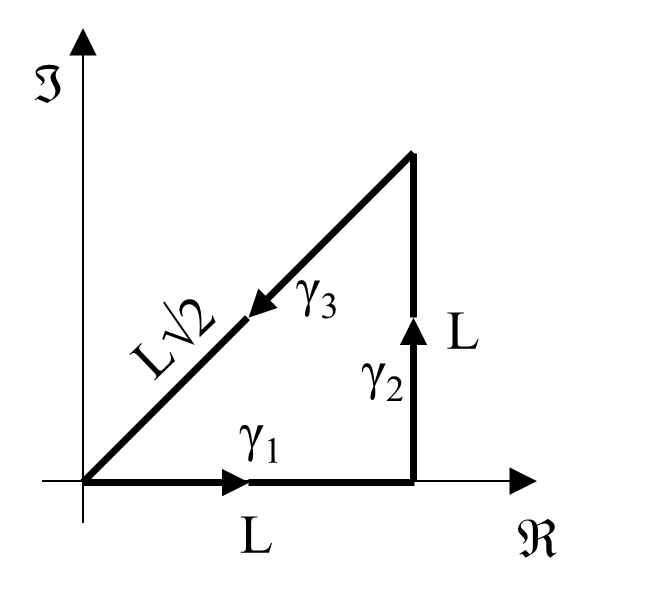 Image: Fresnel integral contour, CC0. Example contour in the complex plane used to evaluate the Fresnel integral.

Definition
A contour is a piecewise-smooth oriented curve in , parameterized by , , with piecewise continuous. For a continuous function along ,
Same shape as the vector line integral: substitute the parameterization, multiply by the velocity (now complex), integrate over the parameter.
Properties
- Linear in : .
- Orientation-sensitive: .
- Decomposition: .
- Reparameterization-invariant within the same orientation.
Closed contours
When is a closed contour (starts and ends at the same point), write . By convention, closed contours are traversed counterclockwise (positive orientation) unless stated otherwise.
Worked examples
Example 1: where is the unit circle, counterclockwise.
Parameterize , . . .
is not analytic, so the integral didn’t have to vanish, and didn’t.
Example 2: where is the unit circle.
, , integrand .
This time the integral was zero. is analytic, and (as Cauchy’s theorem will say) every closed integral of an analytic function over a contour in a simply connected region is zero.
Example 3: where is the unit circle.
, , . Integrand: .
The integral was . is analytic on but has a singularity at the origin, which the contour encloses. That is the residue contribution that becomes systematic in the Residue theorem.
The fundamental integral
Generalizing example 3, on the unit circle:
For : is analytic on the disk, Cauchy’s theorem gives .
For : parameterize and the integral is , which vanishes because .
For : the integral is .
Only the term contributes to a circular integral around the origin. This single fact is the kernel of the residue theorem.
Connection to vector line integral
Expand :
The first piece is the circulation of the 2D vector field ; the second is the flux of (or equivalently the circulation of ). A contour integral is two line integrals packaged into one complex number.
When is analytic, the Cauchy-Riemann equations make both conservative and source-free, so both line integrals vanish by Green’s theorem, giving Cauchy’s theorem. The major theorems of complex analysis are restatements of vector calculus identities in complex notation.
What builds on it
- Cauchy’s theorem: for analytic .
- Cauchy integral formula: expresses inside a contour from boundary values.
- Residue theorem: .
Each one collapses a contour integral to algebra.