The Gibbs phenomenon is the overshoot that appears when you reconstruct a discontinuous signal from finitely many sinusoidal terms of its Fourier series. Near a jump, the partial sums overshoot the true signal by about 9% of the jump size, and this overshoot does not go to zero as you add more terms. It just gets narrower.
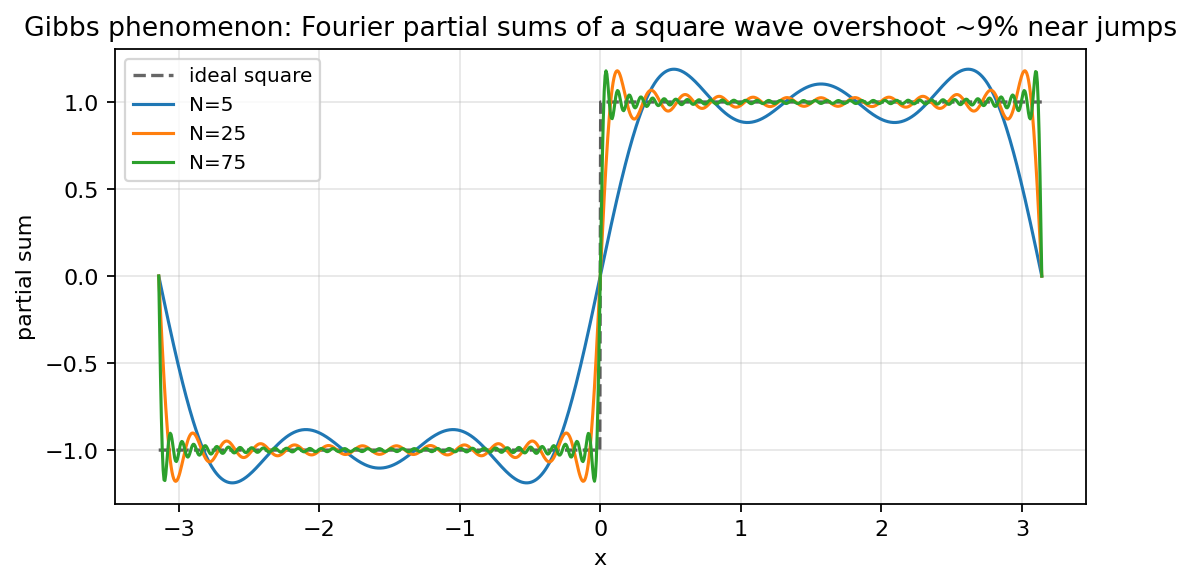 Partial Fourier sums of a square wave: the ~9% overshoot near jumps persists as .
What happens at a jump
For a signal with a jump from to at , the full Fourier series converges to the midpoint at and to the correct values at every other point. So pointwise the series is fine.
The truncated partial sum (sum of the first harmonics) does something different near the jump: it overshoots above and undershoots below , by roughly of , with the overshoot concentrating closer to the jump as grows but never shrinking in height.
Why it doesn’t go away
The proof is technical, but the picture is that the partial sum is the original signal convolved with a truncated sinc (the Fourier dual of truncating the frequency spectrum). Convolving a jump with a sinc-like kernel produces ringing on both sides of the jump, with peak amplitude proportional to the integral of the kernel up to its first zero, and that integral is a fixed number independent of .
More terms give narrower ringing, not smaller ringing. The peak overshoot stays at about forever.
The phenomenon was first observed numerically by Henry Wilbraham (1848) and rediscovered by J. Willard Gibbs (1899), after whom it is named.
Practical implications
Whenever you reconstruct or filter a signal with sharp edges using finite frequency content, you’ll see ringing artifacts:
- Image processing: edges of objects show ringing if you apply ideal lowpass filtering or aggressive JPEG compression (which throws away high-frequency DCT components).
- Audio: brick-wall lowpass filters at the Nyquist boundary can cause “pre-ringing” before transients.
- Bandlimited reconstruction: forcing a discontinuous signal into a band-limited representation makes Gibbs ringing unavoidable.
The fix in practice is a windowed version of the filter. Multiplying the sinc kernel by a smoother window function (Hamming, Hann, Blackman, etc.) trades some passband flatness and frequency selectivity for reduced overshoot.
Connection to convergence
The Fourier series of a function with bounded jumps still converges (in the sense and pointwise at every continuity point) to the original signal. Gibbs phenomenon is a statement about uniform convergence, which fails near jumps: the partial sums don’t converge uniformly to the function in any neighborhood of a discontinuity. This is a feature of the family of sinusoids, not a defect of the function.