Graphical convolution, or the flip-and-slide method, is the pictorial way of evaluating the convolution integral
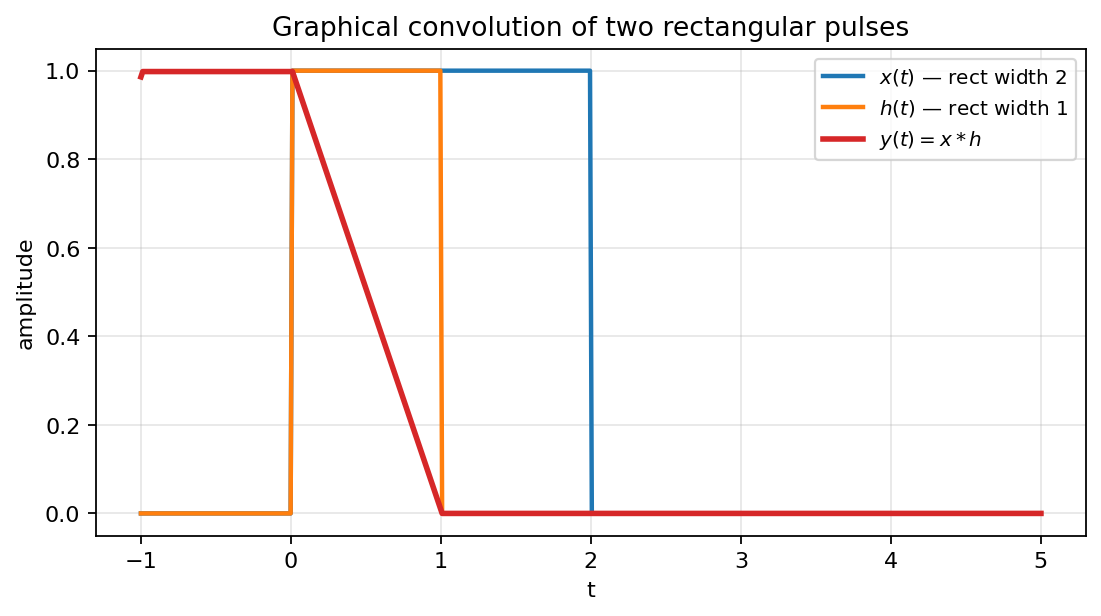 Convolving two rectangular pulses of widths 2 and 1 — the result is a trapezoid of width 3.
Plot two things on the same -axis: (the input, unchanged) and (the impulse response, flipped and shifted). Multiply pointwise, integrate over . The integral is the area under the product. Each value of gives a different shifted , a different product, and a different area, so comes out as a function of .
Constructing h(t − τ)
First step replaces with , reflecting about the vertical axis. Second step is a shift: as a function of has argument zero when , so the signal’s origin is at .
So we flipped about the vertical axis and slid it so its origin sits at . As increases, the flipped impulse response moves right.
The general procedure
- Plot on a -axis.
- Plot (flipped ) on the same axis.
- For each value of , shift the flipped to and identify the overlap region with .
- Compute the area of the product over the overlap region. That’s .
- As varies, the overlap region’s shape changes. Break into piecewise regions of corresponding to those shape changes.
Worked example
Take (rectangle of height 2 on ) and for , zero elsewhere (triangle from height 2 at down to 0 at ). Find .
Flip : is a triangle on , with height 2 at , height 0 at . Slide by : is a triangle on , same shape.
Now slide this triangle across the rectangle on :
- : triangle entirely left of rectangle. .
- : partial overlap on right side of triangle. Overlap is . In overlap: , . Product: . Integrating: . (Hand-check: ✓; ✓.)
- : triangle entirely inside rectangle. Overlap is the whole triangle. Integral = area of triangle × height of rectangle = . Flat top.
- : triangle half-in, half-out on right side. By symmetric algebra, . (Hand-check: ✓; ✓.)
- : triangle entirely right of rectangle. .
Final shape: zero outside , rising smoothly as on , flat at 2 on , falling smoothly as on . A rounded trapezoid.
What to remember
- slides right as increases.
- is the area under the product as a function of .
- Break the calculation into regions of where the overlap changes shape. Usually three to five regions per problem.
For simple convolutions (rect with rect, exponential with step) this method is fast and reliable. For messier signals, switching to the Fourier or Laplace domain, where convolution becomes multiplication via the convolution theorem, is usually easier.