The learning curve model is the empirical observation that the cost (or labour-hours) per unit drops by a constant percentage every time cumulative production doubles. Make twice as many units and the per-unit cost falls to times what it was, where (the learning rate) sits between 0 and 1.
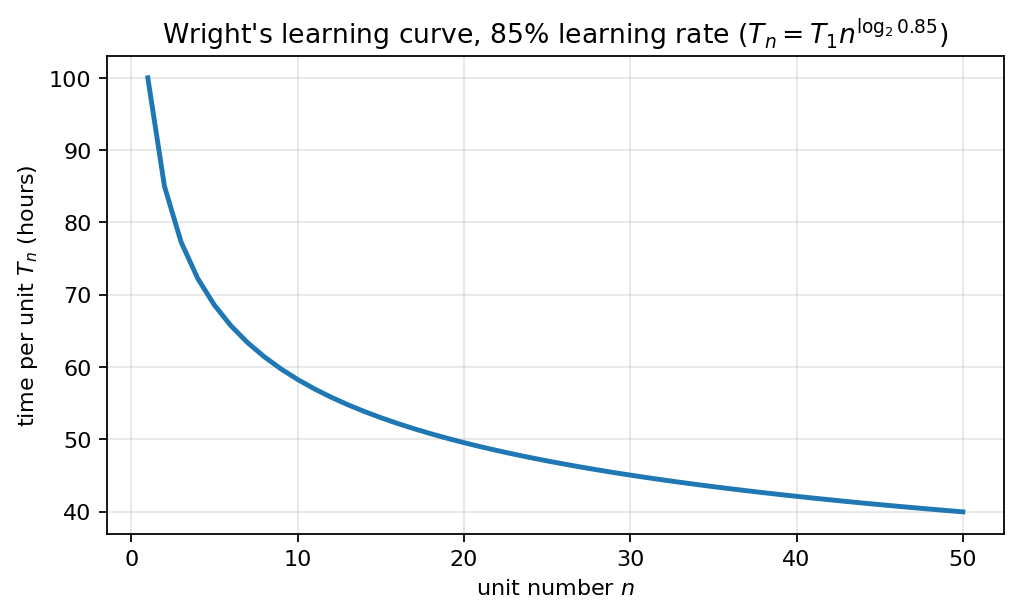 Wright’s learning-curve model at an 85% learning rate: .
The standard formula for the -th unit’s cost:
where is the cost (or hours) of the first unit, is which unit you’re estimating, and is the learning rate. (Equivalently, .) An 80% learning curve has : every doubling of cumulative output, the per-unit cost drops to 80% of its previous level. So unit 2 costs ; unit 4 costs ; unit 8 costs .
The learning curve was first observed for aircraft manufacturing in the 1930s (T. P. Wright, 1936). The original Wright’s law was an 80% curve for airframe labour-hours. The empirical observation has since been extended across many industries: semiconductors, solar panels, ships, ball bearings, generic manufacturing.
Why it works (intuition):
- Workers get faster as they repeat a task.
- Tooling, fixtures, and processes are refined.
- Defect rates fall, so less rework.
- Designs are simplified — features get removed once they prove unnecessary.
In engineering economics, learning curves matter for repetitive production: estimating total labour for a fleet of identical units, comparing a one-off design with a mass-produced alternative, forecasting cost reductions as production volume grows. Solar PV is the modern example. Costs have fallen on roughly a 20%-learning curve (each doubling of cumulative deployment cuts cost by 20%) for decades.
Caveats: the curve is empirical, not a guarantee. It captures historical patterns but extrapolation past current cumulative volume can fail. Step-changes in technology can break the curve (cheaper underlying physics, a new manufacturing process). And the curve runs on cumulative production, not per year of production, so a stagnant industry won’t move along it.
The learning curve is one input to Parametric cost estimation.