The logistic model is a population growth model that includes resource limitation: per-capita growth slows down as the population approaches a maximum carrying capacity. Improves on the Malthusian model which predicts unbounded exponential growth.
The differential equation:
The first term is Malthusian growth; the second is a competition term proportional to the number of pairwise interactions .
Standard form
Rearranging:
where and is the carrying capacity (the equilibrium where growth stops).
Often written more cleanly as:
with the intrinsic growth rate and the carrying capacity. Same equation, different parameterization.
Equilibria
The logistic equation has two equilibria, values where :
- (no population; unstable for : any small positive perturbation grows away from zero).
- (carrying capacity; asymptotically stable).
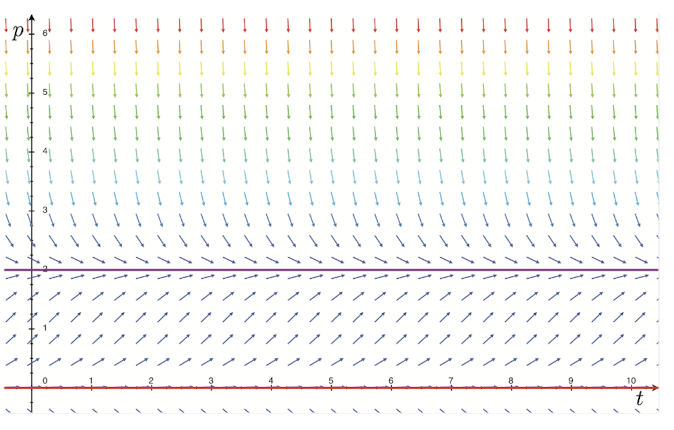
Between them, the population grows:
- If : , population grows toward .
- If : , population shrinks back toward .
So is an asymptotically stable equilibrium: populations starting near converge to . Meanwhile is unstable for , any small perturbation grows.
For a worked example with : equilibria at . The arrows on the slope field point upward in , downward for .
Solution
The logistic ODE is separable. Solving:
Behavior:
- Starts at when .
- Approaches as .
- The graph is the S-curve (sigmoidal): slow start, accelerating middle, decelerating approach to capacity.
Where it’s used
- Population biology: growth in bounded habitats.
- Epidemiology: the SIR model uses logistic-style equations.
- Tumor growth: cancer cells proliferate logistically rather than exponentially.
- Adoption of technology: S-curve diffusion of innovations.
- Neural networks: the logistic function is the same shape, used as an activation function.
The S-curve is the generic shape for any process with self-limiting growth, so it shows up wherever growth is bounded.
Why it’s better than Malthusian
The Malthusian model says: growth rate is constant, population explodes forever. Reality: growth slows as resources run out. The logistic model captures this with one extra parameter () and matches real-world data far better for medium-to-long-term predictions. Drop the competition term (early-stage growth) and you’re back to the Malthusian model.