A plane wave is the simplest solution of the source-free Maxwell’s equations in a homogeneous medium: an electromagnetic wave whose phase fronts (surfaces of constant phase) are infinite parallel planes, and whose amplitude is uniform across each plane.
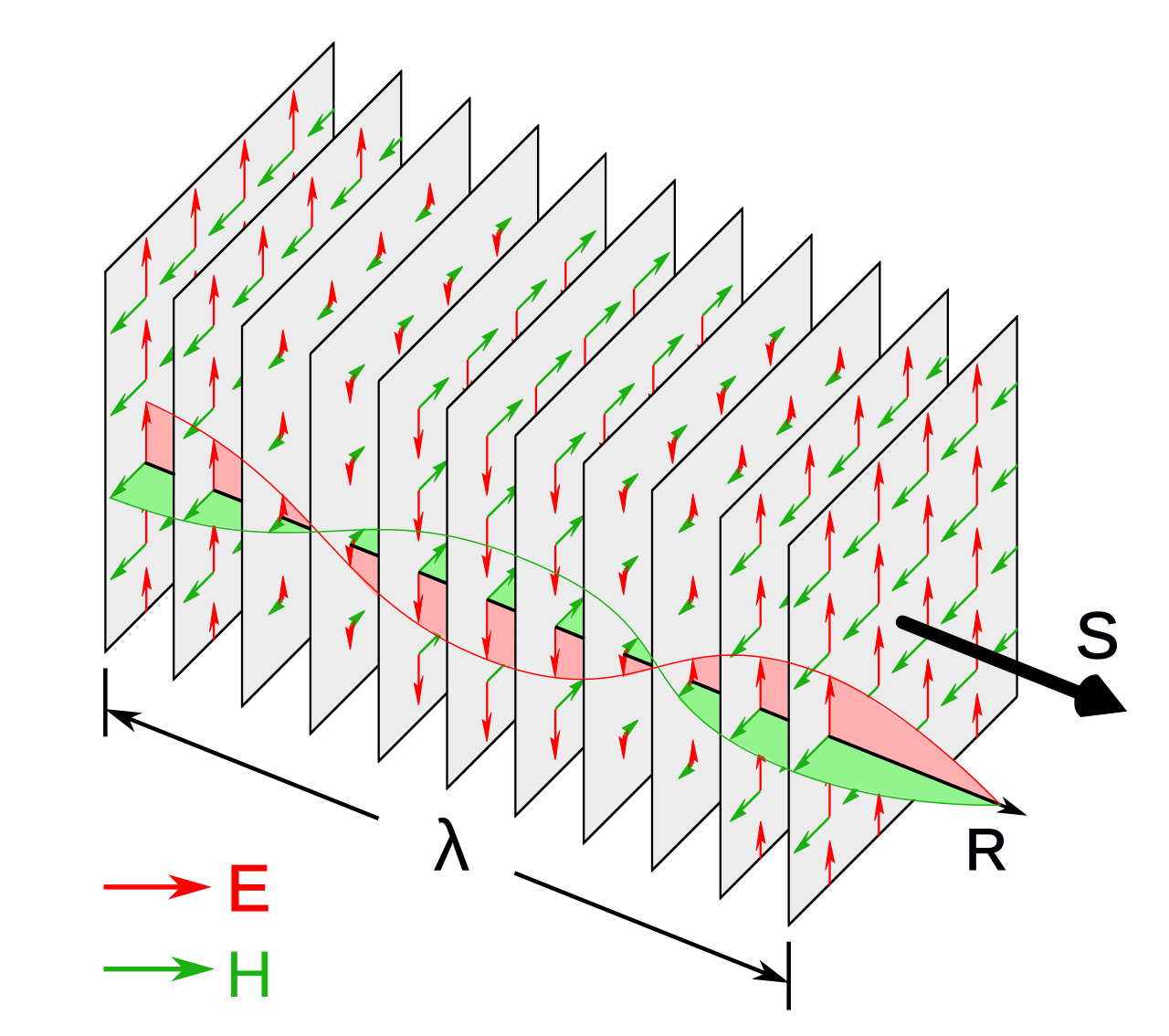 Image: Plane electromagnetic wave, CC0. Electric (red) and magnetic (blue) fields of a linearly polarised plane wave; both perpendicular to the propagation direction.

For a plane wave propagating in with electric field along :
Field is constant on any plane const, oscillates sinusoidally in time and space, and propagates at phase velocity .
The accompanying magnetic field is in (perpendicular to both and the propagation direction):
The ratio is the intrinsic impedance of the medium. In free space: Ω.
Why it’s “transverse electromagnetic” (TEM)
Both and are perpendicular to the direction of propagation, and to each other. The triad forms a right-handed orthogonal set, where is the propagation direction.
This is what “transverse” means in TEM: there are no field components along the wave’s travel direction. Different geometries of guided waves (TE, TM, hybrid) can have non-transverse components, but uniform plane waves in unbounded space are always TEM.
The wave equation
Plane waves are solutions of the wave equation derived in source-free space:
with propagation speed
In free space: m/s.
The frequency , wavelength , angular frequency , and propagation constant are related by:
Phasor form
In sinusoidal steady state, drop the time dependence and the cosine:
The complex amplitude can carry a phase. The full time-dependent field is .
In phasor form, Maxwell’s equations become algebraic:
and the wave equation is
with . The propagation constant is the “spatial frequency” of the wave.
Lossy media
In a medium with finite conductivity , replace by the complex permittivity . The propagation constant becomes complex: , with:
- — attenuation constant (Np/m): how fast the wave decays.
- — phase constant (rad/m): the spatial frequency.
The field becomes
with exponential decay . The intrinsic impedance is also complex, and and have a phase lag relative to each other.
Why plane waves are useful
Real EM waves are not infinite plane waves (no such source exists). But:
- Far from a localized source, the wavefront curvature is small, and locally the wave looks like a plane wave. The plane-wave solution is the standard starting point.
- By Fourier decomposition, any wave field can be written as a superposition of plane waves with different propagation directions and frequencies. Solving for plane waves gives a building block for general solutions.
- The plane-wave solution captures the physics (propagation speed, polarization, energy flow via Poynting vector, reflection and transmission at interfaces) without geometric complications.
So textbooks introduce plane waves first, even though they’re an idealization.