A summing amplifier (weighted summer) is the inverting configuration with several input resistors feeding the same inverting node. Its output is a weighted sum of all the inputs, inverted, with each weight set independently by its own resistor:
Derivation
Bring input in through , input in through , and so on; all of them meet at the inverting node, with a single feedback resistor running to the output . The non-inverting input is grounded.
Apply the Ideal op-amp model golden rules. Golden rule 2 makes the inverting node a virtual ground: . Golden rule 1 says no current enters the op-amp input. So write KCL at the inverting node: the sum of every input current must equal the current leaving through .
That is
Solve for :
Each input appears with its own weight . Adding another input is trivial: drop in another resistor to the same node and it contributes another term, nothing else in the circuit changes.
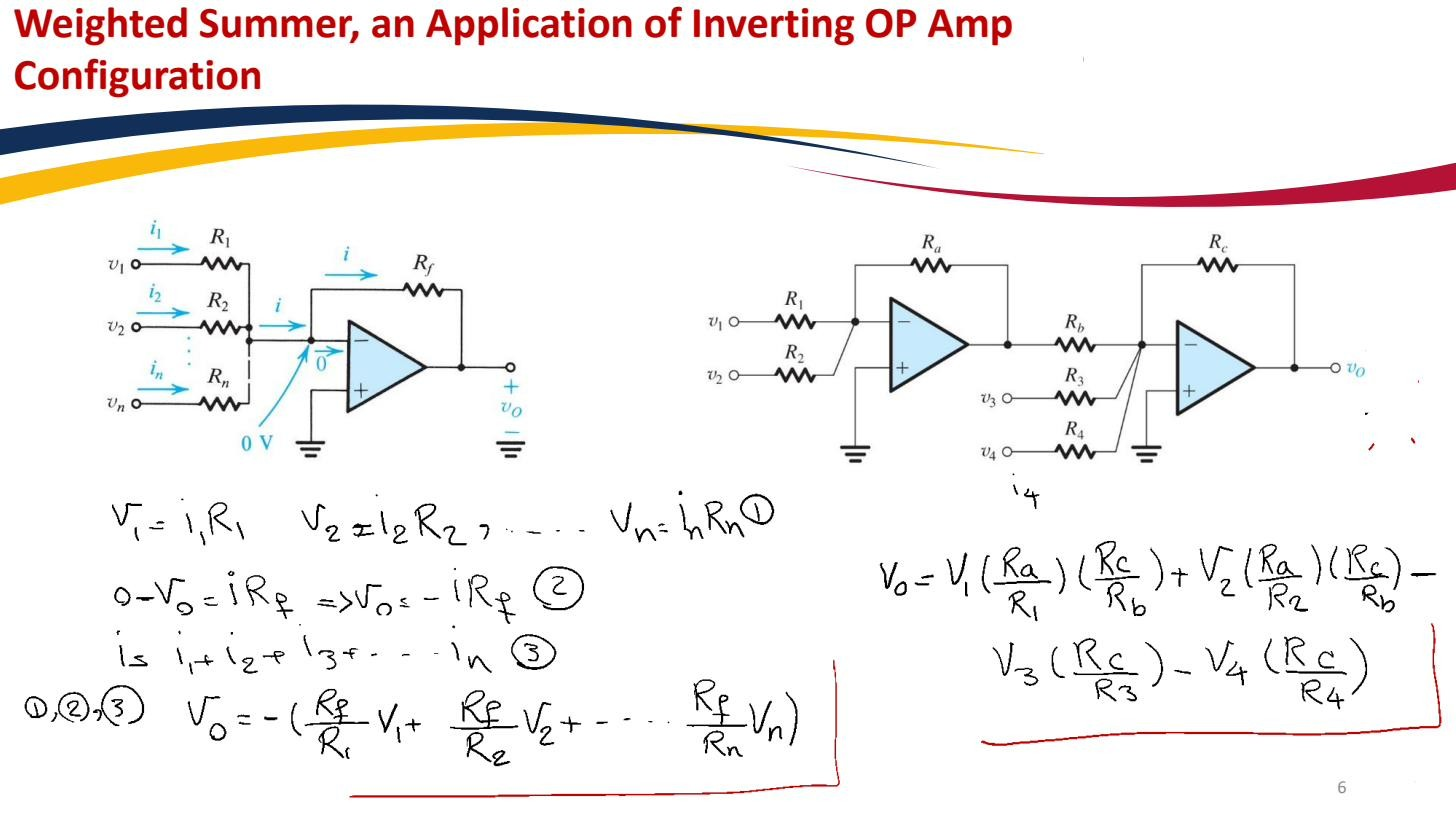 Each input summed at the inverting node with weight .
Why the weights are independent
The virtual ground is what makes this work. Every input branch terminates at the same fixed node that draws no current and that no branch can disturb. So the current in branch is , set only by that input and that resistor, with zero coupling to the other branches. The virtual ground lets you superpose currents at the node without the voltages interacting. Change and only the weight moves; the weight is untouched. Without it (e.g. tying the inputs to a plain resistor network) the branches would load each other and the weights would be a coupled mess. This independence is why the summer shows up as an audio mixer (each channel a separate fader) and as a binary-weighted Digital-to-analog converter (resistors in powers of two reconstruct a number from its bits).