A BJT has two pn junctions, the emitter–base junction (EBJ) and the collector–base junction (CBJ), and each can be forward- or reverse-biased. That gives four operating modes. Three of them matter for amplifier and switching analysis at this level; the fourth is here only for completeness.
| Mode | EBJ | CBJ | Used for |
|---|---|---|---|
| Active | forward | reverse | Amplification (analogue of MOSFET saturation) |
| Saturation | forward | forward | Closed switch (digital logic) |
| Cut-off | reverse | reverse | Open switch (digital logic) |
| Reverse-active | reverse | forward | Rarely used, see below |
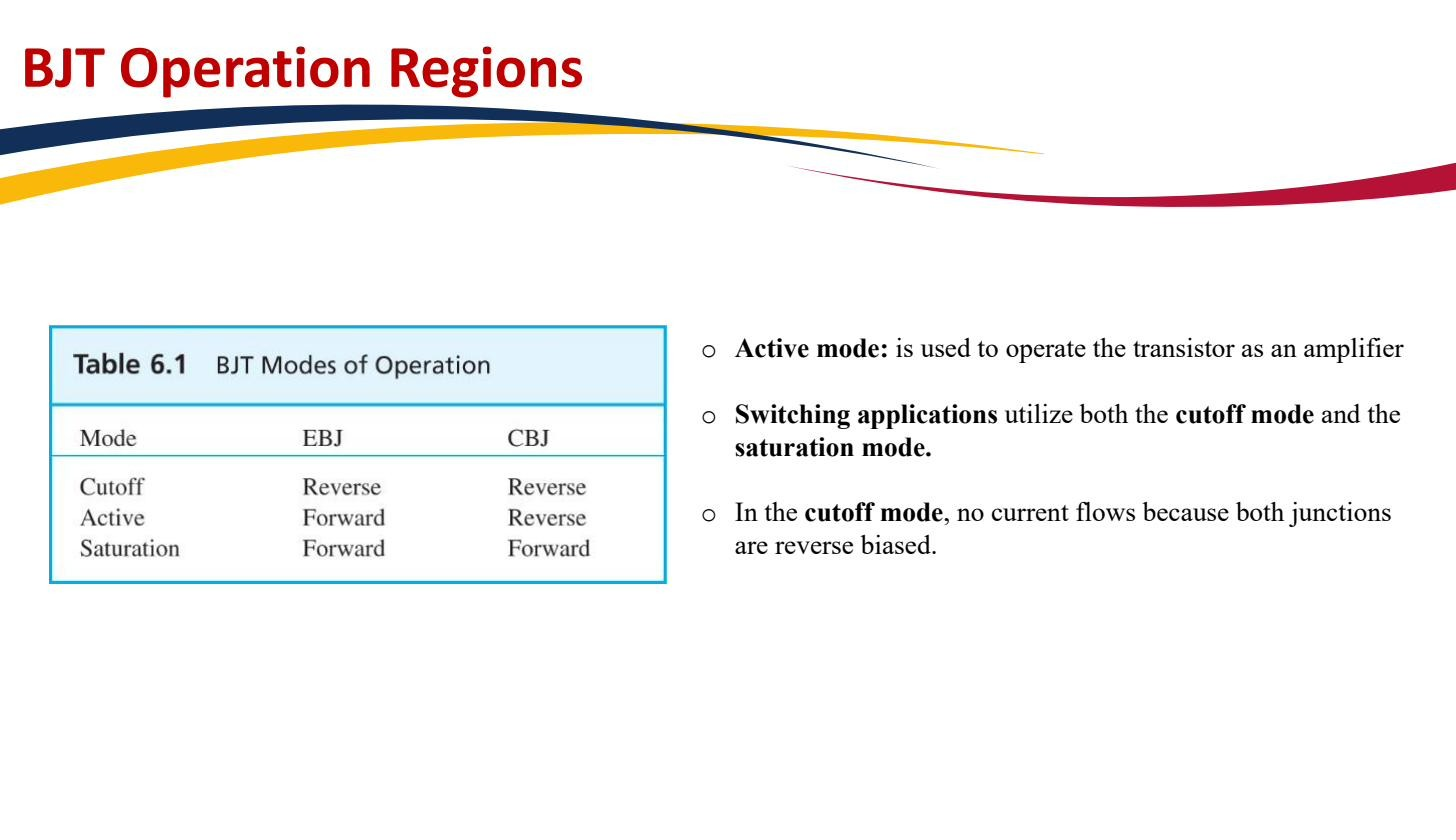 Active mode (forward EBJ, reverse CBJ) is used for amplification; saturation (both forward) and cut-off (both reverse) are used for digital switching. The three modes that matter here.
- Active is the amplifying region: forward EBJ, reverse CBJ. The device behaves as a controlled current source with . This is where every BJT amplifier is biased.
- Saturation is “on hard”: both junctions forward, pinned near 0.2 V, collector current set by the external circuit (the relation no longer holds). The closed-switch state.
- Cut-off is “off”: both junctions reverse, no appreciable current. The open-switch state.
- Reverse-active mode has the EBJ reverse-biased and the CBJ forward-biased, active mode with emitter and collector swapped. It works, but badly: the emitter and collector are deliberately not designed symmetrically (the emitter is heavily doped to inject efficiently, the collector is not), so the current gain in reverse-active is small and the device is rarely operated this way intentionally.
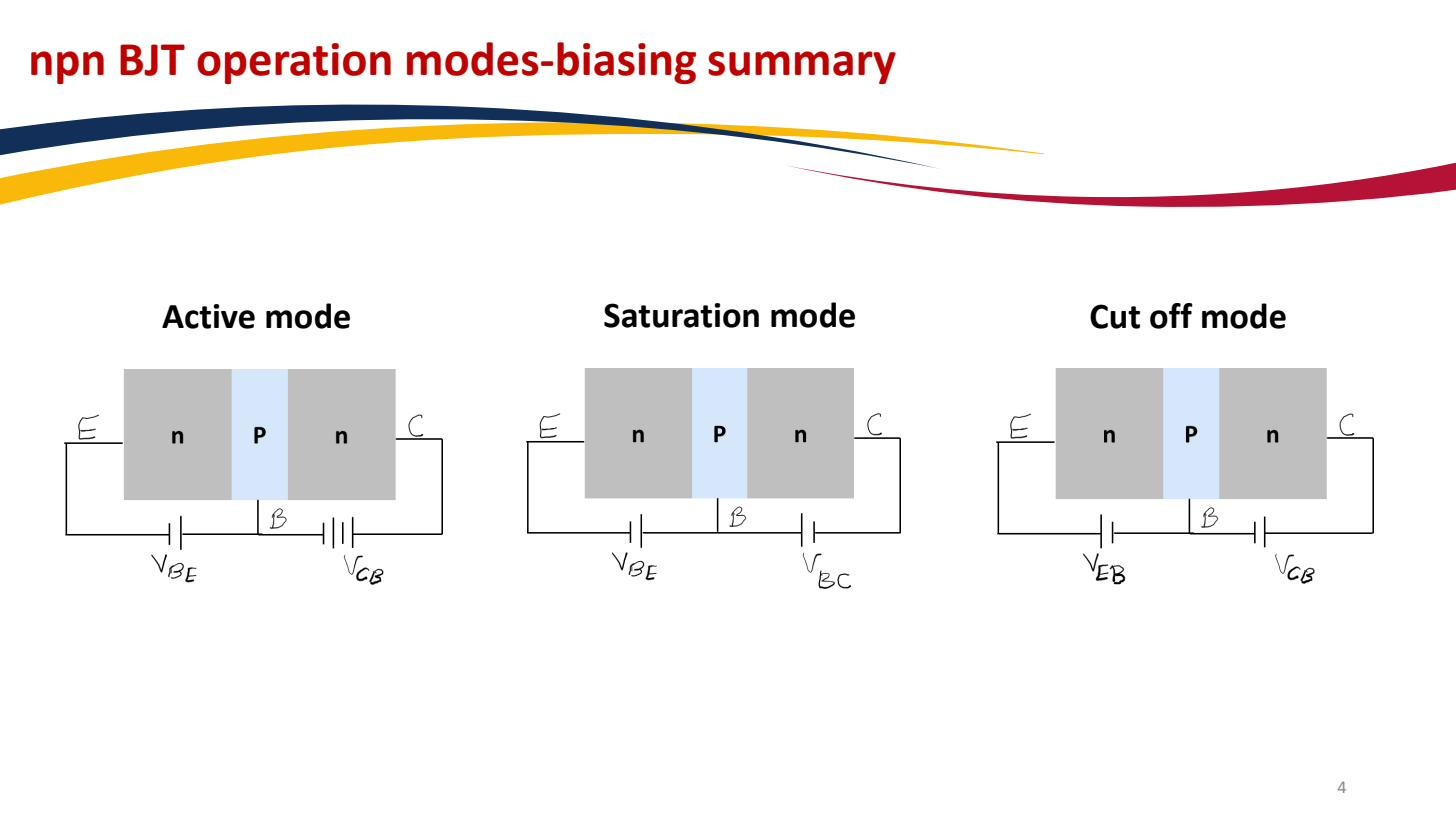 npn mode summary: active (EBJ forward, CBJ reverse), saturation (both forward), cut-off (both reverse). Each mode has its own simplified large-signal model.
The “saturation” naming trap. The word saturation means different things for the two transistor types, and mixing them up is a classic exam error:
- MOSFET saturation ↔ BJT active. Both are the constant-current, amplifying region.
- MOSFET triode ↔ BJT saturation. Both are the low-voltage, fully-on region.
So a MOSFET amplifier biased in saturation corresponds to a BJT amplifier biased in active mode. The names are unfortunate but standard.