The Dirac delta function is an idealized “function” that’s zero everywhere except at , where it’s infinite, with the property that its integral equals . It models an instantaneous unit impulse: an infinite force applied for zero duration, with finite total impulse.
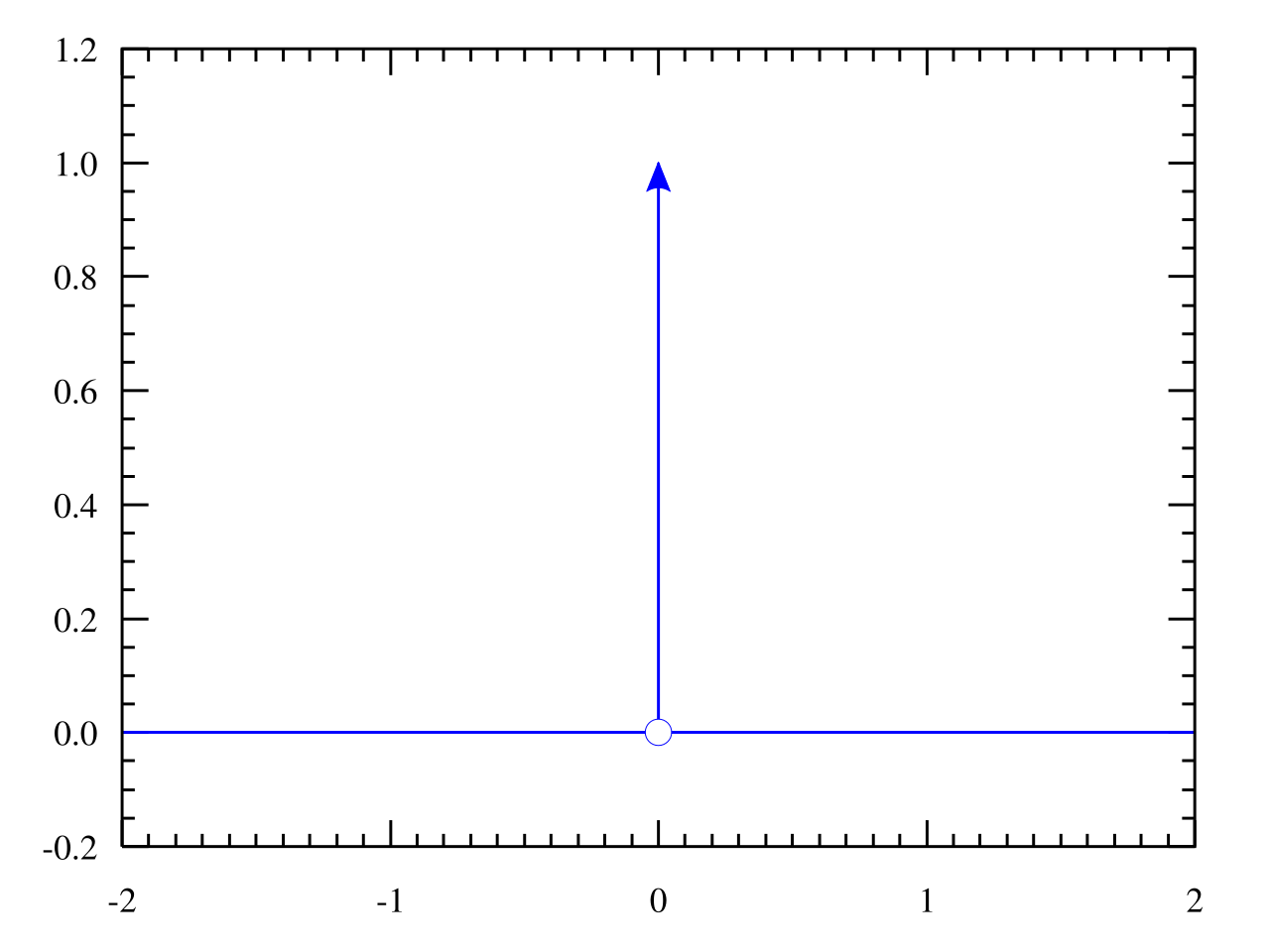 Image: Schematic of the Dirac delta function (a line surmounted by an arrow), CC BY-SA 3.0

Strictly speaking, isn’t a function in the ordinary sense. It’s a distribution (or generalized function). But it behaves like a function under integration and is used freely in physics and engineering.
Definition (operational)
There is one defining property, the sifting property, plus one heuristic picture that helps you remember why it’s true.
Sifting property (the definition):
for every test function that is continuous at . Equivalently, is the linear functional that maps .
Heuristic picture (not a definition):
It is tempting to write and call this the definition. Don’t. There is no ordinary function that is zero everywhere except at one point and integrates to : Lebesgue integration of any pointwise-defined function tells you the integral is . The “spike of infinite height, zero width, area one” picture is a useful intuition for visualizing approximations (see “How it arises” below), but the actual mathematical object is the sifting functional. Anything you want to prove about should be derived from the sifting property, not from the heuristic.
Shifted version
Shifted sifting (this is the substantive statement):
Heuristically, is “concentrated at ” instead of .
How it arises
Consider a physical impulse: a force applied during a short interval . The total impulse is
If we want to keep but shrink , the force has to grow . In the limit, the force becomes the delta function :
This is the rigorous way to think of : a limit of increasingly tall, narrow pulses of constant area.
Laplace transform
For : .
Clean transform: the delta becomes a constant (or pure exponential) in the s-domain.
Use case: impulsive forcing
Solve , , .
This models an undamped spring at rest at position , then hit with an impulse at .
Laplace. Using with , :
The ODE becomes , i.e.
The on the right comes from the initial-condition term moved to the right side; the is .
Solve:
Inverse:
.
: by the second shifting theorem, this is .
Final:
Before , the system oscillates as a simple cosine. At , the impulse “kicks” it, adding a sine term that shifts the trajectory. After , the system continues oscillating but with new amplitude/phase.
Properties
Beyond the sifting property:
- Identity for convolution: .
- Derivative of step: in a distributional sense, , where is the Heaviside step function. Differentiating a jump gives an infinite spike.
- Scaling: for .
Why it’s not really a function
Mathematicians built up distribution theory (Schwartz, 1940s) to give a rigorous foundation. A distribution is a continuous linear functional on a space of test functions. The delta corresponds to “evaluation at a point”, a perfectly well-defined operation even though no ordinary function realizes it.
For engineering use you don’t need the rigor. The sifting property and the Laplace transform formula are enough to handle impulsive forcing in ODEs.
Three properties used constantly in Continuous-Time Signals and Systems
Three operational properties show up constantly in signals-and-systems work, all derivable from the limit-of-rectangles picture above:
- Equivalence: . See Equivalence property of the impulse.
- Sampling (sifting): , the defining property above.
- Scaling: . See Scaling property of the impulse.
In a typical signal-processing derivation, you spot one of these being needed (most often the sampling property in convolutions), apply it, and the integral collapses.
Building blocks made from the impulse
A periodic impulse train is the central object in Sampling: multiplying a continuous signal by an impulse train models the sampling operation.
Feed the delta into a system as input and you get the Impulse response.