The Heaviside step function (or unit step function) is the function that equals before and after:
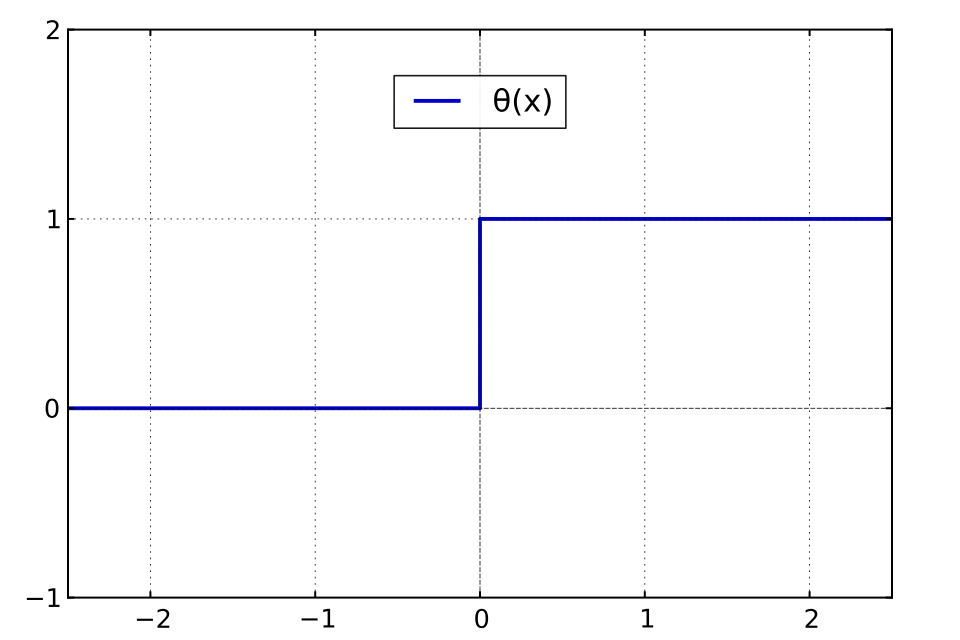 Image: Heaviside step function, CC BY 3.0

The value at is a convention; common choices are , , or . For ordinary Riemann/Lebesgue integration in the Laplace transform it doesn’t matter — a single point has measure zero. It can matter for distributional derivatives and for the inversion of one-sided convolutions; the symmetric choice is the cleanest for those, while is more natural in step-response contexts. Use whichever your surrounding text does.
Named for Oliver Heaviside (1850–1925), the British engineer who systematized operational calculus.
Time-shifted version
Shifting the argument moves the step:
This is “off until , then on forever.” Multiplying by another function “turns on” that function at :
The function is “turned on at ,” with its argument also shifted so effectively starts from its behavior at the moment .
Laplace transform
For : (which matches since on , where the Laplace integral lives).
Why it matters
The Heaviside step function is the building block for representing piecewise functions as a single formula. Instead of writing
you can write
Each step function activates at the appropriate transition, contributing the difference between the new function and the old. The result is one closed-form expression.
This is what makes the Laplace transform tractable for piecewise forcing functions.
Worked example: stitching pieces
Express
as a single formula.
Start with (the value for ). At , switch to : add .
At , switch to : add .
At , switch to : add .
Combined:
Each step contributes the difference between the new and old branches.
Connection to the rectangular window
A common composition: for is the rectangular window:
It “turns on” at and “turns off” at . See Rectangular window function.
Second shifting theorem (in Laplace context)
The Heaviside step function shows up in the second shifting theorem:
So multiplying by in time and shifting the argument corresponds to multiplying by in the s-domain. This is how Laplace handles delayed forcing functions cleanly.
The “derivative” of the Heaviside step is the Dirac delta function. For applying these to discontinuous forcing terms, see Transform of discontinuous functions.