The unit rectangle is a pulse of height 1 and width 1, centered at the origin:
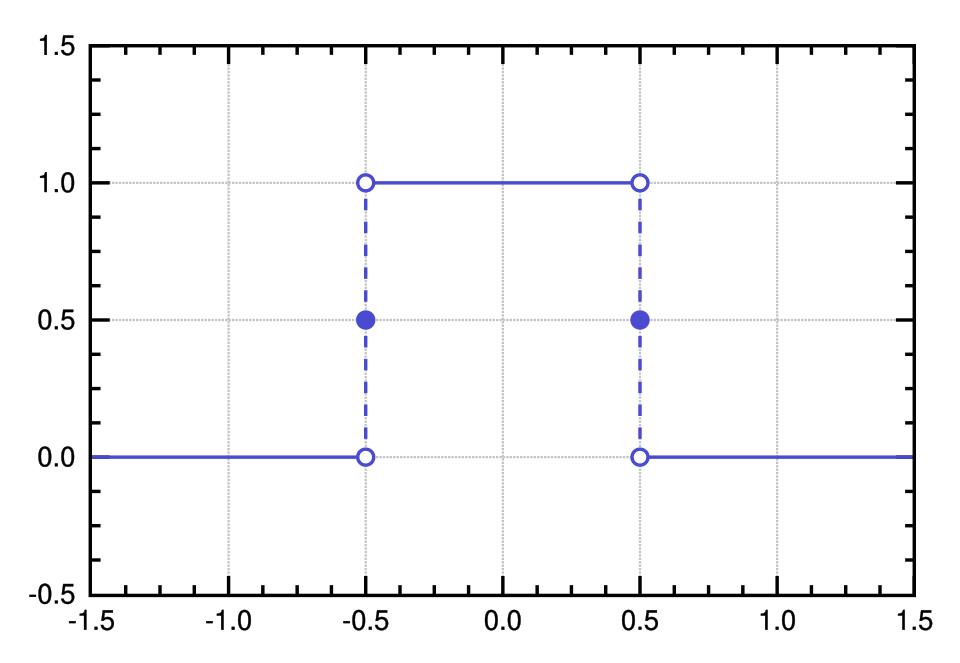 Image: Rectangular function, CC BY-SA 3.0

Equivalently, , a unit step that turns on at and off at . The values at the boundaries are a convention and rarely matter (they affect only a measure-zero set in any integral).
Multiplying a signal by gates it: the product equals the signal on and is zero outside. By scaling and shifting we can place the rect window anywhere.
For the general windowing function with arbitrary endpoints, see Rectangular window function.
Reading rect(t/w)
This is the subtlety that bites students later. The expression does not mean “rectangle of width ” in the direct sense. It means “rectangle that is when and when .” Solving gives , so is a rectangle of width centered at the origin, going from to .
When you see , mentally read off the boundaries as , not . Same for : centered at , with edges at . This rule matters constantly in Fourier series and transform problems.
A consequence: has , so it’s a rectangle of width centered at zero. Width denominator (for ) or width (for ).
Fourier transform
The rectangle and the sinc form one of the transform pairs that comes up constantly:
A narrow rect (small ) has a wide sinc spectrum; a wide rect (large ) has a narrow sinc spectrum. This is the time-bandwidth tradeoff.
Convolution with itself
where is the unit triangle, a triangle of height 1 and base 2 centered at the origin. By the convolution theorem, the Fourier transform of this identity gives as the spectrum of the triangle.