The unit triangle function is a triangle of height 1 and base 2, centered at the origin:
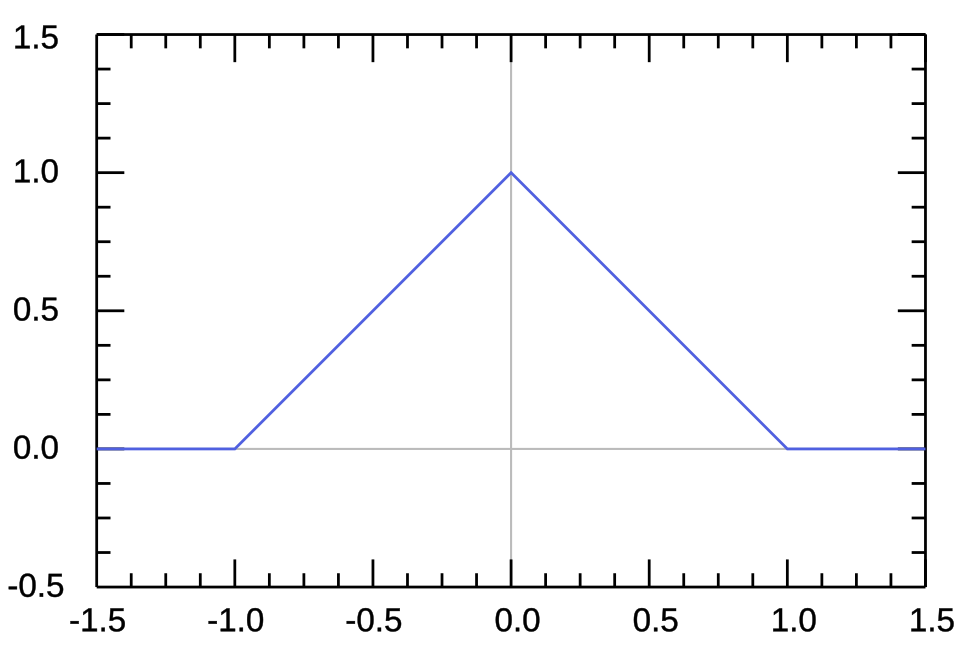 Image: Triangular function, CC BY-SA 3.0

It rises linearly from 0 at to a peak of 1 at , then falls linearly back to 0 at .
As a self-convolution
The triangle is the convolution of a unit rectangle with itself:
The derivation, by flip-and-slide: is on , and is on . The integrand of the convolution is the indicator of the intersection of these intervals. The width of the intersection depends on :
- : no overlap. .
- : overlap is , width .
- : overlap is , width .
So for , zero outside. Two rectangles slid past each other smooth into a triangle.
Sanity check via the area property of convolution: area of is 1, so area of should be . The triangle has base 2 and height 1, area . ✓
Fourier transform
By the convolution theorem, convolution in time becomes multiplication in frequency. So
The triangle’s spectrum is the sinc squared. It shows up in Fourier series examples for periodic triangle waves, in pulse-shaping for digital communications, and whenever two rectangular gates are cascaded.
Scaling
The general scaled triangle is a triangle of height 1 and base , centered at the origin. By the time-scaling property of the Fourier transform, its spectrum is .