The displacement current density is
It has units of current density and behaves like a current source for , but it does not involve any actual motion of charges. It is Maxwell’s modification to Ampère’s law, extending the law from magnetostatics to fully dynamic problems:
The on the right is the conduction current (actual moving charge); the term is the displacement current. Both have units A/m², and they appear on equal footing as sources of curling .
Why it’s necessary: the capacitor paradox
Consider a capacitor being charged: a real conduction current flows in the connecting wires.
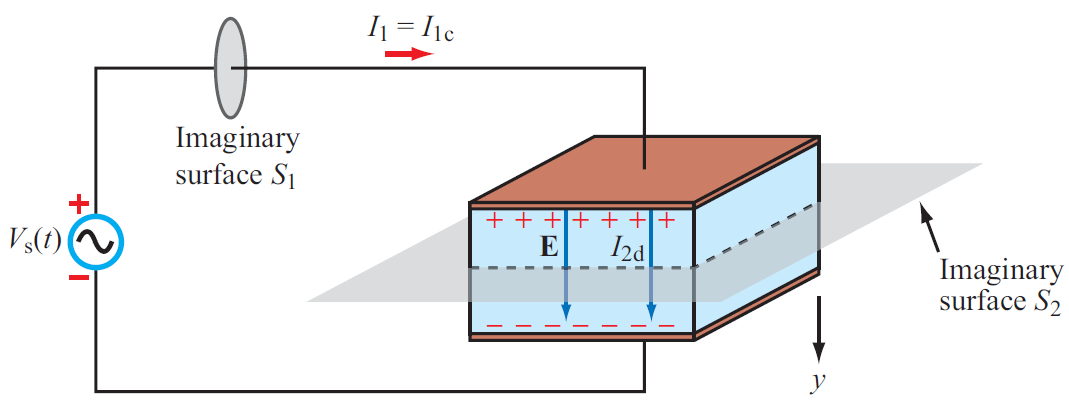 Two imaginary surfaces (cutting through the wire, capturing the conduction current ) and (passing between the capacitor plates, where no conduction current flows).
Apply Ampère’s circuital law to the loop around the wire:
- For surface : , full conduction current.
- For surface (between the plates, no wire passes through): , no conduction current.
But both surfaces have the same boundary . Ampère’s law would give two different answers for the same line integral. Contradiction.
Maxwell’s fix: add the term. Between the plates, changes in time as charge accumulates, and exactly equals . The paradox dissolves: total enclosed “current” (conduction + displacement) is the same for either surface.
Why “displacement”
The name is historical (Maxwell’s term) and a bit misleading. There’s no actual displacement of charge in vacuum across the capacitor gap. What’s happening is that the electric flux between the plates is changing in time as more charge accumulates on the plates. This time-varying behaves as if it were a current: it sources in the same way conduction current does.
In a vacuum or perfect dielectric, displacement current is the only “current” possible, since no charges are present to conduct.
Quantitative example: capacitor
Parallel-plate capacitor, plate area , separation , dielectric . Connected to AC source .
Electric field between plates: , so . Displacement current density:
Total displacement current through the capacitor:
Conduction current in the external wire is . The two are equal: current is continuous through the capacitor as far as is concerned, even though no charge actually crosses the gap.
Charge continuity
Displacement current is what makes total current conserved. Taking the divergence of Ampère’s law:
using Gauss’s law on the last term. This gives the Charge continuity equation:
which says net outflow of conduction current equals the rate of charge decrease in a region. Charge conservation is guaranteed by Maxwell’s equations only because the displacement current term is present.
Why it predicts EM waves
The displacement current is what closes the feedback loop between and :
- Faraday: changing → curling .
- Maxwell-Ampère (with displacement current): changing (via ) → curling → curling .
Together: a perturbation in one field generates the other, which generates the first, propagating outward as an electromagnetic wave. Without the displacement current term, this self-sustaining wave would not exist in Maxwell’s framework.
The propagation speed falls out: . Maxwell predicted this in 1865 and immediately identified it with the experimentally measured speed of light, unifying optics with electromagnetism.