The magnetic field is the vector field that mediates magnetic forces between moving charges and currents. EM uses two related fields:
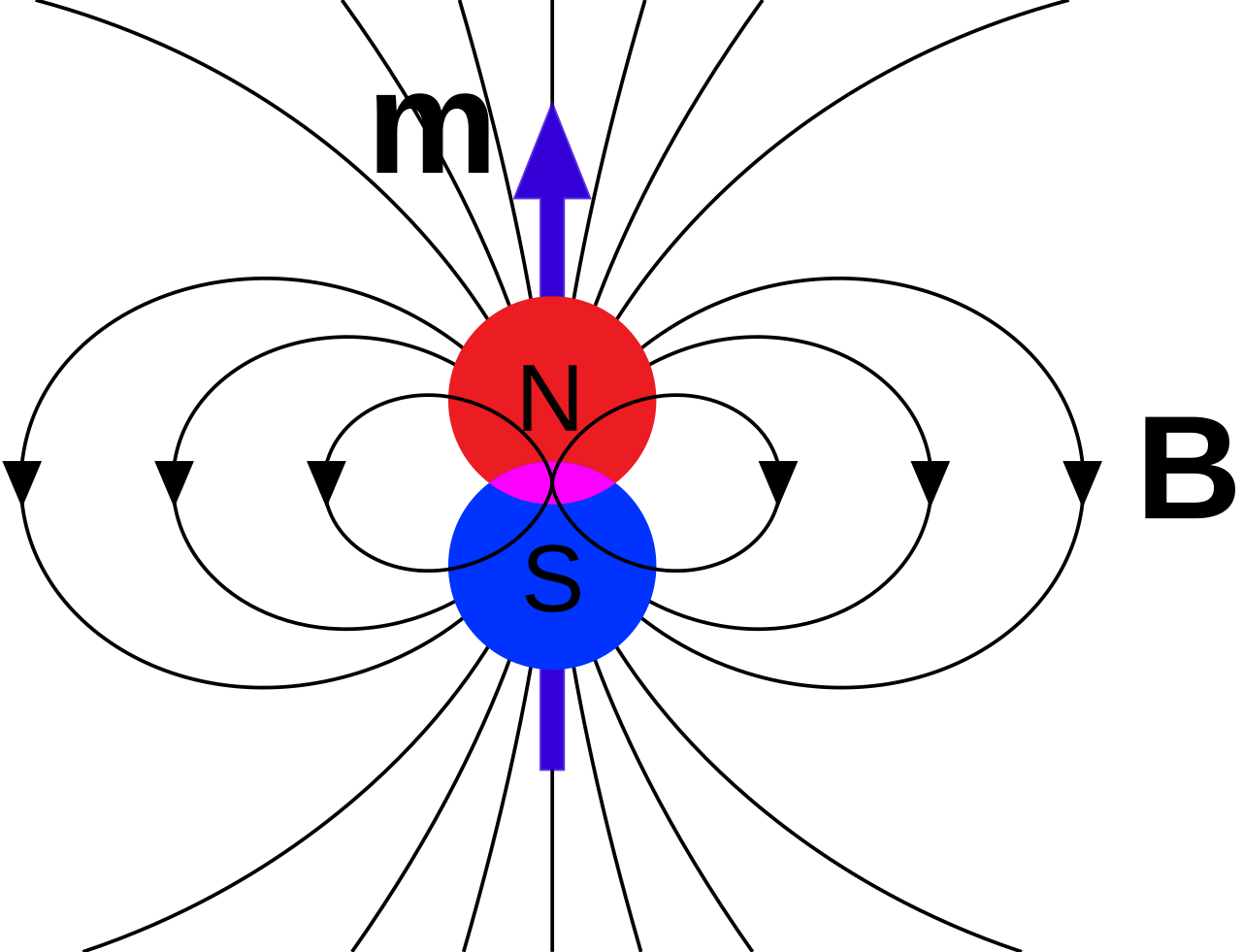 Image: Magnetic field of a dipole, Public domain — field lines of a magnetic dipole — the same topology as the electric dipole.

- Magnetic flux density (tesla, T = Wb/m²) — the field that produces forces on moving charges via the Lorentz force .
- Magnetic field intensity (A/m), the field whose curl is sourced by free currents.
The constitutive relation in a linear, isotropic, homogeneous medium:
with Permeability . For free space, H/m. For most non-magnetic materials (dielectrics, metals other than iron/cobalt/nickel), and so .
Why two fields
Same logic as for D and E in electrostatics. is the “free-source” field (Ampère’s law ). is the “what charges actually feel” field; its sources include bound magnetization currents in magnetic materials.
For purely non-magnetic problems they’re proportional and interchangeable up to . Electromagnetics mostly considers non-magnetic media and uses both interchangeably depending on the formula.
How magnetic fields are produced
Magnetic fields are produced by moving charges, equivalently by electric currents. Two equivalent ways to compute them:
Biot-Savart law (analog of Coulomb’s law), direct integration over the current distribution:
Ampère’s law (analog of Gauss’s law) uses symmetry to bypass integration:
For problems with cylindrical, axial, or planar symmetry, Ampère is dramatically easier.
Magnetic field of common sources
Infinite straight wire carrying current on the -axis. By symmetry . Ampère around a circle of radius : , so
The field circles around the wire. The right-hand rule: thumb along , fingers curl in direction.
Circular current loop of radius , current , in the -plane. On the -axis:
At the center (): .
Long solenoid of length with turns carrying current :
Uniform inside, ~zero outside. This is why solenoids are the textbook example of “creating a uniform magnetic field in a region of space.”
Gauss’s law for magnetism
Gauss’s law for magnetism states , equivalently for any closed surface. The physical content: no magnetic monopoles. Every field line is a closed loop. Compare with Gauss’s law for , where field lines start on positive charges and end on negative ones.
Because is divergence-free, it can be written as the curl of a Vector magnetic potential: .
In Maxwell’s equations
The two equations involving magnetic fields:
- — no monopoles.
- — Ampère’s law with Displacement current.
In magnetostatics (), the second reduces to .
Versus electric field
Two key distinctions:
- Magnetic field acts only on moving charges; electric field acts on all charges. The magnetic force vanishes for .
- Magnetic force does no work: since . A magnetic field can change a charge’s direction but never its kinetic energy. Energy changes always come from the electric field component of the Lorentz force.
The unification: and are different components of the same electromagnetic field tensor; they transform into each other under Lorentz boosts. What one observer calls a pure field, another (moving) observer sees as a mixture of and . The non-relativistic split into “electric” and “magnetic” is frame-dependent.