The Lorentz force is the total electromagnetic force on a charge moving with velocity through electric and magnetic fields:
The expression splits into two pieces:
This is the defining equation of and . These fields are exactly what makes the Lorentz force law produce the observed forces on a test charge.
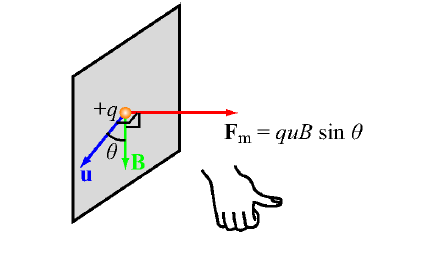
What’s special about the magnetic part
Two key properties of :
1. Acts only on moving charges. When , . Stationary charges feel only the electric force.
2. Magnetic force does no work. Since is perpendicular to (by the Cross product geometry),
A magnetic field changes the direction of a charge’s velocity but never its kinetic energy. Bend the trajectory, but don’t speed up or slow down. This is why charged particles spiral in magnetic fields (circular or helical motion) but don’t gain energy unless an electric component is also present.
Energy changes always come from the electric component. Particle accelerators use for steering and for acceleration.
Magnitude and direction
The cross product has magnitude and direction perpendicular to both and (right-hand rule). So:
maximized when and zero when . A charge moving parallel to the field feels no magnetic force.
Worked example: velocity selector
A charged particle moves through crossed fields and . What velocity gives zero net force?
Set , i.e., .
Try : . So gives .
A charge moving at exactly this speed in passes through undeflected. Slower or faster charges are deflected by the unbalanced force. This is a velocity selector, used in mass spectrometers to select a specific speed before further analysis.
Force on a current-carrying wire
A wire carrying current in a magnetic field. Each infinitesimal segment contains moving charges. The total force on the segment is
For a straight segment of length in uniform :
For a curved or arbitrary-shape wire, integrate: . In a uniform field, the integral over a closed loop is zero (because ). So a closed current loop in a uniform field experiences no net force, but can experience a net torque, which is what makes motors work.
In context
The Lorentz force is the bridge between fields and mechanics. It tells you how fields push charges around, completing the cycle “currents create fields → fields exert forces on currents.” Combined with Newton’s laws and Maxwell’s equations, it gives a complete classical EM dynamics.
Two natural extensions:
- For a continuous charge distribution: , force per unit volume.
- For relativistic charges, the same Lorentz expression works (with relativistic momentum on the left), but and themselves transform between frames.