The cross product of two 3D vectors is a vector perpendicular to both, with magnitude equal to the area of the parallelogram they span. Unlike the Dot product, it’s specific to three dimensions.
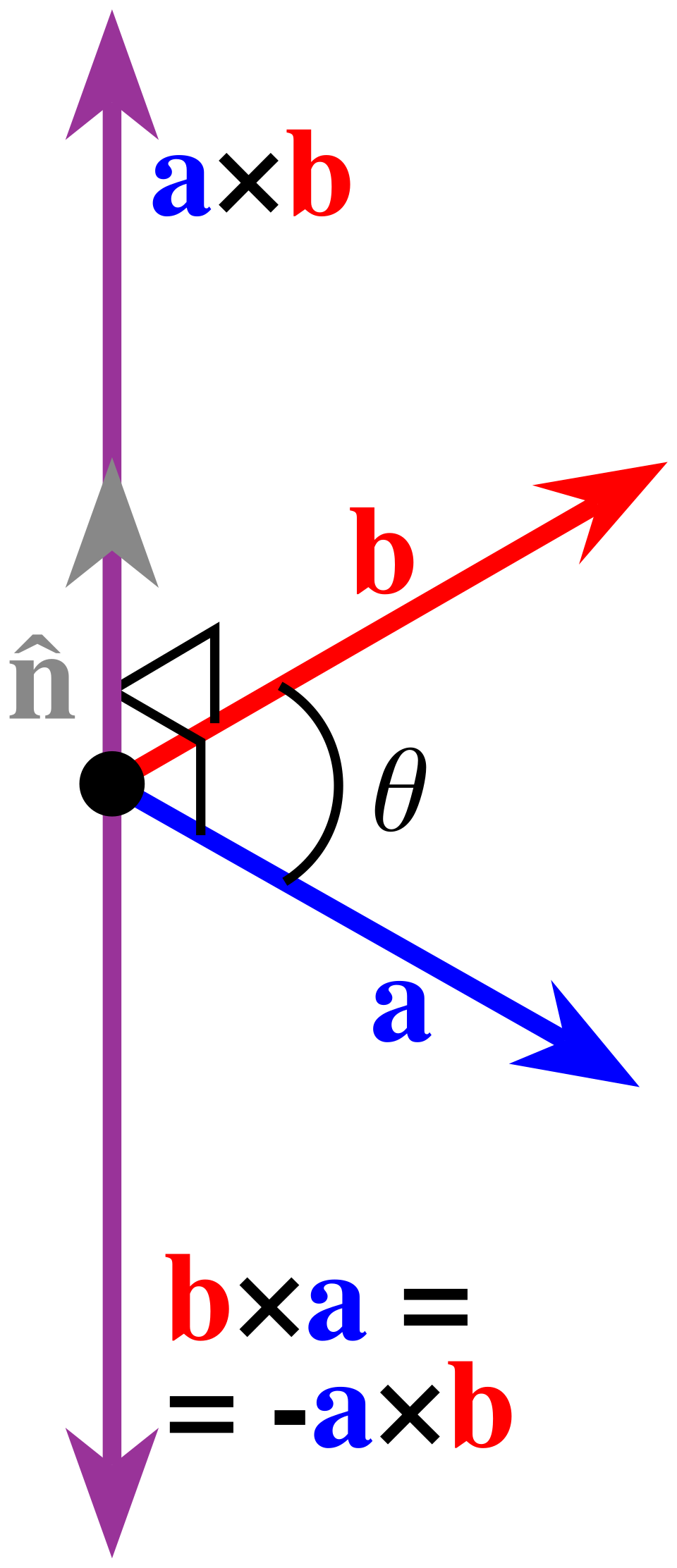 Image: Cross product illustration, public domain

Two definitions
Geometric. Let be the angle between and (). Then has
- magnitude ,
- direction perpendicular to both and , chosen by the right-hand rule: point the fingers of your right hand from toward through the smaller angle; your thumb points along .
The magnitude is the area of the parallelogram spanned by and (base , height ).
So it encodes both an area and a choice of perpendicular direction. That dual role is what makes it show up in surface normals and the Flux integral.
Algebraic (mnemonic determinant):
Watch the sign on the term, that’s the standard cofactor-expansion sign.
Properties
- Anticommutative: . Order matters; flipping reverses the direction.
- Distributive: .
- (parallelogram with one side has zero area).
- iff and are parallel (or one is zero).
Cyclic unit-vector rules:
Cyclic order gives the positive sign; reverse order flips the sign ().
Not associative: in general. The vector triple product has the BAC-CAB identity to handle nested cross products.
Worked example
For and :
: . (sign flip): . : .
So .
Verify perpendicularity: . Same for .
Applications
Area of a triangle with vertices : .
Surface normal. Given a parameterization of a surface, the partial derivatives are tangent vectors; their cross product is normal to the surface, with magnitude equal to the area-element factor. This is what the Flux integral is built on.
Torque: , perpendicular to both lever arm and applied force, magnitude = .
Angular velocity: , the velocity of a rotating point.
Curl. The curl is formally a “cross product” of the operator with the vector field .