The right-hand rule is a family of mnemonics for the direction of a vector quantity in EM and vector calculus. The rules share the same physical content. They assign a sign to oriented surfaces, cross products, and rotational quantities consistent with a right-handed coordinate system, but appear in different forms in different contexts.
The “right” in right-hand rule reflects a convention choice baked into the definition of cross product: , and the unit vectors of a Cartesian coordinate system form a right-handed triad. If we’d chosen left-handed conventions, all the “right-hand rules” would be “left-hand rules”, but the physics doesn’t change.
Variant 1: cross product
For :
Point the fingers of your right hand along , curl them toward , your thumb points along .
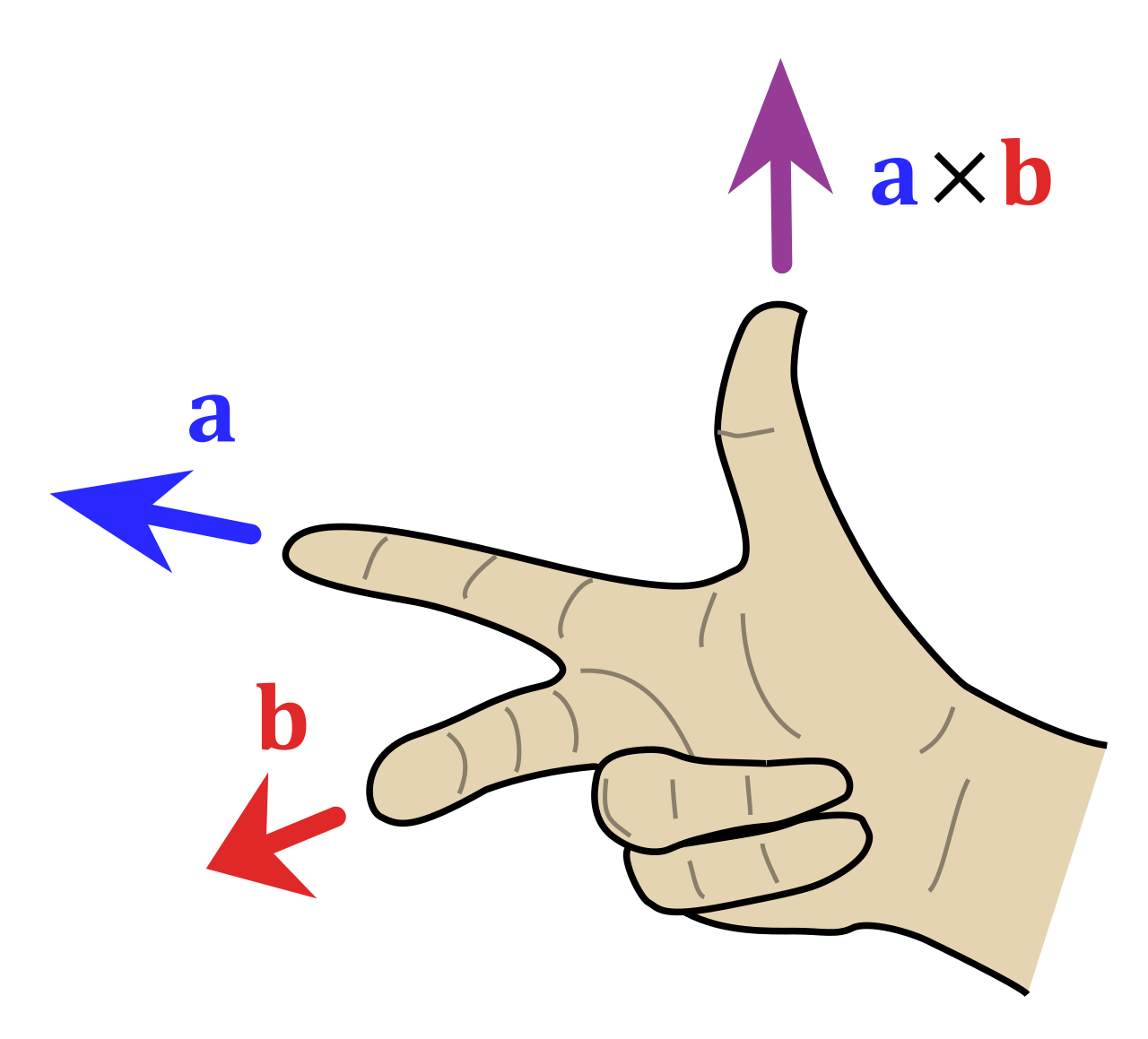 Image: Right-hand rule for cross product, CC BY-SA 3.0 — right-hand rule for : curl fingers from toward ; thumb points along the product.

Equivalently: , with direction perpendicular to both and , by the right-hand convention.
Applications everywhere: angular momentum, torque, cross products in any context.
Variant 2: current-carrying wire (Ampère’s right-hand rule)
For a straight wire carrying current in direction :
Wrap your right hand around the wire with the thumb pointing along . Your fingers curl in the direction of the resulting field.
This is just Variant 1 applied to Biot-Savart . The field curls around the wire, counterclockwise viewed against the direction of current.
For an infinite wire on the -axis with current in : , with counterclockwise viewed from .
Variant 3: current loop (solenoid)
For a current loop or solenoid:
Curl the fingers of your right hand in the direction of current flow around the loop. Your thumb points along on the axis of the loop (the “north” pole side).
This generalizes Variant 2, combining the field contributions from all the segments of the loop. For a solenoid with the current spiraling counterclockwise (viewed from one end), the magnetic field inside the solenoid points along the axis toward that end.
Variant 4: force on a moving charge ()
For a positive charge with velocity in field :
Point your fingers along , curl them toward , your thumb is . (Cross product again.)
For a negative charge, reverse the result. This is what makes electrons in a cathode-ray tube deflect opposite to where a positive charge would go.
Variant 4 applied to a current-carrying wire () gives the BIL motor force. See Magnetic force on conductor.
Variant 5: surface orientation + boundary curve (Stokes’ theorem)
For a surface bounded by curve :
Curl the fingers of your right hand in the direction you’re traversing . Your thumb points in the direction of the outward normal to .
This is the convention that makes Stokes’ theorem work: . Reverse the direction of traversal on and the sign of the surface integral flips, but the right-hand convention pairs them consistently.
Variant 6: induced EMF and Lenz’s law
For Faraday’s law: a changing flux through a loop induces an EMF that drives current in the direction that opposes the change in flux.
Operationally: if is increasing in some direction, the induced current circulates such that (by the current-loop right-hand rule, Variant 3) its self-generated opposes the increase.
The “minus sign” in encodes this opposition, but the geometric details, which way the current actually goes, come from a chain of right-hand rules: pick a positive sense for on the loop, use Variant 5 to fix the positive direction of circulation, then drives current in that direction.
Variant 7: rotation and angular quantities
For a rotation by angle about an axis:
Wrap your right hand around the axis with fingers pointing in the rotation direction. Your thumb points along the rotation vector (or angular momentum vector ).
This is what makes torque point along the rotation axis: positive torque rotates the system in the positive sense as defined by the right-hand rule.
Why all these are “the same rule”
Underneath, they’re all the right-hand convention for the cross product. The chain:
- Cross product direction (Variant 1) is defined by the right hand.
- Biot-Savart law is a cross product → Variant 2.
- Current loops integrate Variant 2 around a path → Variant 3.
- Magnetic force is a cross product → Variant 4.
- Stokes’ theorem orients a surface with respect to its boundary via cross product → Variant 5.
- Faraday’s law inherits its sign from Variant 5 and the consistent cross-product structure → Variant 6.
- Angular quantities are defined via cross products → Variant 7.
Remember Variant 1 firmly and the others are applications of it to specific physical situations.
Common mistakes
Using the left hand: any rule applied with the wrong hand inverts the result. Easy to do under time pressure or when your right hand is busy holding a textbook.
Forgetting to negate for negative charges: with flips the direction relative to the right-hand-rule prediction for positive charge.
Mixing up source vs. field direction in Biot-Savart: the rule applies to the current direction, not the direction from source to field point.
Reversing the boundary traversal in Stokes: choosing the wrong direction around the loop flips the sign of the line integral.
A common diagnostic: predict the direction physically (e.g., “the force should attract this charge toward the wire”), then check whether the right-hand-rule result matches. If they disagree, recheck the hand orientation and the sign of every quantity.