The Biot-Savart law gives the Magnetic field produced by a steady current. For a line current flowing along contour , the field at observation point is
where is the infinitesimal vector element of the wire at source point , and is the unit Distance vector from source to observation point (), with magnitude .
For surface current density (A/m, current per unit width):
For volume current density (A/m²):
Biot-Savart is the magnetostatic analog of Coulomb’s law: a direct, integral statement of how steady currents create , regardless of geometry.
The cross product
The integrand encodes two facts:
- Magnitude : same as Coulomb, with the for the angle between current direction and observation direction.
- Direction by right-hand rule: from a current segment points perpendicular to both and the line from source to field point. Globally this makes curl around the wire.
Worked example: infinite straight wire
A wire along the -axis carrying current in . Observation point at distance in the -plane.
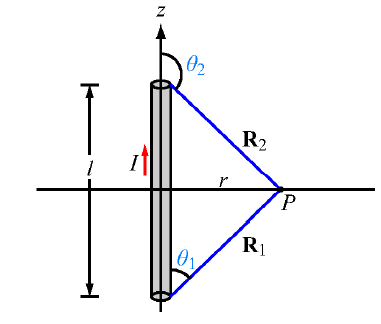 Geometry: source point varies along the wire, observation point is at perpendicular distance .
Set up: , source position , observation . Distance vector , magnitude .
Cross product: (using , ).
Substituting:
The integral evaluates to :
So the field circles the wire with magnitude . This matches the Ampère’s law answer.
Worked example: circular loop on axis
A loop of radius in the -plane carrying current . Find at point on the axis.
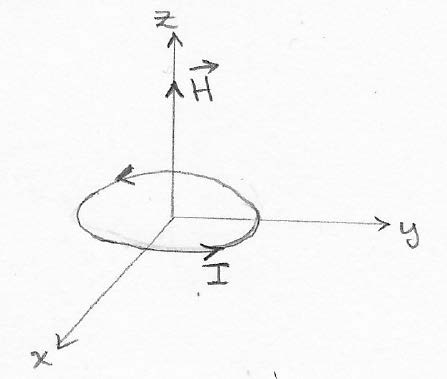 Geometry: source element at angle on the ring contributes a tilted off the axis. Pairs on opposite sides of the loop cancel each other’s off-axis components, leaving only the piece.
Set up: source , . Distance vector to : magnitude .
By symmetry, only the component of survives the integration; the horizontal components from opposite sides of the loop cancel.
The component of works out to (algebra). Substituting:
So
At the center of the loop (): .
This is the result behind Helmholtz coils: pairs of identical loops separated by their common radius produce a very uniform field at the midpoint.
When to use Biot-Savart vs Ampère
- Use Ampère when the field has high symmetry (axial, planar, cylindrical) and can be pulled outside a line integral. Easy.
- Use Biot-Savart when symmetry is partial or absent: finite-length wires, off-axis points of loops, irregular geometries. Necessary, just messier.
Same field, two computational pathways. Biot-Savart is to magnetostatics what direct Coulomb integration is to electrostatics: the universal but ugly tool.
Derivation from Ampère’s law
Biot-Savart can be derived from together with , using vector potential methods. The two formulations are exactly equivalent, but Biot-Savart is the integral form most useful for direct calculation.