Euler’s formula is the identity
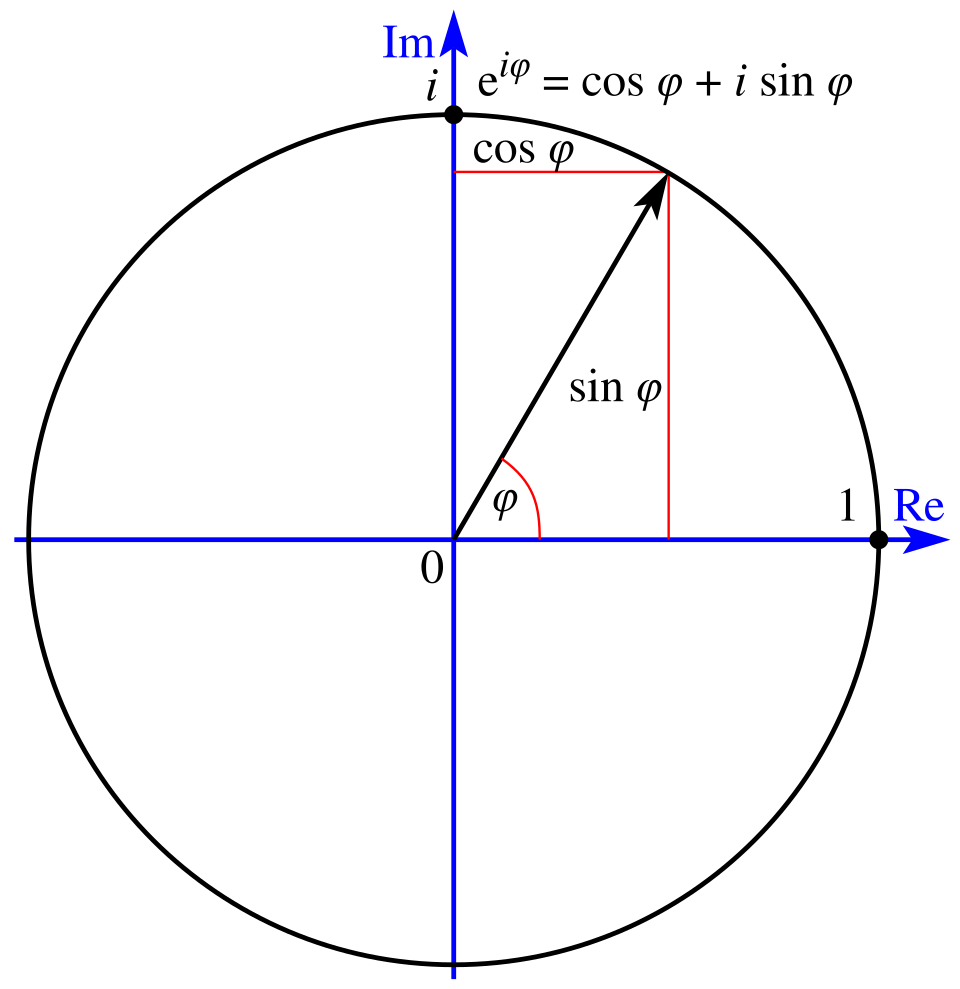 Image: Euler’s formula in the complex plane, CC BY-SA 3.0

connecting the complex exponential to the trig functions. Most of signals-and-systems analysis leans on it.
Named after Leonhard Euler (1707–1783). It follows from comparing the Taylor series of , , and . Setting gives the Euler identity .
Geometric picture
Plot the path of in the complex plane as increases and you get a point rotating counterclockwise around the unit circle at angular speed . The real part of that point is , the imaginary part is . A rotating unit vector with a “shadow” projected onto each axis: that picture is the geometric basis for frequency-domain analysis.
Two everyday identities
Rearranging Euler’s formula with gives the two identities that appear in every Fourier-transform derivation:
These let you turn any real sinusoid into a sum of complex exponentials, which are algebraically easier to manipulate. A typical move: replace in an integrand by this sum, do the integral, then recombine.
Why it shows up everywhere
Complex exponentials are eigenfunctions of LTI systems: feed in , the output is . Real sinusoids aren’t eigenfunctions in the same clean way (they get rotated in phase by the system), but they decompose into complex exponentials via Euler.
The Fourier transform and Laplace transform integrands and are Euler-form objects, so every derivation around those transforms uses Euler.
And the phasor representation of an AC signal, replacing by the complex amplitude , is Euler’s formula in disguise. The phasor is the time-independent part you pull out when the time-dependent part is implicitly .
Polar form of complex numbers
A general complex number can be written in polar form as
(The plain only gives correct angles in the first and fourth quadrants; it loses the sign information when both and flip sign. The two-argument , or an equivalent quadrant correction added to , covers all four quadrants.)
This is Euler’s formula viewed from the complex-number side. Multiplication of two complex numbers in polar form is clean: magnitudes multiply, angles add. See Polar representation of complex numbers.