The management process is what managers actually do when they manage. The standard framework, from Henri Fayol in the early 20th century, splits the job into four functions known as POLC:
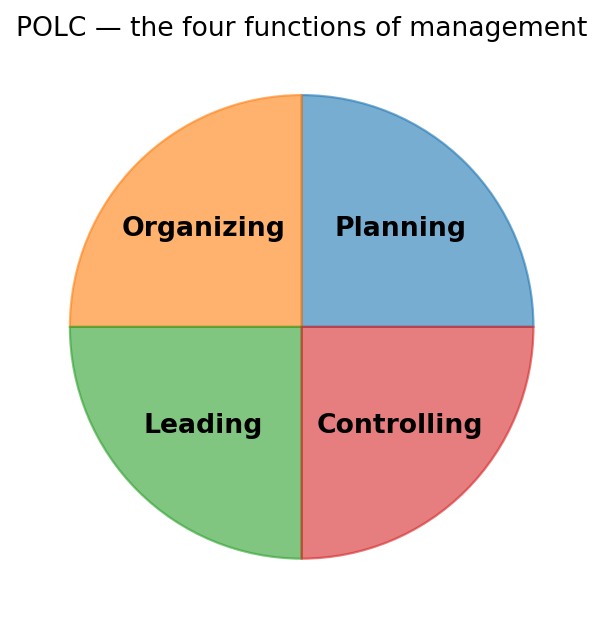 The POLC management cycle: Planning, Organizing, Leading, Controlling.
- Planning — determine goals; develop strategy at strategic, tactical, and operational horizons.
- Organizing — arrange resources, design the org chart, define roles and information flow.
- Leading — guide, motivate, and coach so individual efforts align with shared goals.
- Controlling — set standards, measure performance, take corrective action when actuals diverge.
The process is cyclical. Goals → Gaps (between current and desired state) → Plans → Actions → Evaluation → Iterate. Performance against goals feeds the next planning cycle, and it repeats indefinitely. POLC has the per-function breakdown, planning horizons, controlling sub-steps, and how the mix shifts across management levels.
Management levels
| Level | Roles | Focus |
|---|---|---|
| Top management | C-suite (CEO, COO, CFO, CTO), board | Overall company performance, strategic decisions |
| Middle management | VPs, EDs, directors | Implementing top-level decisions, coordinating across functions |
| First-line management | Managers, supervisors | Direct supervision of workers, daily operations |
The skill mix shifts across levels: top management leans on conceptual (strategic-thinking) skills, first-line management on technical (operational) skills. Time management and decision-making are needed at every level.
Areas of management
Cross-cutting functional specialisations: marketing, financial, engineering, operations, human resources, information (systems and IT). Managers usually pair generalist skills with depth in one or two of these.
For deeper topics: Strategic management, SWOT analysis, Levels of strategy, Organizational culture, Change management.