POLC (Planning, Organizing, Leading, Controlling) is the classical four-function framework for what managers actually do. Henri Fayol articulated it in Administration Industrielle et Générale (1916) and it’s still the standard scaffolding for management textbooks a century later.
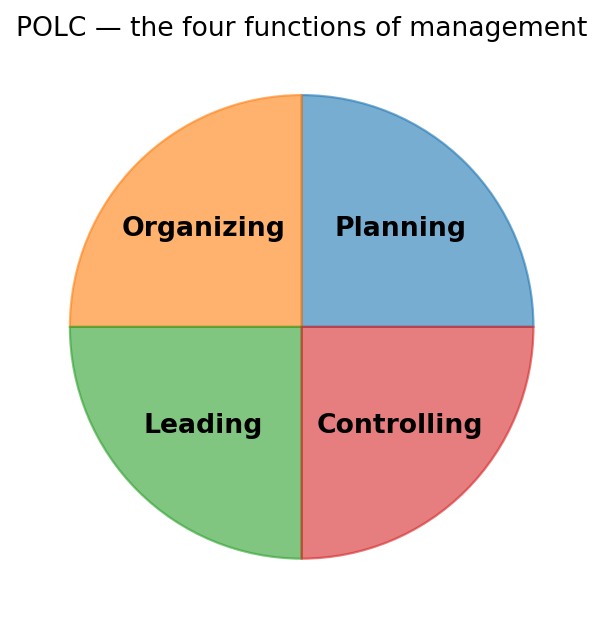 POLC: Planning, Organizing, Leading, Controlling, the cyclic four-function model of management.
POLC is cyclical, not sequential. A manager doesn’t finish planning before starting to organize. The four functions interleave continuously, and outcomes from controlling feed back into the next round of planning.
The four functions
Planning
Determine the firm’s goals and develop strategies and plans to achieve them. Plans operate at different time horizons:
- Strategic plans (3–10+ years), set by top management, define the firm’s overall direction. Goals at this horizon are broad (“become the market leader in personal-care robotics”) and adapt slowly.
- Tactical plans (1–5 years), set by middle management, translate strategic objectives into concrete medium-term programs (a product launch, a market expansion, a capability build-out).
- Operational plans (0–2 years, often quarterly or monthly), set by first-line management, specify day-to-day execution. Schedules, headcount, budgets.
The horizons overlap and feed each other: operational results inform tactical plan adjustments; tactical outcomes inform strategic plan revisions.
Organizing
Determine how to use resources (money, people, equipment, technology, materials) to implement the plan. Arrange jobs into a structure that creates an efficient task system. Define who reports to whom, who handles what, how information flows.
The output of organizing is the org chart and the workflow, the static structure within which work happens. Choices include:
- Functional vs. divisional vs. matrix structure. Group people by function (marketing, engineering), by product line, by geography, or by some matrix combination.
- Span of control. How many direct reports per manager. Wide spans flatten hierarchies, narrow spans deepen them.
- Centralisation vs. decentralisation. Where decisions get made.
- Roles and responsibilities. RACI charts (Responsible, Accountable, Consulted, Informed) make ownership explicit.
Leading
The interaction between people, usually between managers and subordinates, but also with peers, suppliers, and customers. Guiding, motivating, and coaching, not just giving orders. Effective leading aligns individual efforts toward shared goals.
This is the function with the largest gap between textbook description and lived reality: leading happens through countless small interactions, not formal documents. Communicating vision, recognising contributions, working through conflicts, building trust, hiring well, firing carefully, all part of leading.
The classical framing distinguishes leadership styles (transformational, transactional, servant, etc.) and motivation theories (Maslow’s hierarchy, Herzberg’s two-factor, expectancy theory). The depth here is largely outside POLC itself but feeds back into it.
Controlling
Establish standards, measure performance against those standards, take corrective action when performance deviates. Closing the loop:
Controlling has three sub-steps:
- Set standards. Decide what “good” looks like: KPIs, milestones, budgets, quality metrics.
- Measure performance. Collect actual data on the same metrics. Periodic reports, dashboards, audits, feedback.
- Take corrective action. When actuals diverge from standards, intervene. Sometimes the plan was wrong, sometimes execution was, sometimes the standard itself needs revising.
The third step is where controlling feeds back into planning, closing the cycle.
Why POLC persists
The framework gets criticised for being too tidy. Real management is messier than four discrete functions. But it persists because:
- It’s a useful scaffold for teaching. New managers need a vocabulary for the things they’re being asked to do.
- It maps to organisational artifacts. Plans, org charts, employee reviews, KPI dashboards: each function produces something concrete.
- It exposes deficits. A team heavy on planning and organizing but weak on controlling will execute well but never learn from results. A team strong on leading and controlling but weak on planning will work hard in the wrong direction. POLC gives names to specific imbalances.
Management levels and POLC mix
The mix of POLC effort shifts across the management hierarchy:
| Level | Planning emphasis | Organizing | Leading | Controlling |
|---|---|---|---|---|
| Top | High (strategic) | Org structure | Vision-setting | Outcomes |
| Middle | Medium (tactical) | Function/division design | Coaching | Programs |
| First-line | Low (operational) | Job design | Daily supervision | Tasks |
A first-line manager spends most of their time on leading and controlling at the task level; a CEO spends most theirs on planning and organizing at the company level. Both touch all four functions, but the proportions differ dramatically.
In context
POLC is the central framework in Management process. The associated topics fit under the POLC functions: SWOT analysis informs Planning, Organizational culture is shaped by Leading, Change management is Controlling-driven re-planning.