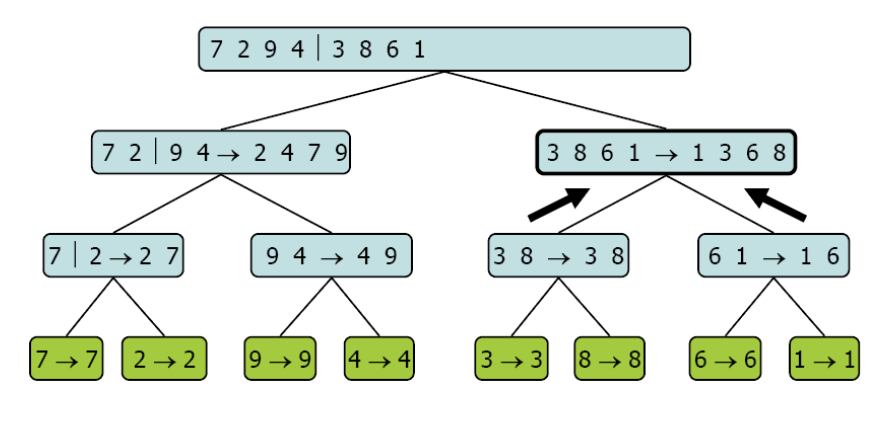
Merge sort is a divide-and-conquer sorting algorithm. Recursively split the array in half, sort each half, then merge the two sorted halves into one sorted result. Runs in in all cases (best, average, worst), is stable, but uses extra space.
The structure:
- Divide: split the array into two halves.
- Conquer (recur): sort each half.
- Combine (merge): merge the two sorted halves into a single sorted array.
The base case is a sub-array of size 1, which is trivially sorted.
The merging step
Merging two sorted arrays into one sorted array. This is where the actual work happens:
Input: A = [3, 7, 12], B = [5, 8, 15]
Output: C = [3, 5, 7, 8, 12, 15]
Walk through both with separate indices, taking the smaller front element at each step:
indexA = 0, indexB = 0, indexC = 0
A[0]=3, B[0]=5  → take A: C[0]=3, indexA=1
A[1]=7, B[0]=5  → take B: C[1]=5, indexB=1
A[1]=7, B[1]=8  → take A: C[2]=7, indexA=2
A[2]=12, B[1]=8 → take B: C[3]=8, indexB=2
A[2]=12, B[2]=15 → take A: C[4]=12, indexA=3 (done with A)
B[2]=15 remaining → C[5]=15
When one input is exhausted, drain the other into C. Each element gets compared to one element of the other array (or fewer); merging is .
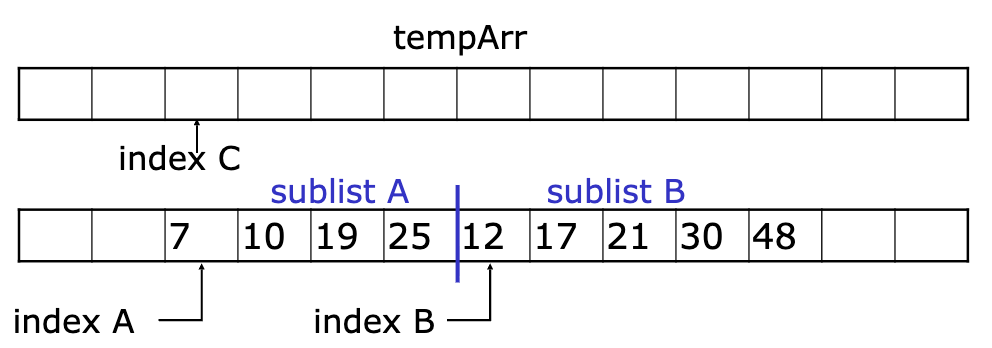
void merge(int arr[], int tempArr[], int first, int midpt, int last) {
    int indexA = first;
    int indexB = midpt;
    int indexC = first;

    while (indexA < midpt && indexB < last) {
        if (arr[indexA] < arr[indexB]) {
            tempArr[indexC++] = arr[indexA++];
        } else {
            tempArr[indexC++] = arr[indexB++];
        }
    }

    while (indexA < midpt)  tempArr[indexC++] = arr[indexA++];
    while (indexB < last)   tempArr[indexC++] = arr[indexB++];

    for (int i = first; i < last; i++) {
        arr[i] = tempArr[i];
    }
}
The recursive partition
void msort(int arr[], int tempArr[], int first, int last) {
    if (first + 1 < last) {
        int midpt = (first + last) / 2;
        msort(arr, tempArr, first, midpt);
        msort(arr, tempArr, midpt, last);
        if (arr[midpt - 1] <= arr[midpt]) return;   // already sorted
        merge(arr, tempArr, first, midpt, last);
    }
}
The early-exit if (arr[midpt - 1] <= arr[midpt]) return; is an optimization — if the left half’s last element is already ≤ the right half’s first, the merge is a no-op.
Big O
- Each level of recursion does work (merging across the array).
- Recursion depth is (halving each time).
- Total: .
This holds for all inputs — no input pattern can degrade merge sort. Compare to quicksort which has worst case.
Properties
- Stable: yes. Equal elements preserve relative order (the merge step takes from the left half first when elements are equal).
- In place: no. Requires extra space for
tempArr. - Predictable: same time on any input.
When to use
Reach for merge sort when:
- Stability matters — sorting records by one field while keeping the order from another.
- Worst-case performance matters. Real-time systems can’t tolerate quicksort’s degenerate cases.
- External sorting (data doesn’t fit in memory). Merge sort handles streaming naturally: read sorted chunks, merge them. Databases use it for sorting on disk.
When in-memory cache behavior matters more, Quick sort usually wins on real workloads. When extra space matters, Heap sort.
Variants
- Top-down (the version above): recurse, then merge.
- Bottom-up: iteratively merge size-1 chunks into size-2, then size-4, etc.
- Timsort: hybrid merge sort + insertion sort, used by Python and Java’s
Arrays.sortfor objects. Adaptive to existing runs of sorted data.
For the in-place divide-and-conquer alternative, see Quick sort. For O(n log n) without extra space, see Heap sort.