The Nyquist rate of a bandlimited signal with maximum frequency is twice that maximum.
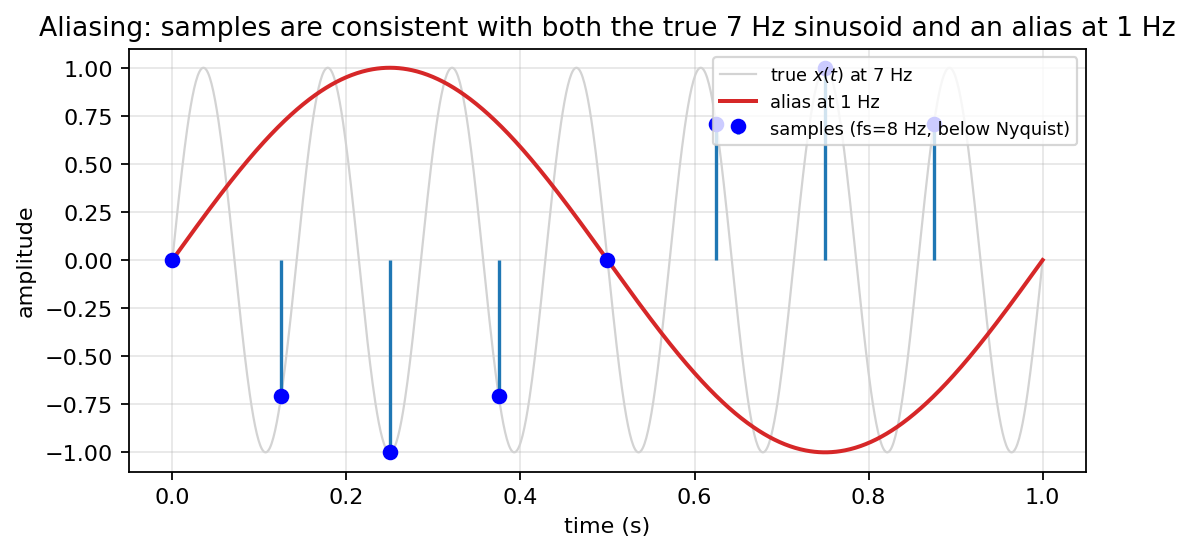 Below-Nyquist sampling: the true 7 Hz tone and a 1 Hz alias fit the same samples exactly.
This is the critical rate above which sampling preserves the signal completely. Sample above the Nyquist rate and reconstruction is possible. Sample below and aliasing destroys information.
The “Nyquist frequency” sometimes refers to half the sampling rate (), the highest frequency that can be unambiguously represented at sampling rate . The two terms get used interchangeably, but the distinction matters: is the rate you need for a signal of max frequency ; is the upper limit of what a sampler at rate can resolve.
Finding it for given signals
- Find the Fourier transform of the signal.
- Determine the highest frequency in (the largest for which ).
- The Nyquist rate is .
Examples
: cosine at . Spectrum: two impulses at . So , Nyquist rate .
: rectangle of width 2 in time. Spectrum: , a sinc that never strictly reaches zero. So formally the signal isn’t bandlimited and the Nyquist rate is infinite. In practice the sinc decays past its first zero at , so you make a judgment call about how much high-frequency content you can afford to lose, then anti-alias filter and sample.
Pattern: any time-limited signal (zero outside a finite interval) is not bandlimited, so technically has infinite Nyquist rate. And reverse: bandlimited signals extend over all time. This is the time-bandwidth tradeoff again.
: spectrum is , a rectangle of width 5 in frequency. So , Nyquist rate .
: spectrum is the convolution of the sinc’s spectrum (rectangle from to ) with the sin’s spectrum (impulses at ). Each impulse drags a copy of the rectangle with it, giving two rectangles centered at . The rectangle near spans to . So , and Nyquist rate .
This last example is a sinc carrying narrowband information ( bandwidth) modulated onto a 250 kHz carrier. To sample it faithfully you need , determined by the carrier, not the bandwidth. That’s why broadcast radio needs such high sampling rates even when the message is narrowband.
Boundary subtlety
The sampling theorem requires strictly , not . Sampling exactly at the Nyquist rate doesn’t always work. For pure tones, sampling at exactly can hit the zero crossings of , missing the signal entirely. Always sample strictly above.
Practical undersampling
In practice you choose a few times larger than the Nyquist rate for safety margin. CD-quality audio uses 44.1 kHz to capture frequencies up to ~22 kHz (a small margin above the human hearing limit of ~20 kHz). Professional audio uses 48, 96, or 192 kHz for additional headroom in mixing and processing.