The Sampling Theorem (also called the Nyquist or Nyquist–Shannon theorem) states:
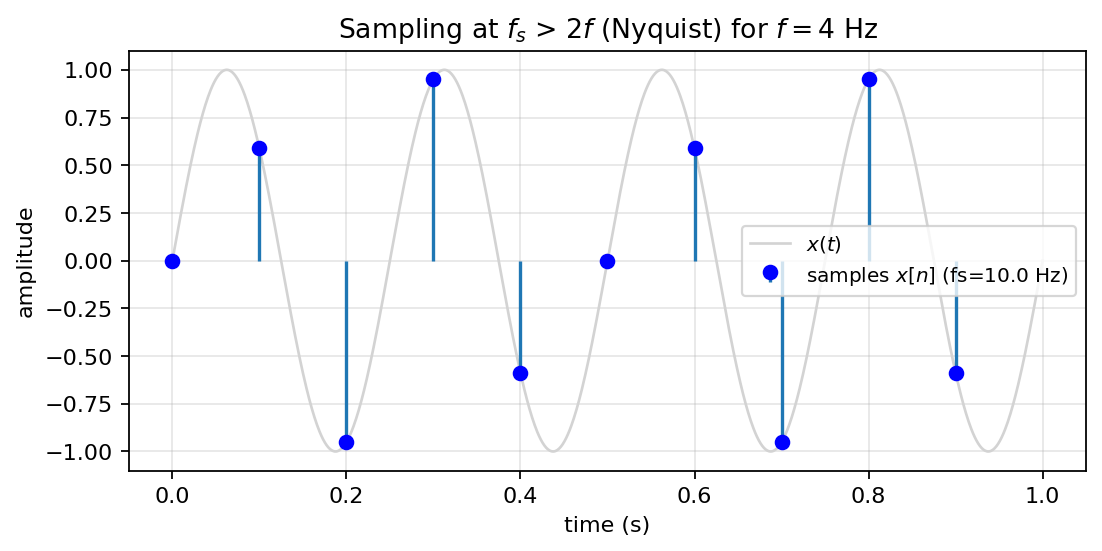 Sampling a 4 Hz sinusoid at 10 Hz, above the Nyquist rate, so the samples preserve the signal exactly.
If a continuous-time signal is bandlimited with maximum frequency (that is, for ), and is sampled at a rate , then the samples contain enough information to reconstruct exactly.
The critical sampling rate (twice the highest frequency) is the Nyquist rate. A signal sampled at is oversampled; at it is undersampled.
Why it works
Sampling produces a spectrum , copies of spaced apart in frequency. For the copies not to overlap, the right edge of the copy (at ) must be below the left edge of the copy (at ):
When this holds, the copies are cleanly separated, and the copy is just , a faithful replica of the original spectrum. Lowpass-filter to isolate it (multiply by in frequency), and the result is .
In time, multiplying by a frequency rect becomes convolving with a sinc. That’s the sinc interpolation formula for recovering from :
If you sample below the Nyquist rate, the copies overlap and aliasing destroys information.
Things to internalize
It’s a strict inequality. , not . Sampling exactly at the Nyquist rate is a boundary case where reconstruction is not always guaranteed. Sampling at gives samples that land on the zero crossings: every sample is the same value, and you lose the cosine. Always sample strictly above Nyquist.
It’s about bandlimited signals. Real signals are never perfectly bandlimited. Every real signal has some high-frequency content (noise, harmonics, sharp edges). The fix is to apply an anti-aliasing filter before sampling, enforcing bandlimiting.
It guarantees exact reconstruction in principle. “Reconstructible exactly” doesn’t mean “easy to reconstruct in practice.” The sinc-interpolation formula involves an infinite sum of sincs, which you can’t compute exactly with finitely many samples. Real systems use approximations (zero-order hold, FIR filters).
The Nyquist rate depends on the highest frequency, not the bandwidth. A signal in the band has bandwidth but highest frequency , so the Nyquist rate is , not . (Bandpass sampling handles narrowband signals far from DC with a more careful argument; the basic theorem uses .)
The practical signal chain
A complete digital signal chain looks like:
analog signal → anti-aliasing filter → sampler → digital processing → reconstruction filter → analog out
The anti-aliasing filter prevents aliasing during sampling; the reconstruction filter smooths the discrete output back into a continuous-time signal (approximating sinc reconstruction). Without both filters the digital chain mangles the signal.
Why it matters
The theorem says a continuous signal can be completely represented by a discrete sequence, with no information lost, as long as you sample fast enough. That’s the basis for digital audio, digital cameras, and digital communication links.
Named after Harry Nyquist (1928) and Claude Shannon (1949), though variants were known earlier (Whittaker, Kotelnikov).