The inverting configuration with the input resistor replaced by a capacitor (mirror image of the Op-amp integrator). Output is proportional to the time-derivative of the input, scaled and inverted:
Derivation
The input element is a capacitor from to the inverting node; the feedback element is a resistor from the inverting node to the output. The non-inverting input is grounded.
Golden rule 2 of the Ideal op-amp model makes the inverting node a virtual ground, . The capacitor sits between and that node, so the voltage across it is , and its current is
Golden rule 1 says no current enters the op-amp input, so this same current flows through the feedback resistor toward the output. The current through from the virtual ground to is . Equate:
Solve for :
A ramp input gives a constant output; a constant input gives zero — the signature of differentiation.
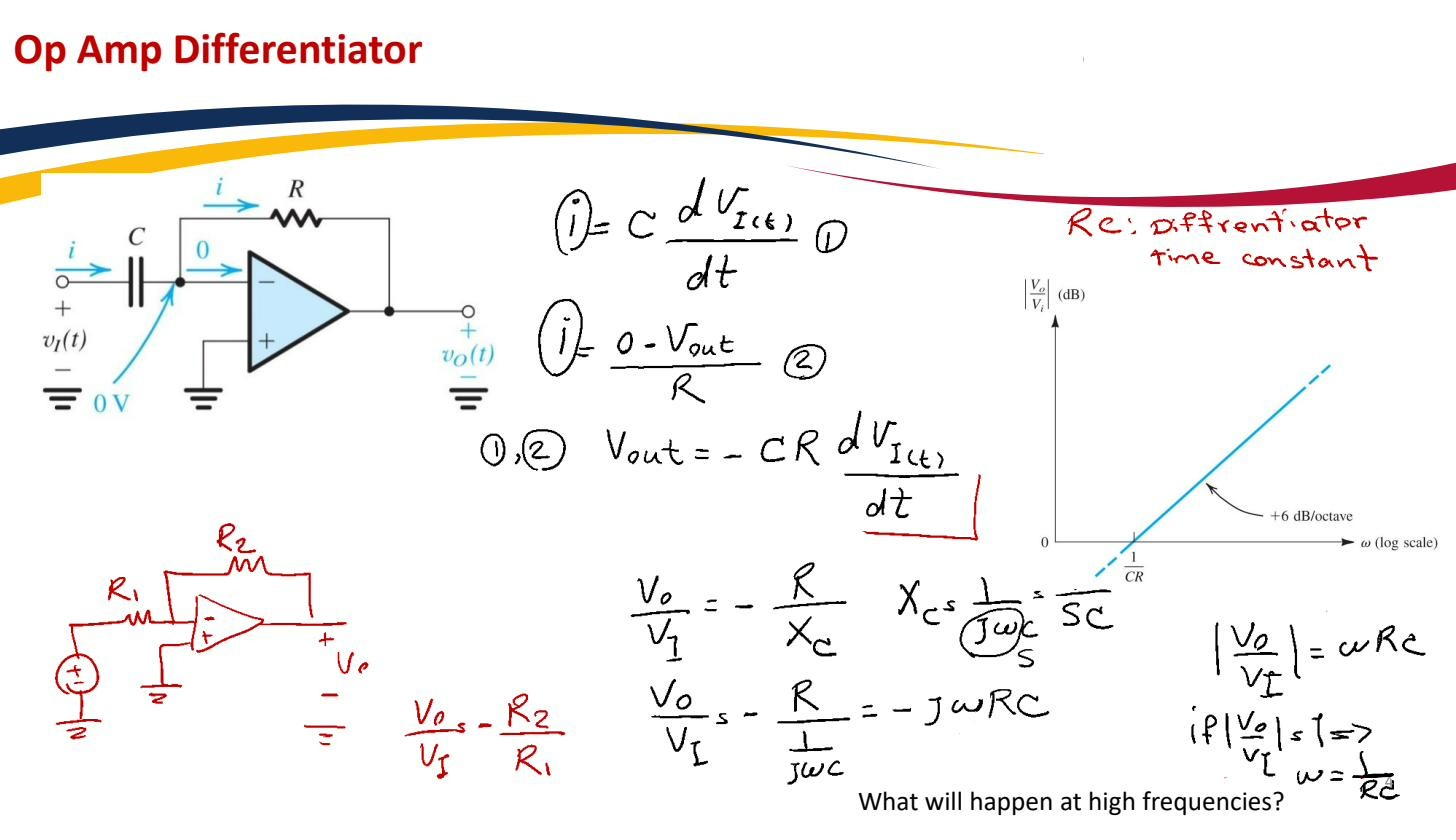 Input capacitor, feedback resistor ⇒ output ∝ derivative, gain +20 dB/decade.
Frequency domain and the noise problem
Using as the input element in the inverting gain :
The magnitude is , rising with frequency at ( is the frequency-domain derivative operator). That rising response is what makes practical differentiators noisy: high-frequency noise on the input is amplified more than the lower-frequency signal of interest, so the output can be swamped by hiss and pickup. The standard fix is a small resistor in series with the input capacitor; it flattens the gain above a chosen corner so the high-frequency amplification stops climbing. This noise sensitivity is why the differentiator is used far less often than the Op-amp integrator in real designs. When a derivative is genuinely needed it’s more common to integrate elsewhere and rearrange, or to differentiate with heavy bandwidth limiting.