The open-loop gain is the gain of an op-amp with no feedback applied, the raw differential gain of the bare chip:
where is the non-inverting input, the inverting input, and the output, all measured to ground. For a real op-amp is huge, typically to (–).
Why it is useless on its own
A gain of sounds great until you use it. An input difference of produces . Thermal noise, a stray thermocouple at a solder joint, a few millivolts of offset, anything, drives the output hard against a supply rail. Open-loop, the op-amp is a comparator, not a linear amplifier. To get controllable, predictable gain we wrap it in Negative feedback and let the large work for us: because is so large the virtual short holds and the Closed-loop gain collapses to a resistor ratio.
Frequency dependence
The ideal model pretends is constant at all frequencies. It isn’t. is large only near DC; above a corner frequency (often a few hertz) it rolls off at (a single-pole roll-off, like an RC lowpass filter). Above the corner the product of gain and frequency is roughly constant:
is the gain-bandwidth product: the frequency at which has fallen all the way to unity (). For a 741 ; modern parts reach hundreds of MHz.
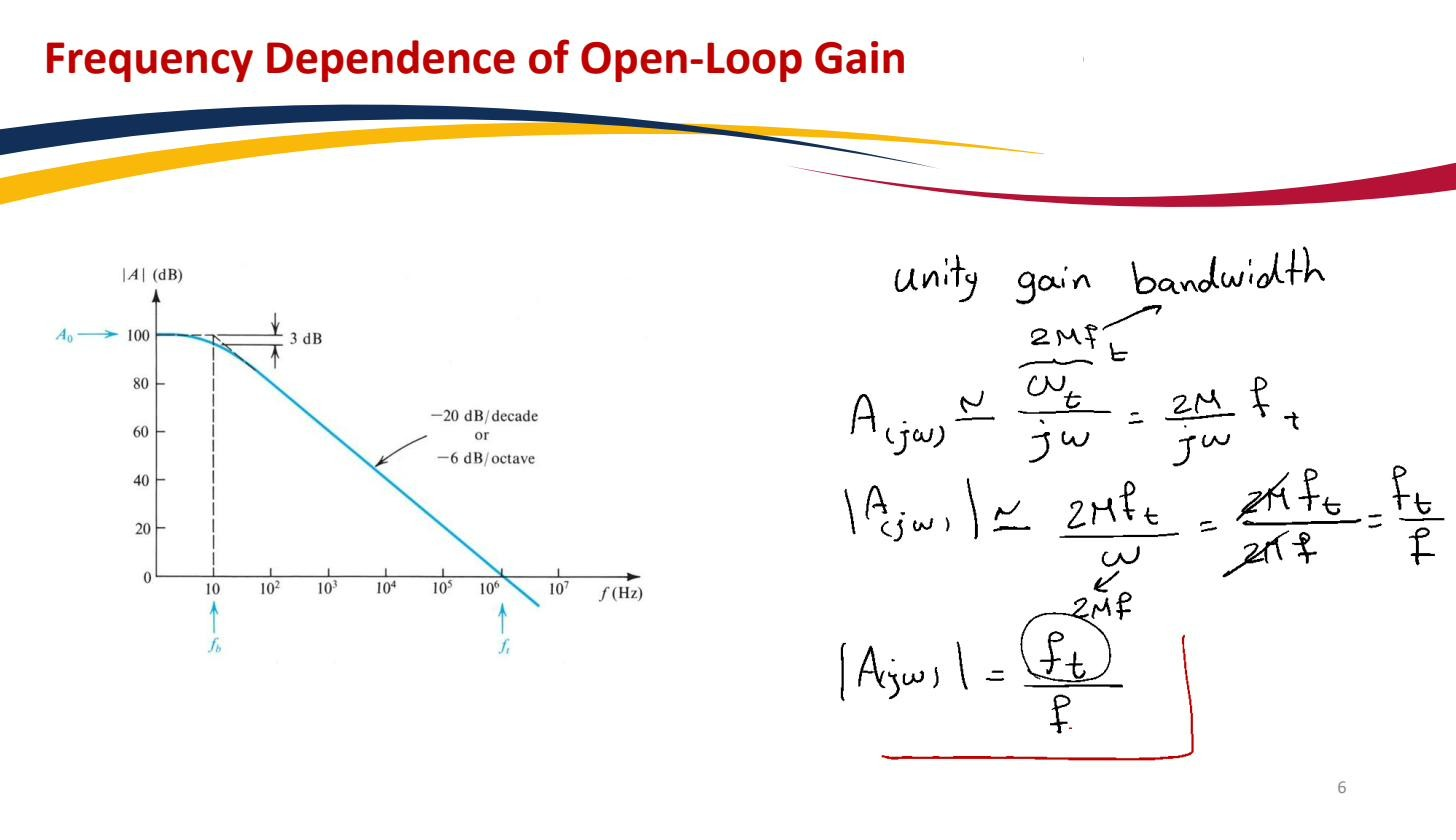 large only at DC; −20 dB/decade above ; unity at the gain-bandwidth product .
The practical payoff is the closed-loop bandwidth. Because is constant, an amplifier with closed-loop gain magnitude has a bandwidth of approximately
So a inverting amplifier built from a 741 () is flat only to about ; push it to and the output is attenuated and phase-shifted. You trade gain for bandwidth one-for-one. This finite, frequency-dependent is one of the Real op-amp imperfections. This small-signal bandwidth is independent of Slew rate limiting, so check both.