The slew rate SR is the maximum rate at which an op-amp output voltage can change, in volts per microsecond:
For a 741 it is about ; fast modern parts reach hundreds of V/µs. It is a large-signal limitation caused by a finite internal current charging the op-amp’s internal compensation capacitor. That current cannot exceed a fixed value, so is capped no matter how big the demanded change is.
Distinct from output saturation
Op-amp output saturation is an amplitude limit (how high can go); slew rate is a rate limit (how fast it can get there). Even when the steady-state output sits comfortably within the rails, the op-amp may be unable to move fast enough to trace a fast-changing waveform. Feed a small step and the output does not jump, it ramps at the slew rate. Feed a large fast sine and the output cannot keep up on the steep parts, so the sinusoid degenerates into a triangle wave (constant-slope ramps between turning points). This is slew-rate limiting.
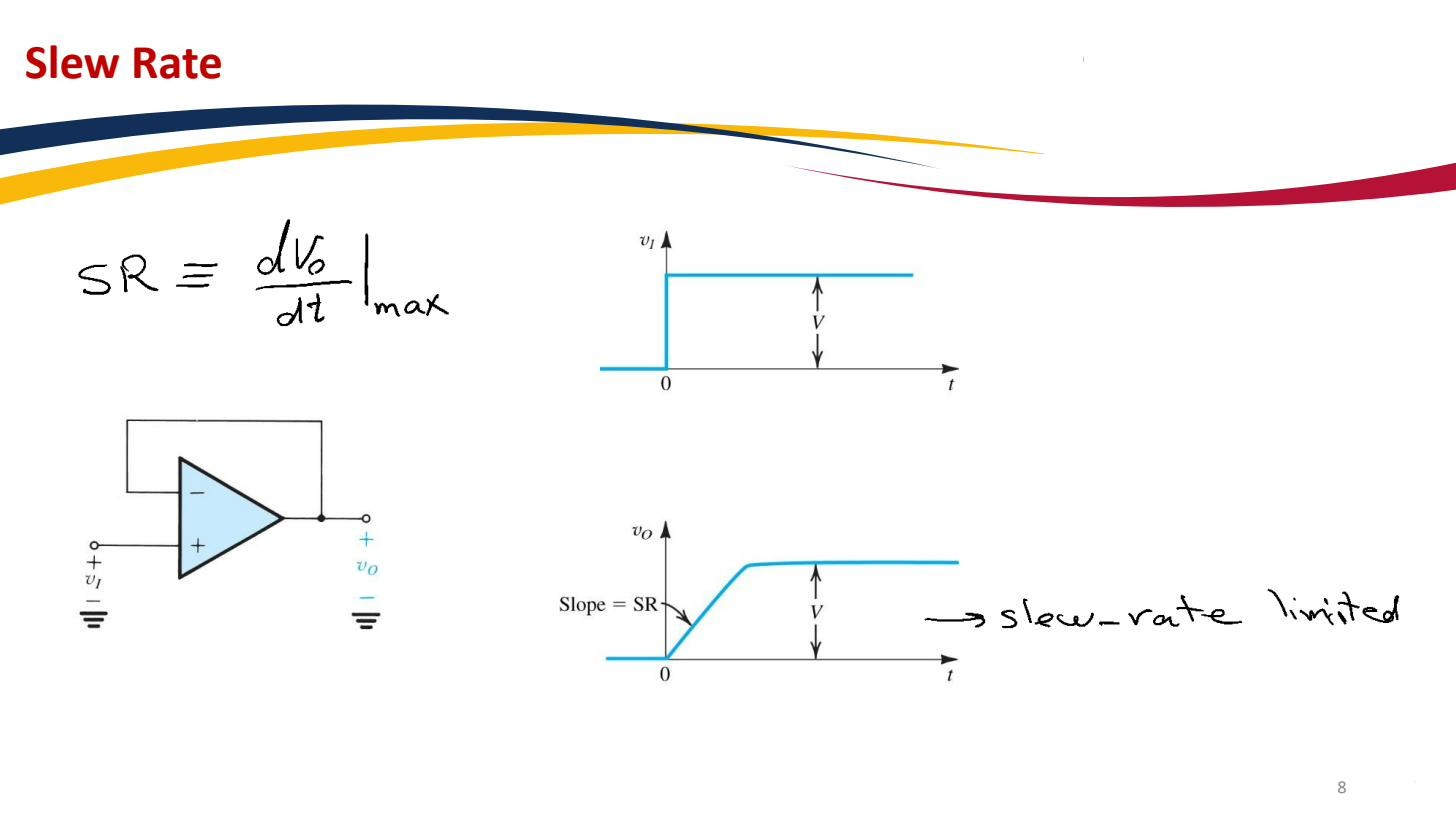 Output cannot change faster than SR; above large sines distort.
When it bites: the full-power bandwidth
A sine wave has derivative , whose maximum magnitude is (steepest at the zero crossings). The op-amp can reproduce this sine undistorted only while that peak slope stays below the slew rate: . The highest frequency at which a full-amplitude sine of peak survives is therefore
the Full-power bandwidth. For a 741 driving a swing, . Above large signals near the rails turn triangular.
This is an amplitude-and-frequency limit. Small signals (well below the rails) have a small even at high frequency, so they never hit the slew rate and stay linear all the way up to the small-signal gain-bandwidth limit (Open-loop gain). So an op-amp has two independent bandwidths: small-signal and large-signal (full-power) . A circuit may be limited by either, so check both.