Op-amp output saturation is the hard physical limit that an op-amp output voltage cannot exceed its supply rails. The op-amp is powered between and ; the output transistors need a volt or two of headroom each, so is clamped within
where and are the few volts of internal headroom lost on the positive and negative sides. With a typical lab supply of and , the output saturates near and . It is a real-op-amp limit, not a parameter you can trim away.
Why it breaks linear analysis
All the closed-loop gain derivations assume the op-amp can produce whatever output the feedback equations demand. That assumption holds only inside the rails. If you compute, say, a Inverting amplifier (op-amp) driven by a input, linear analysis predicts . The op-amp cannot deliver it. The output simply clips flat at about and stays there until the input lets it back inside the rails. The waveform is no longer a scaled copy of the input: its peaks are sheared off into plateaus, injecting large harmonic distortion. Worse, while clipped the op-amp is out of its linear region, the virtual short no longer holds, and every formula derived from the Ideal op-amp model is invalid for that part of the cycle.
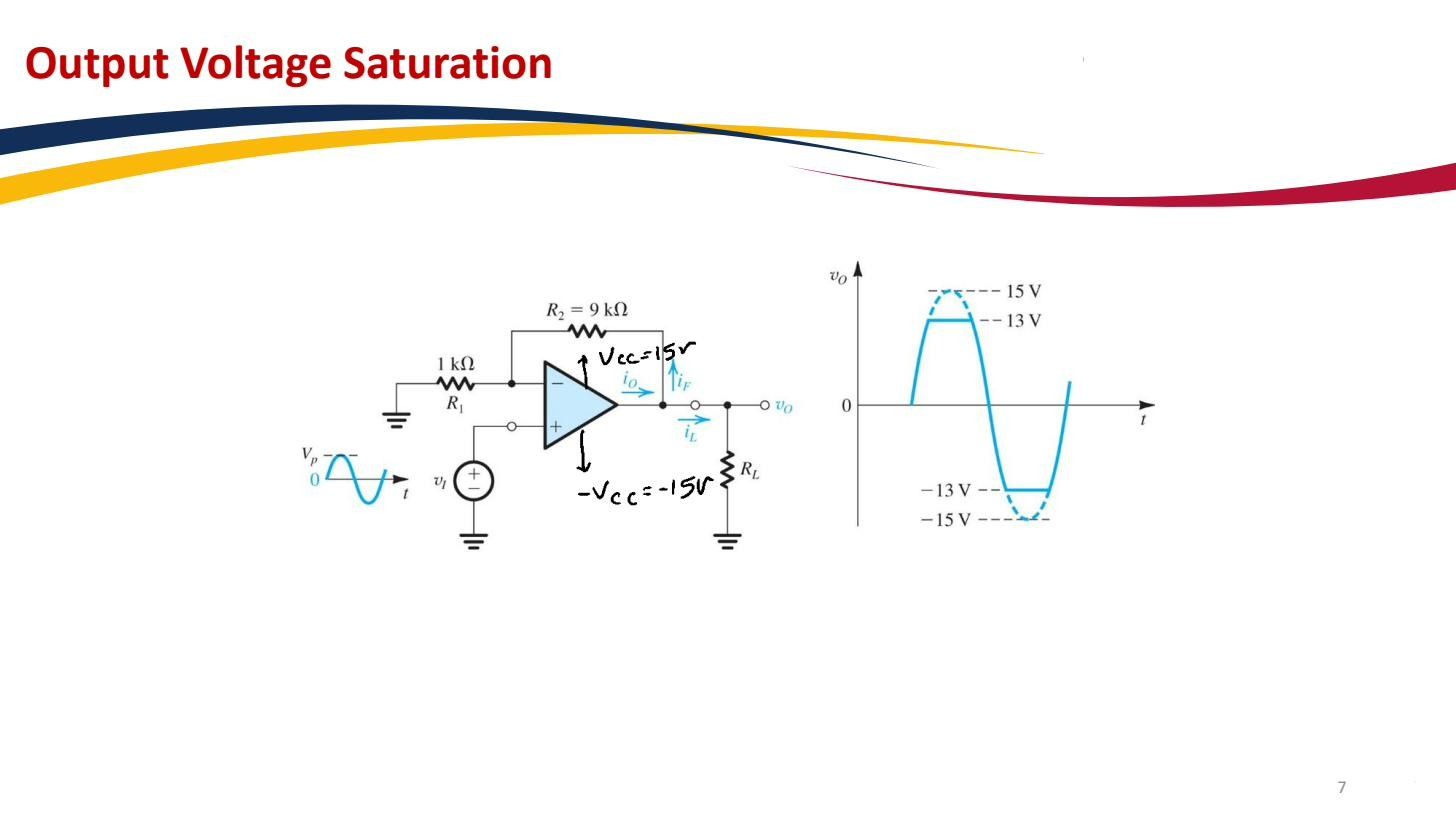 Output cannot exceed the rails (minus headroom); beyond that it clips and linear analysis fails.
The practical rule
Always sanity-check the predicted output swing against the rails. After computing a Closed-loop gain and the largest expected input, multiply them out: if the result exceeds (or goes below ), the design will clip and you must reduce the gain, reduce the input amplitude, or raise the supplies. This is purely an amplitude limit at DC and low frequency. There is a separate rate limit, the output also cannot change arbitrarily fast, which is the Slew rate. The two distortion mechanisms (clipping vs. slewing) are independent; check both.