Phase is the position of a waveform within its cycle: it says when, relative to some reference time, the waveform reaches its peak. The third of the three numbers (with amplitude and frequency) that fully describe a sinusoid.
In the phase is , the constant added to the angle inside the sine. Here is the amplitude, the angular frequency, and time. At the waveform is not necessarily at zero; it sits at . So tells you how far into the cycle the signal already is when you start your clock.
Phase is a time shift
Pull the out of the argument:
Same sinusoid as , evaluated at a shifted time . A positive shifts the waveform earlier (it leads, peak arrives sooner by seconds); a negative shifts it later (it lags). So phase is just a time offset expressed as an angle, which makes it independent of the particular frequency. Two sinusoids with identical and but different are time-shifted copies of one another: same shape, same size, same pitch, slid along the time axis.
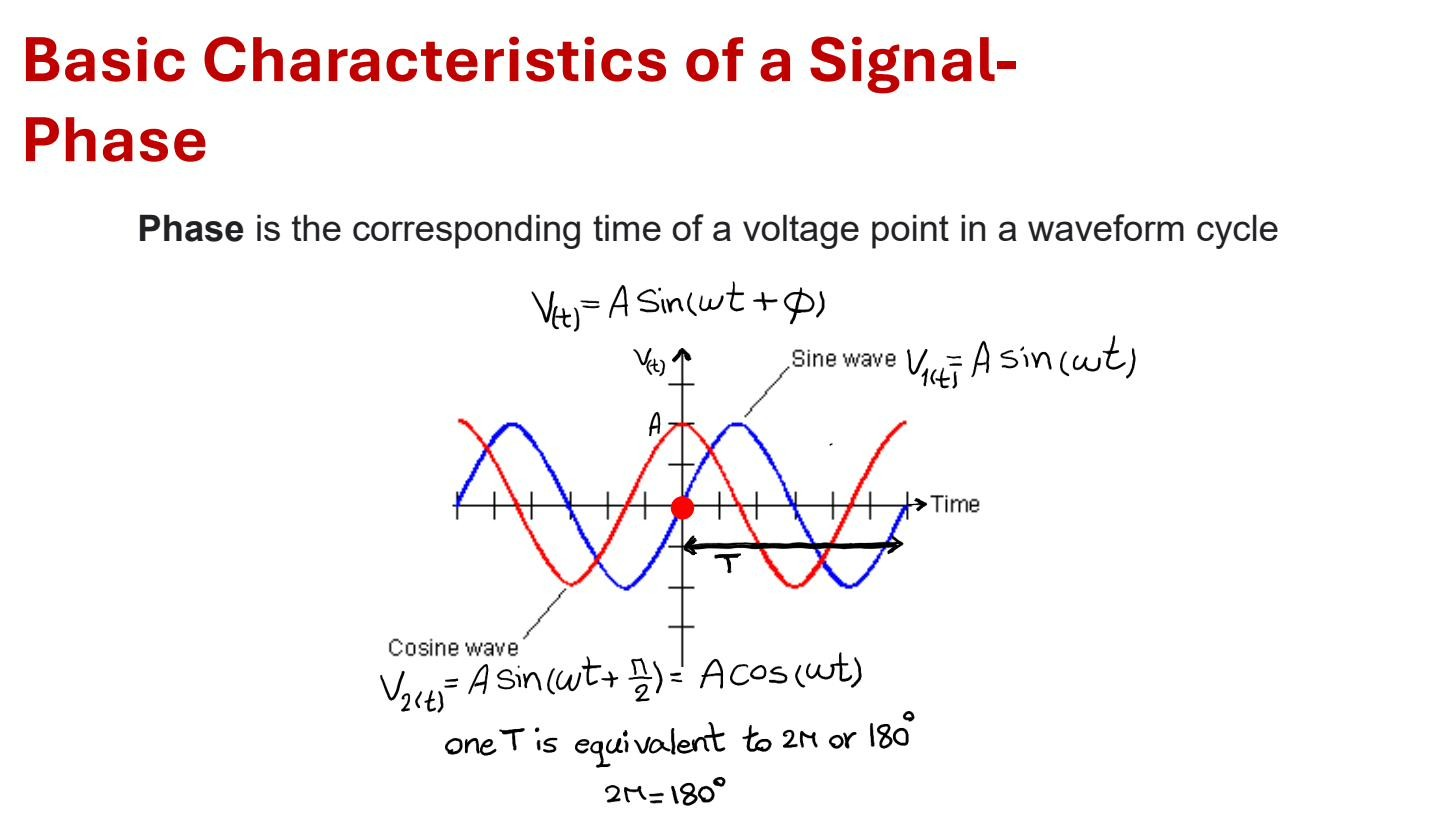 Phase in is the time position within a cycle; a cosine is a sine shifted by .
Cosine is a phase-shifted sine
A cosine is a sine advanced by a quarter cycle.
This follows from the trig identity : the cosine curve is the sine curve slid left by . Sine and cosine aren’t really different functions, just the same waveform at two different phases. That’s why circuit analysis can pick either as the reference, the choice only shifts every phase in the problem by a constant.
Degrees vs radians, and a slide typo
One full period is one complete trip around the circle: radians, or . Half a period is rad , and a quarter period is rad , the sine-to-cosine shift above.
The handwritten note on the course slide reads “one T = 2π = 180°“. The "" part is fine (a period is radians of the argument), but rad is , not . Slide typo, acknowledged in the notes. The correct correspondences are for a full period and for the sine→cosine shift.
Why phase matters
Phase carries no information about a signal’s strength or pitch, but it governs how sinusoids combine. Two equal sinusoids exactly in phase ( difference ) add to double the amplitude; the same two exactly out of phase ( apart) cancel to zero. Filters and amplifiers shift phase as well as amplitude. An RC highpass filter, for instance, produces a phase shift that approaches at low frequency. The phase part of a circuit’s Transfer function is half of its Bode plot and matters whenever timing or feedback stability is at stake.