The phase plane is the 2D plot of for a system in . Instead of plotting and separately as functions of time, you plot the trajectory as a curve traced through the plane.
For a 2D autonomous system, the trajectory’s shape (geometry) doesn’t depend on how fast it’s traversed, only on the relationship between and . This is why phase-plane analysis decouples geometry from time and gives qualitative insight into the system’s long-term behavior.
The generalization to higher dimensions is phase space, but it’s much harder to visualize.
The phase plane equation
For a 2D autonomous system
eliminate via the chain rule:
This is the phase plane equation. It relates and directly without time. Solving it (when possible) gives the trajectories.
For example, gives phase plane equation . Separable: , integrate: . Trajectories are hyperbolas.
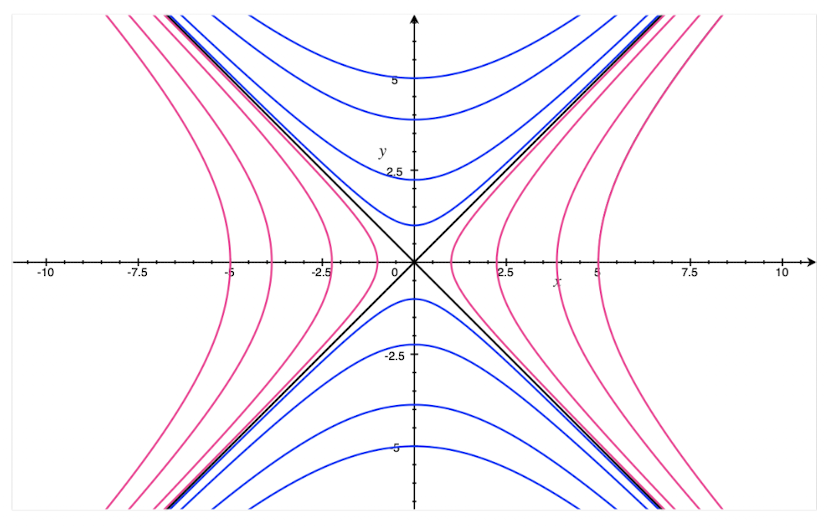
When the phase plane equation is hard
For most nonlinear systems, the phase plane equation can’t be solved in closed form. But you can still:
- Find equilibria: solve and simultaneously.
- Compute the slope field: at each , the trajectory has slope . Plot the direction at a grid of points.
- Numerically integrate to trace specific trajectories.
- Linearize around equilibria (see Locally linear system) to find local behavior.
- Apply Lyapunov’s method for stability without explicit solutions.
Why the phase plane matters
Long-term behavior of a 2D system is determined by:
- Where the equilibria are.
- What kind of equilibrium each is (stable node, saddle, spiral, etc.).
- How trajectories connect them (or escape to infinity).
The phase plane visualizes all this. A glance at the phase portrait tells you whether the system oscillates, converges, diverges, or has multiple stable basins.
Standard equilibrium types in the linear case: Phase plane behaviour. Formal stability theory: Stability of autonomous systems.
Phase plane vs slope field
Closely related:
- Slope field (or direction field): at each point , draw a small arrow with slope . Doesn’t show specific trajectories, just the direction of flow at each point.
- Phase portrait: actual trajectory curves through the plane.
A slope field is a “vector field” view; a phase portrait is the “integral curves” view. The slope field is easier to compute (just evaluate everywhere); the phase portrait is more informative (shows actual flow paths). Tools like Wolfram Alpha or Matlab plot both side by side.
Examples in nature
- Pendulum in phase plane : closed orbits around the rest position (stable center), separatrices through the inverted position (saddle).
- Predator-prey: closed orbits indicating periodic population cycles.
- Damped oscillator: spiral inward to origin (asymptotically stable spiral).
- Limit cycles (in some nonlinear systems): isolated closed orbits that nearby trajectories spiral toward. Explains self-sustained oscillations like heartbeat.
See Autonomous system.