Picard iteration is a constructive method for finding the solution to an Initial value problem , . It’s how the Existence and uniqueness theorem is proved: by actually building the solution as the limit of a sequence of approximations.
The idea
Start with the IVP and convert it to an integral equation by integrating both sides from to :
This gives the same information as the IVP but in integral form. The unknown appears on both sides, which is why we iterate.
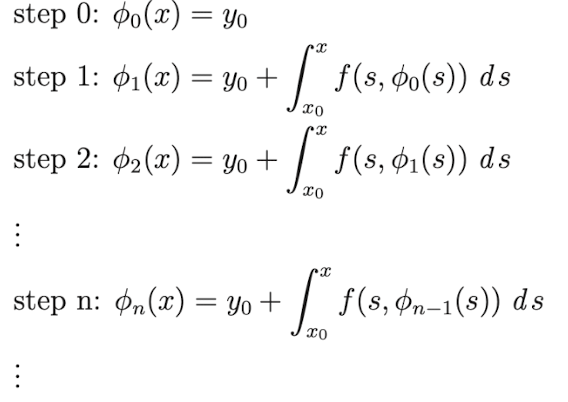
The Picard sequence:
- (constant).
- .
- .
- .
Each is built by plugging the previous approximation into the integrand.
If the conditions of the Existence and uniqueness theorem are satisfied, the sequence converges to the unique solution of the IVP.
When you’ve reached the solution
If at some step exactly, the iteration has converged — that’s the solution. Formally: if there exists such that , then
is the solution of the IVP.
In practice, this only happens for very simple . Usually you compute several iterations and identify a pattern (a Taylor series, an exponential, etc.) that the iterates are converging toward.
Worked example
The IVP , .
Step 0: .
Step 1: .
Step 2: .
Step 3: .
Pattern emerging: .
This is the partial sum of . Confirming with the ratio test:
So the series converges for every , and .
You can verify directly: . ✓ And . ✓
Why this works
Picard iteration is a fixed-point iteration on the operator . The fixed point of (the function with ) satisfies the integral equation, hence the IVP.
The conditions in the Existence and uniqueness theorem don’t directly make a contraction. What they give you is Lipschitz continuity of in (continuity of on a closed rectangle implies a Lipschitz bound there). Lipschitz alone is not enough for to be a contraction in the sup norm; you also need the interval to be short enough. Specifically, if is the Lipschitz constant of in , then is a contraction on functions defined on provided . Once you’ve shrunk to a short enough interval, Banach’s fixed-point theorem applies and gives convergence to a unique fixed point.
This is why the existence-and-uniqueness conclusion is local: the contraction only works on a small enough interval, set by the Lipschitz constant.
Practical relevance
Picard iteration is rarely used to compute solutions. For most ODEs, direct methods (Separable equation, Integrating factor, etc.) or numerical methods (Euler, Runge-Kutta) are vastly faster. Its importance is theoretical: it provides the existence-and-uniqueness proof, and it shows that solutions can be approximated systematically when nothing else works.
Runge-Kutta methods are spiritual cousins of Picard iteration, with much better convergence rates per step.