What comes out of an RC lowpass filter when the input is a unit step. A smooth exponential approach to a final value, with time constant . One of the canonical first-order responses.
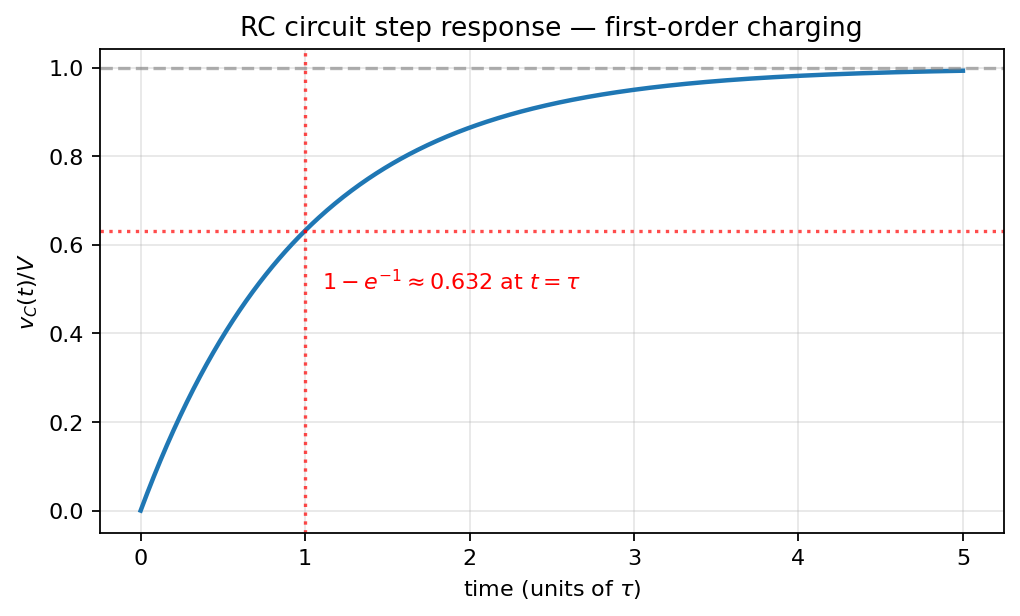 First-order RC charging: . At the response has reached ~63.2% of the final value.
For an RC lowpass with input (a battery switched on at ), the capacitor voltage is
and the current through the resistor is
Before everything is zero; after , the capacitor charges asymptotically toward , and the current decays exponentially from its initial peak.
Derivation via convolution
The RC lowpass has impulse response . The input is . The output is the convolution:
The two step factors restrict the integrand: is zero for , is zero for . So the integrand is nonzero only for , requiring . For , .
For :
So , scaling by for the battery-charging case.
What it looks like
- At : , (maximum current, capacitor acts like a wire when uncharged).
- At : , .
- At : , capacitor is fully charged for practical purposes.
The “five time constants to settle” rule for first-order systems is the that’s left in the exponential.
A useful pattern
Every convolution of two causal signals (signals with a factor) reduces to an integral from to . The lower limit comes from , the upper limit from .
Frequency-domain shortcut
In the s-domain, the same calculation is one line. (step) and (RC lowpass transfer function). Output:
Partial fractions: . Inverse-transforming gives , same answer with much less algebra. That’s the practical reason for developing the Laplace transform.