The time constant of a first-order system is the characteristic time its response evolves over: the time for an exponential to decay to of its initial value, or for a step response to rise to of its final value.
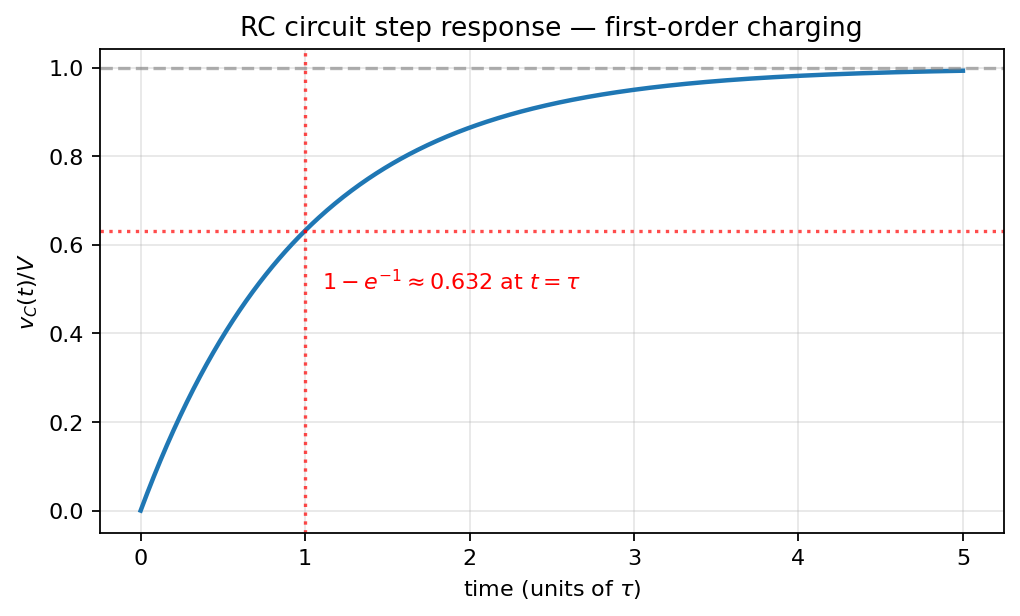 RC charging reaches % of the final value at .
For a decaying exponential :
- At : .
- At : .
- At : , signal settled for practical purposes.
The “five time constants to settle” rule of thumb shows up everywhere from circuit design to thermal analysis.
In an RC circuit
For an RC circuit, the time constant is
with in ohms and in farads. A resistor with a capacitor has . The step response of the capacitor voltage is : rises rapidly at first, then asymptotes to over roughly .
For an RL circuit, .
Connection to poles
A first-order system with impulse response has transfer function and a single pole at . The cutoff frequency of the associated lowpass filter is rad/s. So the time constant, the pole location, and the cutoff frequency are three views of the same thing.
A short time constant means a pole far from the imaginary axis (system reacts quickly, broad bandwidth); a long time constant means a pole close to the imaginary axis (system reacts slowly, narrow bandwidth). This is the time-bandwidth tradeoff in its simplest form.