Resonance occurs when a system is driven at its natural frequency, i.e. the input matches the frequency the system “wants to” oscillate at. Without damping, the response grows unbounded. With damping, it grows to a large but finite amplitude.
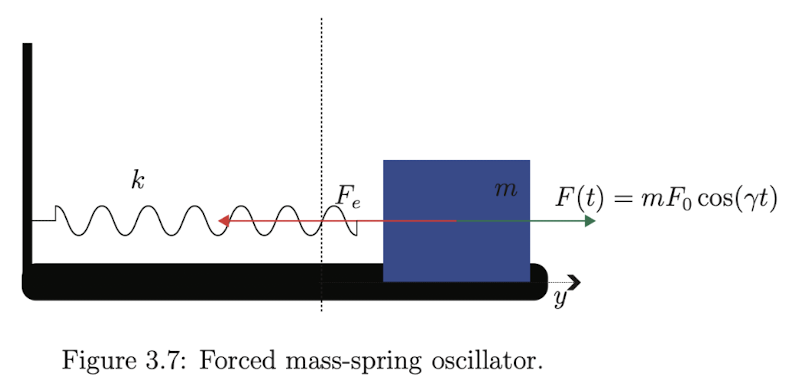
For an undamped mass-spring oscillator driven sinusoidally:
where:
- is the natural frequency, the system’s own oscillation frequency.
- is the forcing frequency, the rate at which the driver pushes.
Resonance happens when .
Non-resonant case ()
For different frequencies, the particular solution has the standard form .
Computing: . Substituting:
So , . Particular solution:
The amplitude blows up as .
The full solution:
Resonant case ()
The non-resonant formula breaks: division by zero. The forcing term matches a homogeneous solution. The standard guess is part of already, so it can’t yield a new particular solution.
Modification: multiply the guess by . Try
Computing derivatives:
Substituting:
(The -dependent terms cancel.) Equating to :
So , . The resonant particular solution:
The amplitude grows linearly with time: the factor dominates the bounded sine. As , . The system absorbs energy from the driver continuously, with no mechanism to dissipate it.
Why resonance is dramatic
Each oscillation of the forcing pushes the system in the same direction as its natural motion. The “kicks” add up coherently, and amplitude grows.
Compare with off-resonance: a forcing slightly faster or slower than the natural frequency goes in and out of phase with the oscillator, sometimes pushing forward, sometimes backward. The pushes don’t add up, they average out, and the response stays bounded.
With damping
Real systems have friction. The resonance equation becomes:
with the damping ratio. The solution near resonance has amplitude
The amplitude evaluated at is — large but finite. This is not the maximum, though, even for small damping. Differentiating with respect to and setting the derivative to zero gives the actual peak at
(real-valued only when ; for higher damping the response decreases monotonically with , no peak). At this true resonant frequency, the peak amplitude is
For very small , both and the peak , so the ”, value ” approximation is fine in that limit. But for moderate damping, the true peak sits noticeably below the natural frequency.
The smaller the damping, the larger the resonant amplitude, and the closer the peak frequency to the natural frequency.
Resonance in the world
- Tacoma Narrows Bridge (1940): wind-driven oscillations matched a torsional mode, growing until the bridge collapsed. The textbook resonance disaster.
- Wine glass shattering at a singer’s pitched note: the glass has a natural frequency; sustained tones at that frequency drive vibration past the breaking strain.
- Radio receivers: tune the LC circuit’s resonant frequency to match the broadcast frequency. Resonance amplifies the desired signal while non-resonant frequencies barely register.
- MRI machines: nuclear magnetic resonance — protons in a strong magnetic field absorb radio waves at a specific frequency that matches their precession.
- Earthquakes: buildings have natural frequencies; shaking at those frequencies (or harmonic submultiples) drives them to amplitude that can collapse them. Tuned mass dampers in skyscrapers absorb resonant energy.
More general principle
Whenever the forcing function in a linear ODE matches a homogeneous solution, you get resonance behavior. The fix is the same: multiply the guess by (or higher powers). See Method of undetermined coefficients for the general modification rule.