Faraday’s law states that a time-varying magnetic flux through a loop induces an electromotive force (emf) around the loop:
For a coil with turns enclosing the same flux per turn:
The minus sign is Lenz’s law: the induced emf drives a current whose magnetic field opposes the change in flux. Energy conservation in disguise. Without it you could extract infinite energy from a changing flux.
Sign convention (often glossed over): pick a direction for the surface element used to compute . Then traverse the loop in the right-hand-rule sense, fingers curl in the loop direction, thumb in . With this paired choice, as written; reverse one of the two choices and the sign flips. The physics doesn’t change, only the bookkeeping.
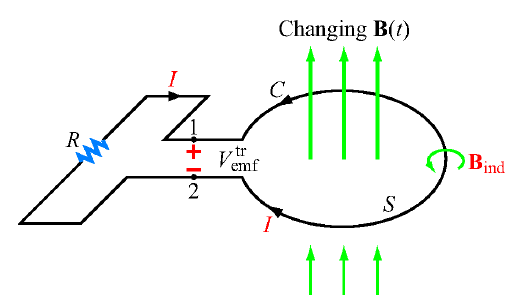 A stationary loop in a time-varying field. The induced emf drives a current through the external resistor; from this current opposes the original change.
The differential form, one of Maxwell’s equations:
A changing magnetic field creates a curling (non-conservative) electric field. In time-varying problems, is no longer the gradient of a scalar, so the closed-loop integral of is nonzero.
Three ways flux changes
The flux can change in three ways. Each gives a named contribution to the emf:
1. Transformer emf : loop is stationary, varies in time.
This is the mechanism behind transformers: a time-varying current in the primary creates a time-varying that links the secondary, inducing there.
2. Motional emf : is static, but the loop moves or changes shape so the linked area changes.
with the velocity of the conductor element . This is the mechanism behind generators: rotating a coil in a static field creates motional emf.
3. Combined: loop moves through time-varying field. Both contributions add:
The decomposition above is for a conducting loop where the EMF is what drives charges around the wire. For a purely mathematical (non-conducting) loop, the rigorous statement is computed in the lab frame, with accounting for both the changing field and the moving/deforming surface. The conducting-loop split into transformer + motional pieces follows from the total derivative and matches what you’d measure with a voltmeter.
Worked example: stationary inductor in oscillating field
A circular loop of turns, radius , in the -plane, connected to a resistor . External field .
Only the component flows through the loop (the component is parallel to the loop plane). Flux per turn:
Transformer emf:
For , cm, T, rad/s: V.
Induced current: A for kΩ.
Why the minus sign
If the induced current’s reinforced the change in flux, the current would grow without bound — an infinite-energy violation. Lenz’s law’s sign ensures induced effects always oppose the cause, like inertia.
Operationally: if is increasing in , the induced current flows clockwise when viewed from (right-hand rule), producing in inside the loop — opposing the increase.
In the integral Maxwell’s equation
This is the integral form of Faraday’s law for a stationary loop. For a moving or deforming loop, the left side picks up the motional emf contribution. Maxwell’s equations are written for a fixed frame, but the line integral around a moving loop in that frame includes the motion effects automatically.
The closed-loop integral of being nonzero is what distinguishes dynamic from electrostatic problems. In statics, everywhere and the electric field is a gradient. In dynamics, acquires a “rotational” piece that’s not a gradient.