The intrinsic carrier concentration is the number of free electrons (equivalently, of holes) per unit volume in pure, undoped semiconductor at thermal equilibrium. In an Intrinsic semiconductor electrons and holes appear in pairs, so , and sets the baseline that all doped material still obeys through the Mass-action law.
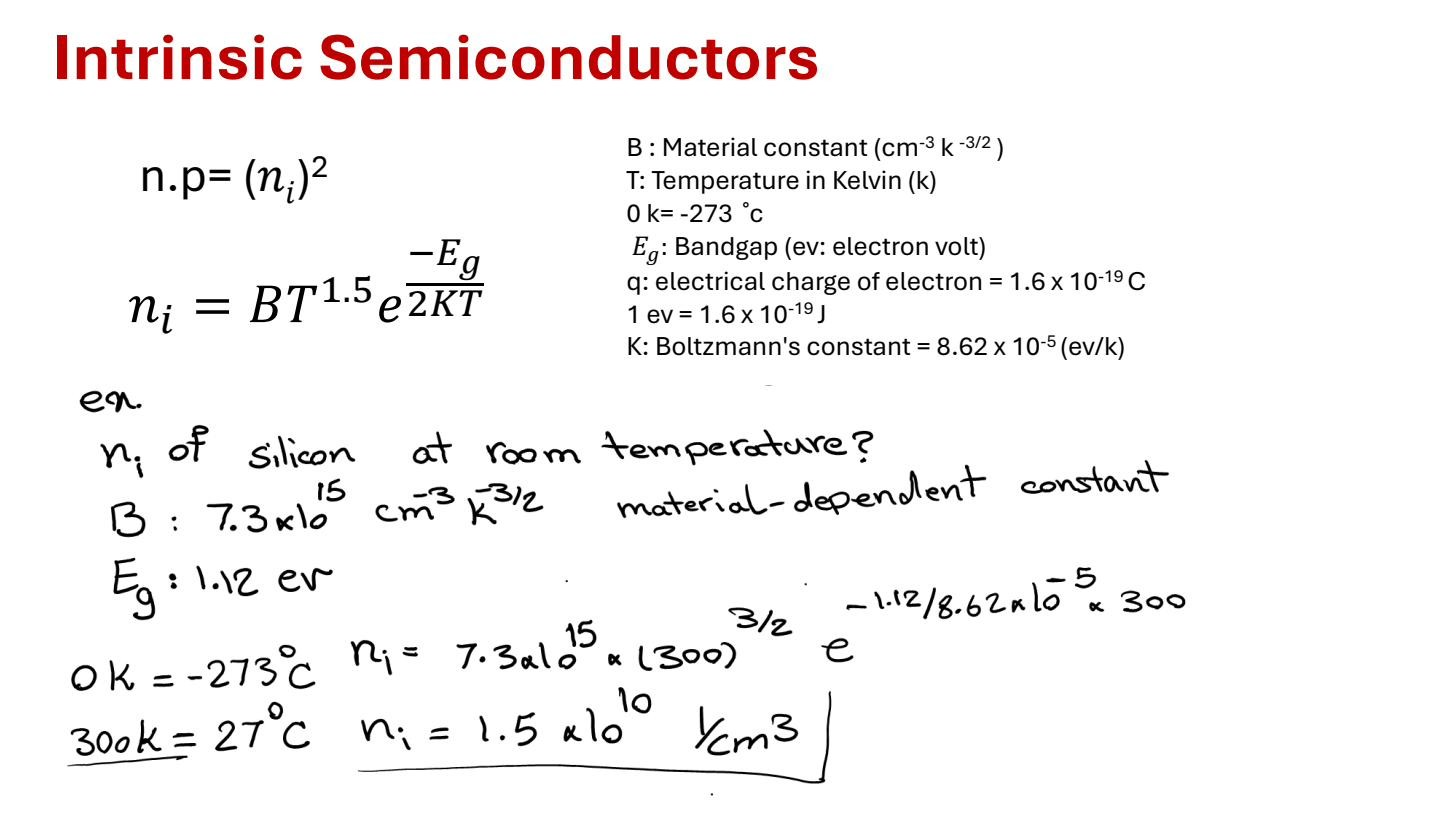
The formula
where:
- is the absolute temperature in kelvin.
- is the Bandgap energy (for silicon, ).
- is the Boltzmann constant, (equivalently ).
- is a material-dependent constant; for silicon .
The exponential Boltzmann factor is the probability that thermal energy is enough to break a bond and create a pair. It dominates, and it’s wildly temperature-sensitive. The prefactor counts how many quantum states the carriers can occupy and varies slowly by comparison. The exponent uses rather than because each generation event makes a pair, so the activation energy is split between the electron and the hole.
Worked example: silicon at room temperature
Plug in the canonical values: , , .
First the thermal energy: .
The exponent:
so the Boltzmann factor is .
The prefactor: , so .
Multiply:
which is the canonical room-temperature value for silicon.
How small that really is
Silicon has roughly atoms per cm³. With , only about one atom in has donated a free carrier. That’s why intrinsic silicon barely conducts, and why even a modest dose of Doping (donor or acceptor atoms at, say, ) swamps the intrinsic carriers by a factor of a million and dominates the conductivity.
Temperature sensitivity
Because sits inside an exponential, depends enormously on temperature: warming silicon from to about raises by several orders of magnitude. This is why semiconductor devices are temperature-sensitive. Leakage currents, carried by carriers proportional to , climb steeply with heat. The product at any temperature is fixed at by the Mass-action law, and the same scaling reappears as the Thermal voltage in junction equations.
 depends strongly on temperature through the Boltzmann factor .