P-type semiconductor is silicon doped with group III impurities so that mobile positive holes heavily outnumber free electrons. The “p” is for the positive majority carrier. Complement of n-type material; the two together form a PN junction.
How it is made
Silicon is group IV with four valence electrons. Introduce a small concentration of a group III element (typically boron or aluminium) and each impurity substitutes for a silicon atom but brings only three valence electrons. It completes only three of the four bonds with its silicon neighbours; the fourth bond is missing an electron. That incomplete bond accepts an electron from an adjacent silicon–silicon bond to complete itself, which leaves the donor bond short an electron. That’s a mobile hole that wanders through the crystal by successive electron hops.
Because each group III atom accepts an electron this way, it’s called an acceptor, and its concentration is written (acceptors per cm³). When an acceptor grabs an electron it becomes a fixed, negatively-charged ionised acceptor locked in the lattice.
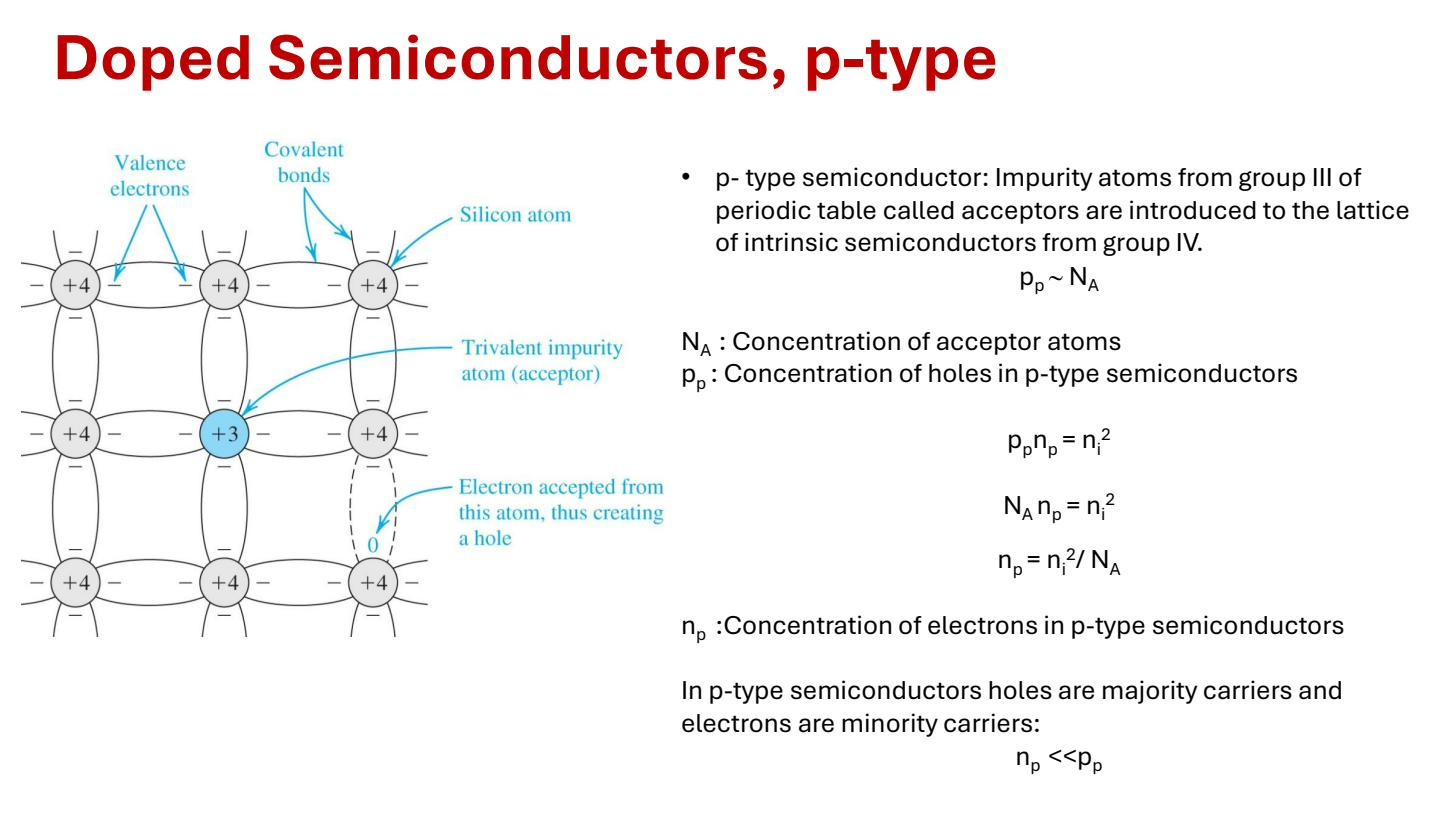 Group III impurities (boron, aluminium) accept electrons from neighbouring Si bonds, creating mobile holes.
Carrier concentrations
At normal temperatures every acceptor is ionised, contributing one hole. When (the Intrinsic carrier concentration), the doping sets the hole concentration:
and the electron concentration is forced down by the Mass-action law :
Worked example: silicon with and gives and
Holes outnumber electrons by about to one. Holes are the majority carrier, electrons the minority carrier.
Charge neutrality
P-type silicon is electrically neutral overall: each mobile hole is balanced by a fixed negative acceptor ion left behind when the acceptor captured an electron. Plenty of mobile positive charge but no net charge on the material. At a junction this balance breaks where holes diffuse away, uncovering the fixed negative acceptors that form part of the Depletion region.