A semiconductor conducts electricity somewhere between a conductor and an insulator, and that conductivity can be controlled. The controllability, not the raw conductivity, is what makes diodes and transistors possible, and why nearly all modern electronics is built from one semiconductor: silicon.
Conductor, insulator, semiconductor
What determines whether a material conducts is how tightly it holds its outermost (valence) electrons:
- A conductor like copper has a sea of loosely bound valence electrons that drift freely the instant an electric field is applied. Lots of mobile charge, always available.
- An insulator like glass binds its electrons tightly to their atoms. Almost none are free, so it conducts essentially nothing.
- A semiconductor sits in between. Its valence electrons are bound, but only just. A small amount of energy (heat, light, or a deliberately added impurity) frees enough of them to make the material conduct usefully.
The reason for this three-way split is the band structure of the material: conductors have overlapping (zero-gap) bands, insulators a wide forbidden Bandgap, and semiconductors a moderate one ( for silicon).
Why controllability is the point
Pure (intrinsic) silicon is a poor conductor on its own. The useful trick is that we can dial in the number of free charge carriers, and even which sign of carrier dominates, by adding tiny controlled amounts of impurity. This is Doping. Dope one region to have surplus electrons (n-type) and an adjacent region to have surplus holes (p-type) and you get a PN junction, the building block underneath every Diode and Transistor in this course. No other class of material lets you engineer conductivity locally and reproducibly like this, which is why the whole industry runs on it.
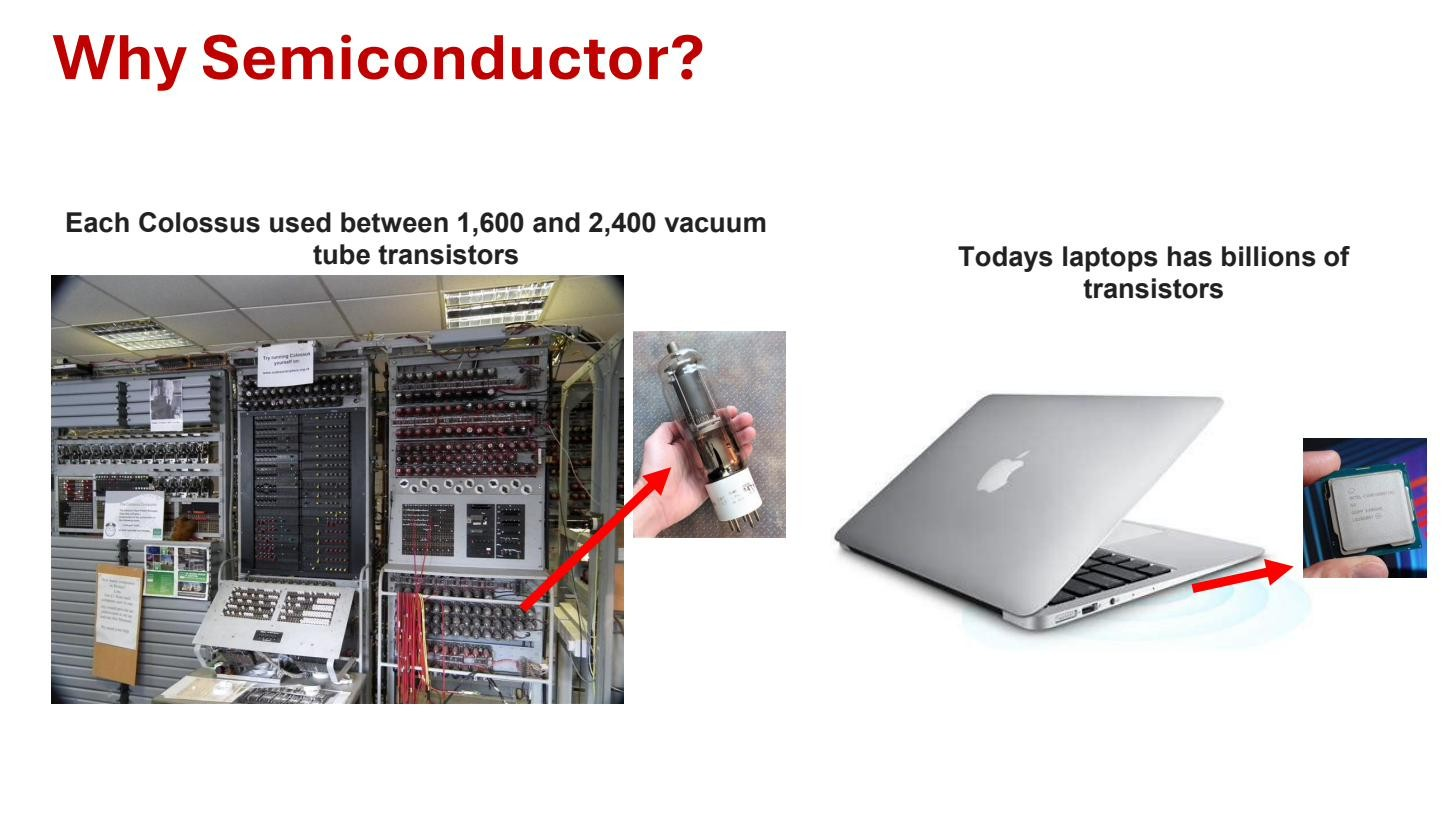 Modern silicon chips contain billions of transistors; each Colossus computer used 1,600–2,400 vacuum tubes to do far less.
Silicon
Silicon is the workhorse semiconductor. It is in group IV of the periodic table, so each silicon atom has four valence electrons. In a silicon crystal each atom shares those four electrons in covalent bonds with four neighbours, locking every valence electron into a bond at low temperature. The group-IV count matters directly for doping: a group V impurity has one extra electron beyond what bonding needs (a donor), and a group III impurity has one too few (an acceptor). That one-electron mismatch is the whole doping mechanism. Silicon also conveniently grows a stable insulating oxide, which is why it, rather than germanium or other semiconductors, dominates manufacturing.