The case of a symbol and the case of its subscript tell you whether it’s a DC bias, total instantaneous, or small-signal AC quantity. Every transistor textbook uses this, and getting it wrong means confusing a bias point with a signal.
A transistor in an amplifier carries a small AC signal riding on top of a DC bias. At the gate-source terminal, the total voltage at any instant is
the DC bias plus the small wiggle. Three different quantities, three different notations:
| Notation | Case pattern | Meaning | Example |
|---|---|---|---|
| , | UPPER symbol, UPPER subscript | DC (bias / quiescent) value | the operating point |
| , | lower symbol, UPPER subscript | total instantaneous value | DC + AC combined, as a function of time |
| , | lower symbol, lower subscript | small-signal AC part only | the wiggle alone |
So reads: total instantaneous = DC + small-signal. The same pattern holds for currents: .
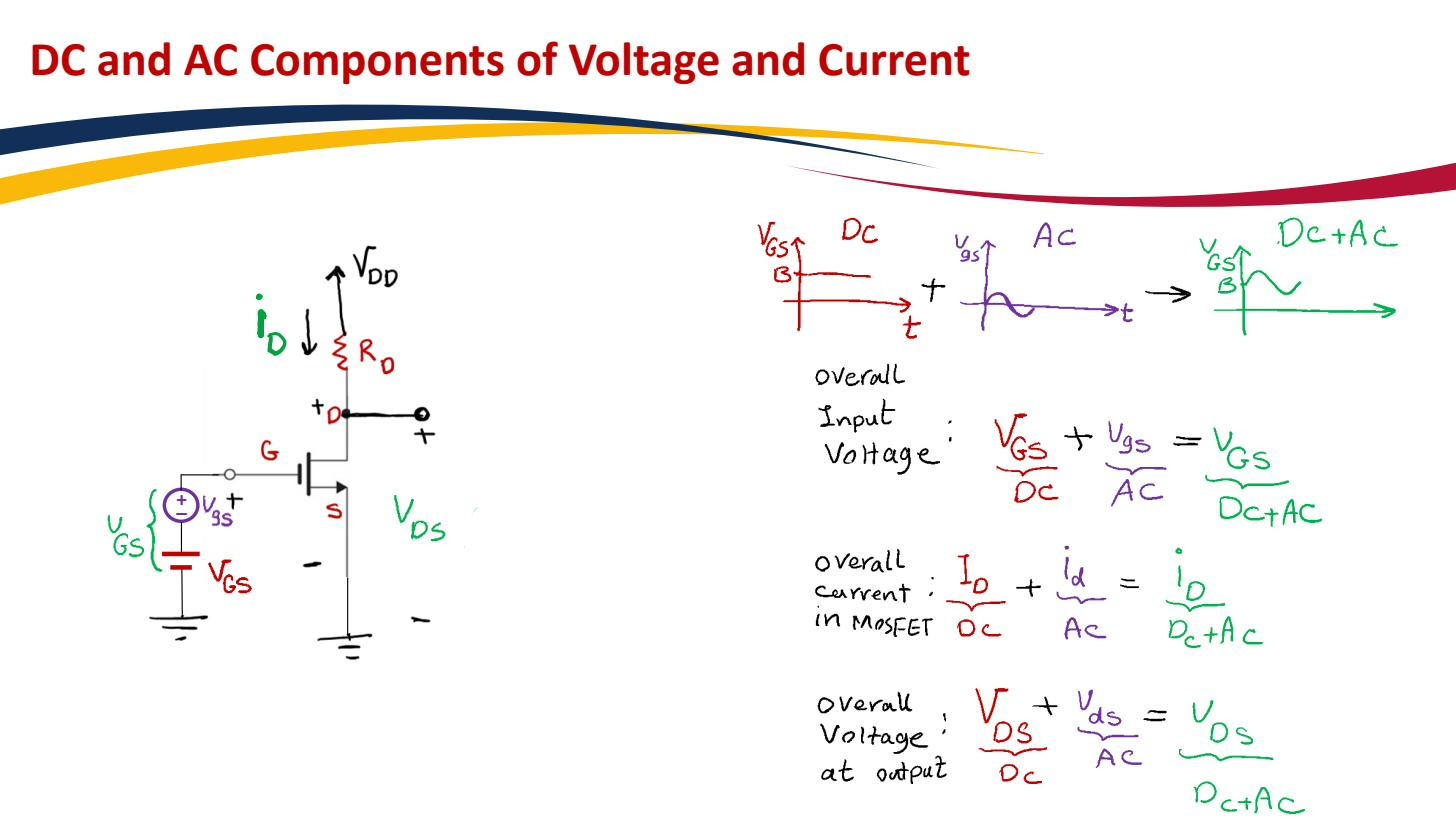 DC, small AC, total.
Why the distinction is load-bearing
Small-signal analysis depends on separating these. You first solve the uppercase circuit (DC only, the Operating point, using the MOSFET large-signal model). Then you solve the lowercase circuit (AC only, DC sources zeroed). The relations differ: the DC current obeys the nonlinear MOSFET square-law , while the AC current obeys the linear . Writing when you mean , or when you mean , silently mixes a nonlinear bias equation with a linear signal one. Read the cases before reading the symbol.