The transconductance is the small-signal gain of the MOSFET itself: how much AC drain current you get per volt of AC gate-source voltage. It’s the slope of the MOSFET transfer characteristic at the operating point, and the single parameter that makes the transistor amplify.
Linearising the square-law
The MOSFET’s big-signal control law is the MOSFET square-law . Put a small signal on top of the DC bias, (notation per Transistor signal notation convention), and expand:
Recognising and :
The first term is the DC bias current. The second is linear in , the wanted signal. The third is quadratic: distortion. Drop the quadratic term provided it’s much smaller than the linear one, i.e.
This is the small-signal condition: the input swing must be much less than twice the Overdrive voltage. Under it,
a clean linear relation. The proportionality constant is the transconductance .
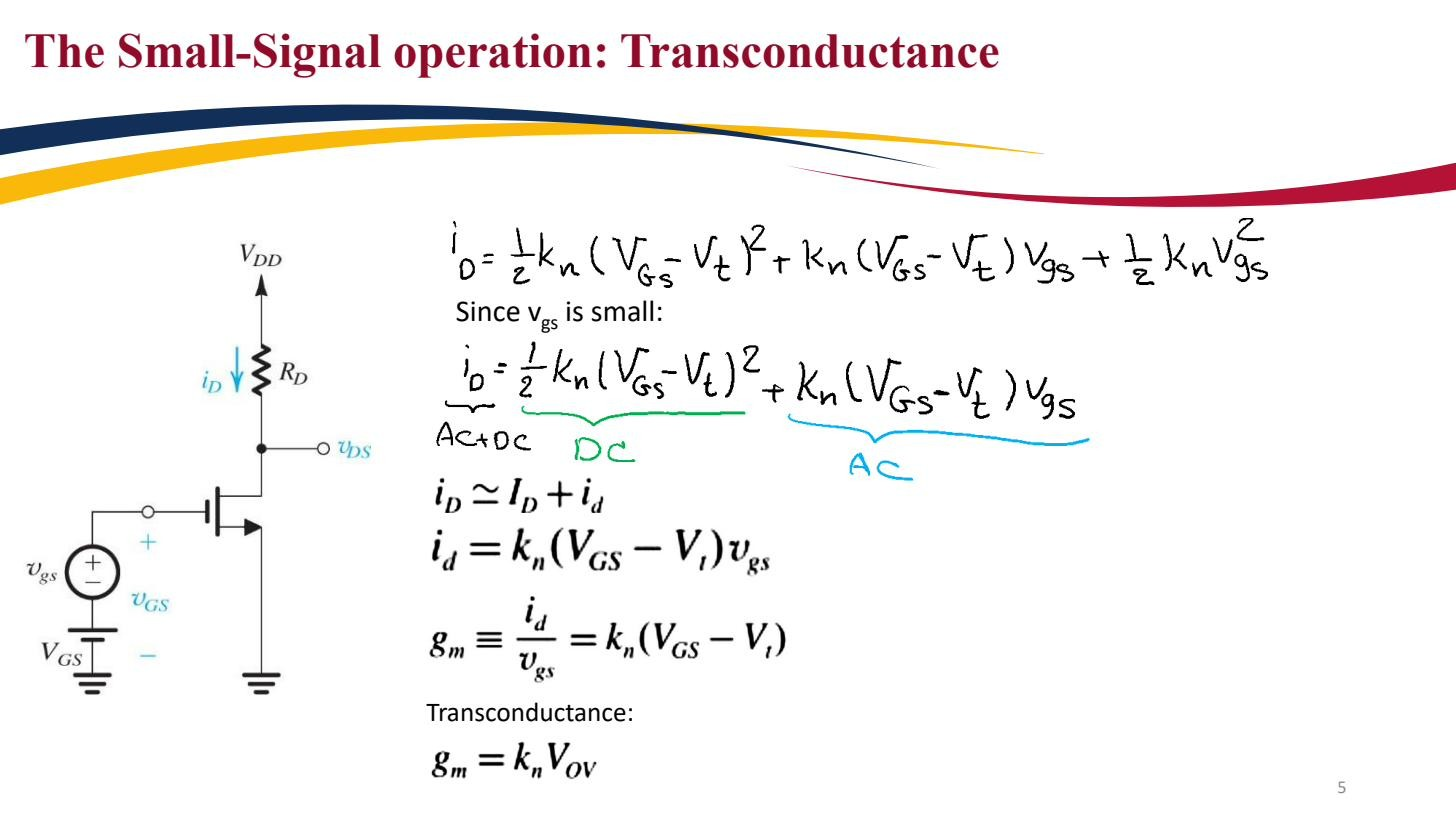 For small the curve looks straight, slope ; valid when .
Three equivalent forms, and when to use each
These are algebraically identical (substitute to convert between them), but you reach for different ones depending on what the problem hands you:
- — when you know the overdrive and the device parameter (the MOSFET transconductance parameter).
- — when you know the bias current and overdrive. The cleanest form for design intuition.
- — when you know the bias current but not (depends on and only).
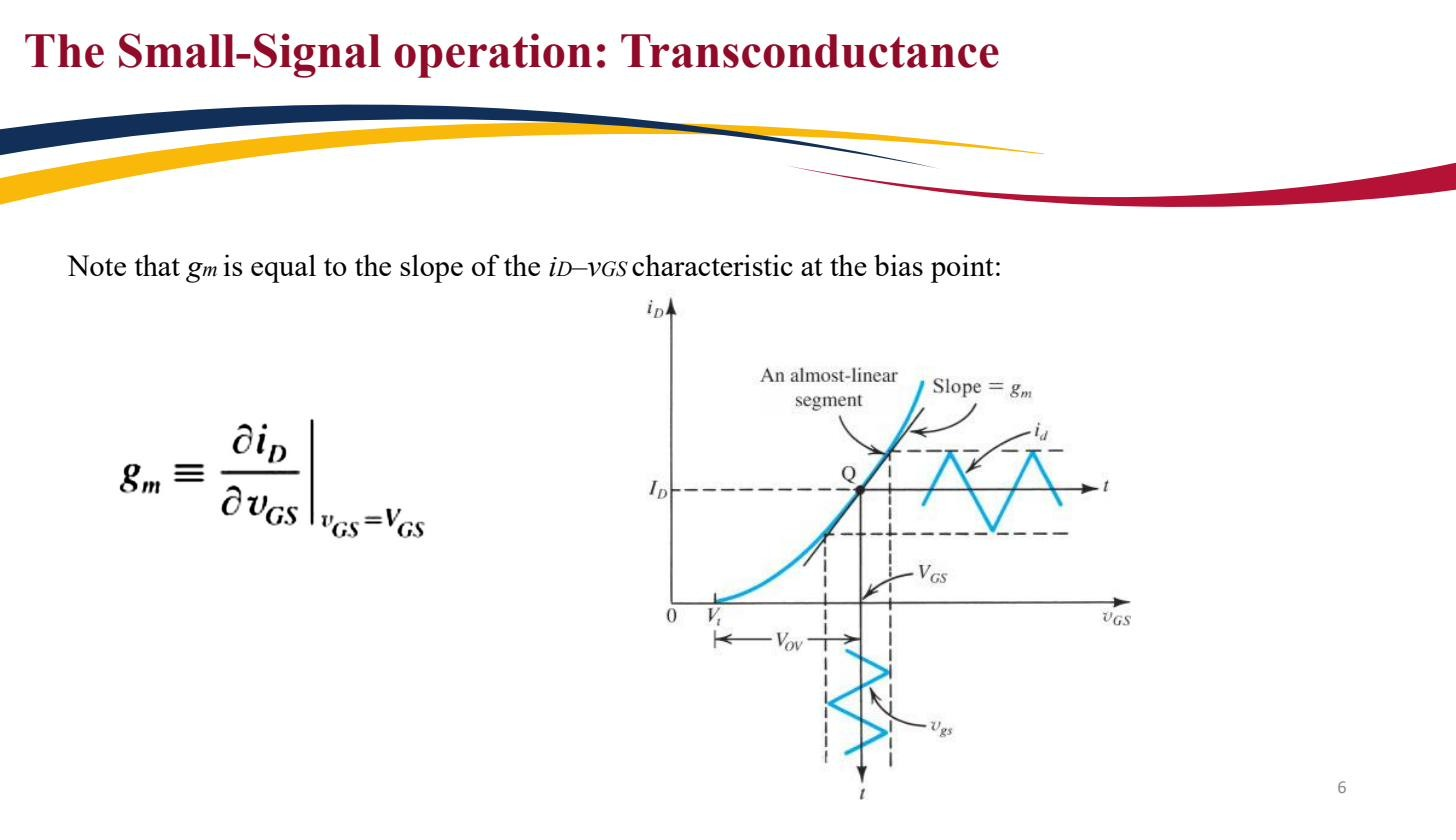 = slope of – at the bias point; three equivalent forms.
The design trade-off baked into
Read . At a fixed bias current , a lower gives a higher , hence more voltage gain, since a Common-source amplifier has . So you’d like a small overdrive. But a small shrinks the headroom (the device needs to stay in saturation) and tightens the linear range (the condition above is ). High versus headroom/linearity/bandwidth is the central tension in analogue MOSFET design, and the reason you sometimes deliberately throw gain away with Source degeneration.