The voltage-transfer characteristic (VTC) of a resistor-loaded MOSFET stage plots output voltage against input voltage . Connect the drain to through a resistor , sweep , and watch . The curve has three regions, one for each MOSFET region of operation, and reading it shows where the stage amplifies and where it clips.
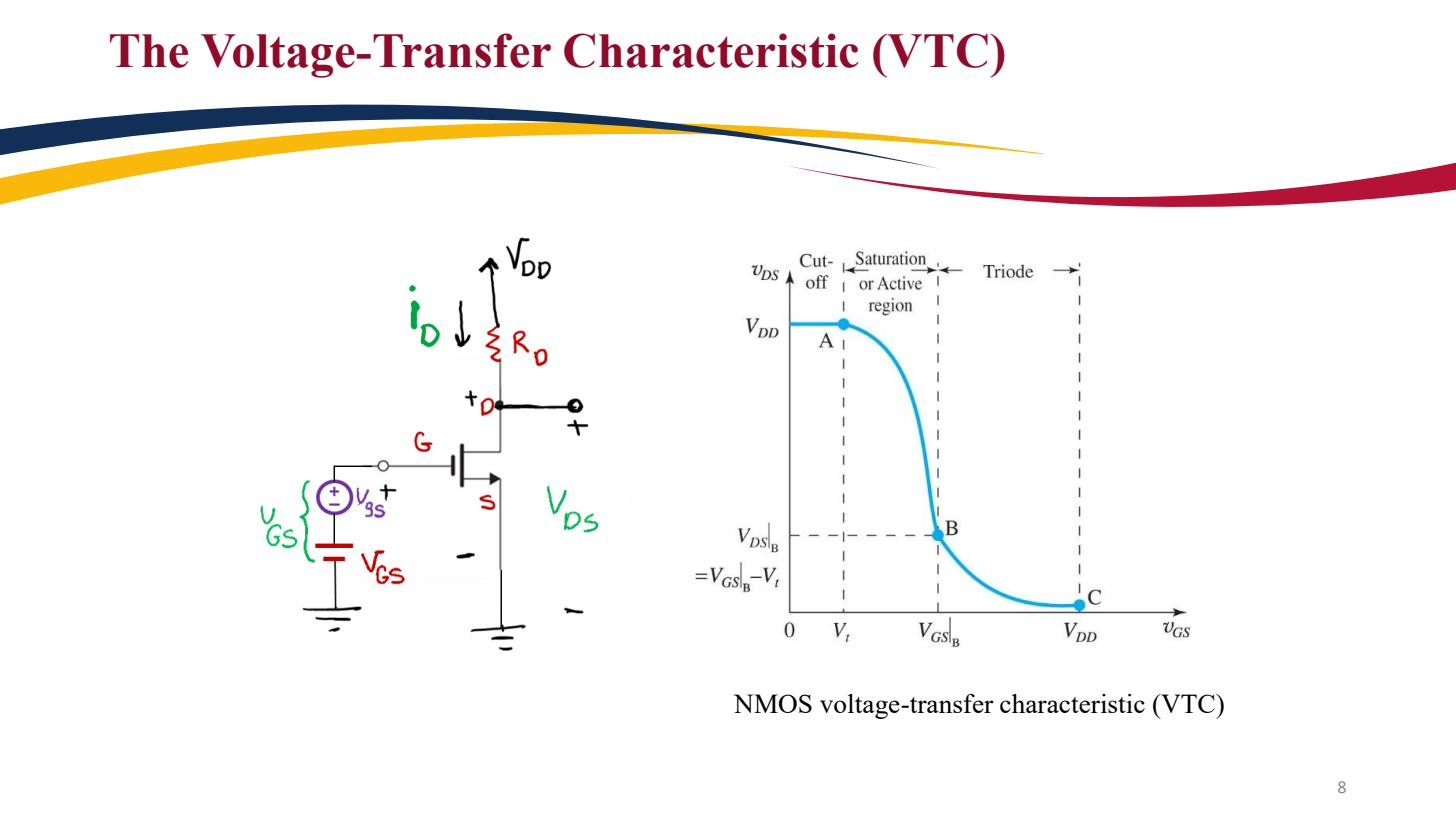 Output vs input : cut-off, saturation (amplifying), triode.
The three regions
- Cut-off (): the MOSFET is off (MOSFET cut-off region), no current, no drop across , so the output sits flat at the top:
- Saturation (, ): the device is a -controlled current source (MOSFET saturation region). With flowing through :
The output drops quadratically with the input. This is the steep middle of the curve, the active region where amplification happens.
- Triode (): the device is on hard (MOSFET triode region), is small, and further increases in produce only tiny additional drops. The curve flattens out near ; the output is “saturated low.”
Here is the Threshold voltage, the Overdrive voltage, and the device MOSFET transconductance parameter.
The slope is the gain
For a small input wiggle around a bias point in the saturation region, the output wiggle is the input times the slope of the VTC at . Differentiate the saturation expression:
using (the MOSFET transconductance). So the small-signal gain is literally the slope of the VTC at the Operating point, exactly the Common-source amplifier result, now seen as the local steepness of this curve.
This is also why bias-point placement matters: must sit on the steep saturation portion with enough room on both sides for the signal to swing without sliding into the flat cut-off plateau (clipped at ) or the flat triode plateau (clipped near 0). For maximum symmetric swing, goes roughly at the midpoint of the saturation segment.