The triode region (also called the linear or ohmic region) is the MOSFET operating mode where a channel is formed end-to-end and the device behaves like a gate-controlled resistor. The conditions are
i.e. the gate is above Threshold voltage so a channel exists, but the drain-to-source voltage hasn’t reached the Overdrive voltage , so the channel is still continuous from source to drain (not yet pinched off).
The drain-current equation
In triode the drain current is
where is the process MOSFET transconductance parameter, the channel width-to-length ratio, the overdrive, and the drain-source voltage. The combination is the device transconductance parameter, so this is also .
Read the equation. For a fixed (fixed ), rises with , but the term bends the curve over: the current grows quickly at first, then flattens as approaches . At the slope goes to zero and the curve hands off smoothly to the flat saturation characteristic. That continuity is why setting here yields the MOSFET square-law.
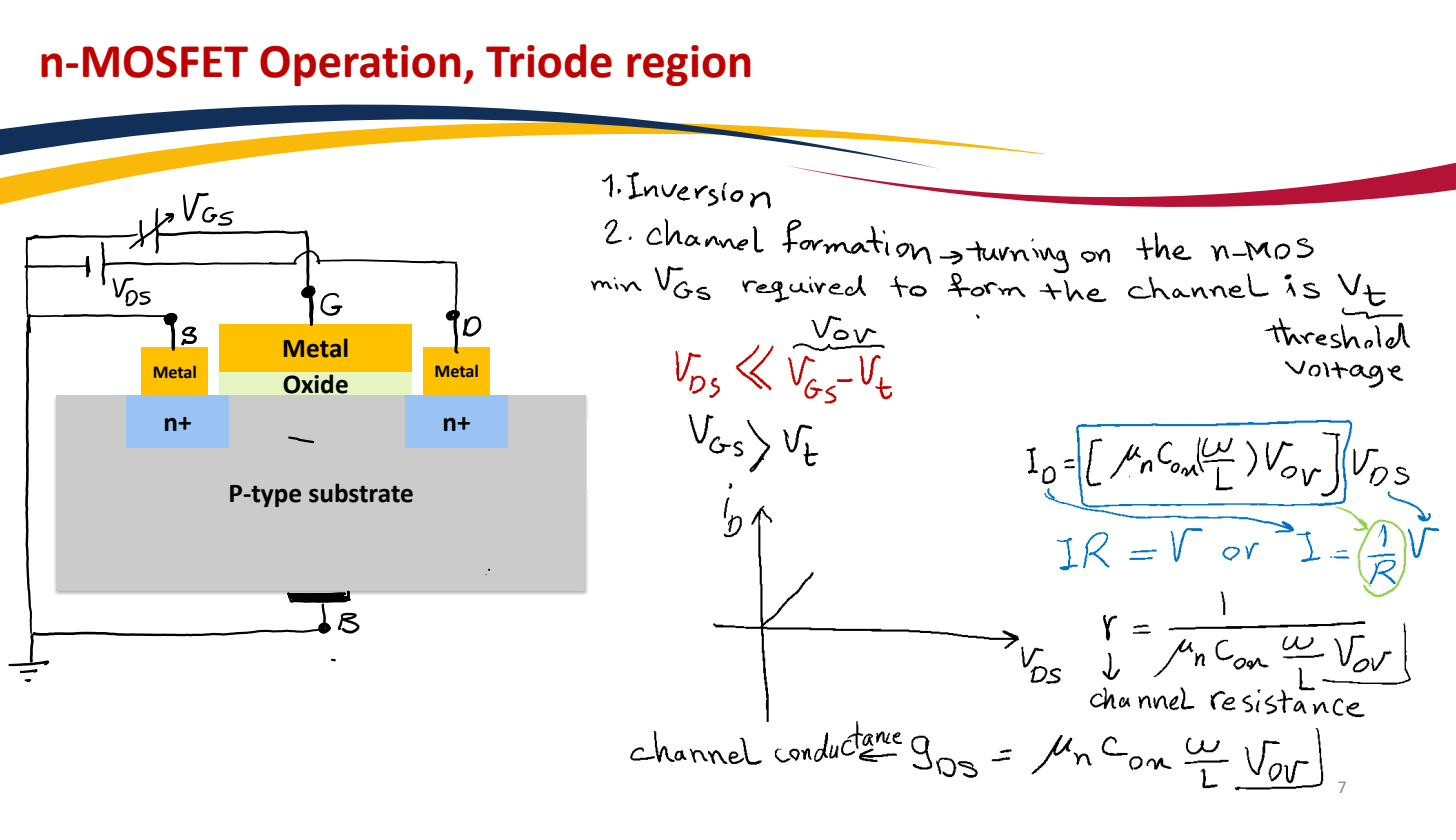 Channel fully formed; for small the device is a gate-controlled linear resistor.
The voltage-controlled-resistor limit
For small the quadratic term is negligible next to , so
This is Ohm’s law: is proportional to , with a channel resistance
That resistance is tunable by the gate. Raising raises and lowers . The MOSFET in triode is a voltage-controlled resistor.
What it is used for
The triode region is the on-state of digital logic (a transistor pulling an output hard toward a rail is a small on-resistance to that rail), and it is what makes MOSFET analog switches and transmission gates work: close the switch by driving the gate hard so is small, open it by dropping below into cut-off. For amplification you don’t want triode, you want saturation, where is set by and is nearly independent of .