A MOSFET sits in one of three regions depending on its terminal voltages. Each region has its own note; this one ties them together.
| Region | Condition | Behaviour |
|---|---|---|
| Cut-off | No channel, . Device off. | |
| Triode | and | Channel formed end-to-end. Gate-controlled resistor. |
| Saturation | and | Channel pinched at drain. Voltage-controlled current source, used for amplification. |
Here is the Threshold voltage and the Overdrive voltage.
How to identify the region
Two questions, in order:
- Is ? If no, cut-off, done, . If yes, a channel exists; continue.
- Is ? If yes, the channel is pinched off at the drain (Channel pinch-off) and you’re in saturation. Use the MOSFET square-law . If no, the channel is still continuous and you’re in triode, so use .
Same idea drives the DC-analysis recipe: in MOSFET DC analysis you assume saturation, solve, then check whether actually holds; if it doesn’t, redo in triode.
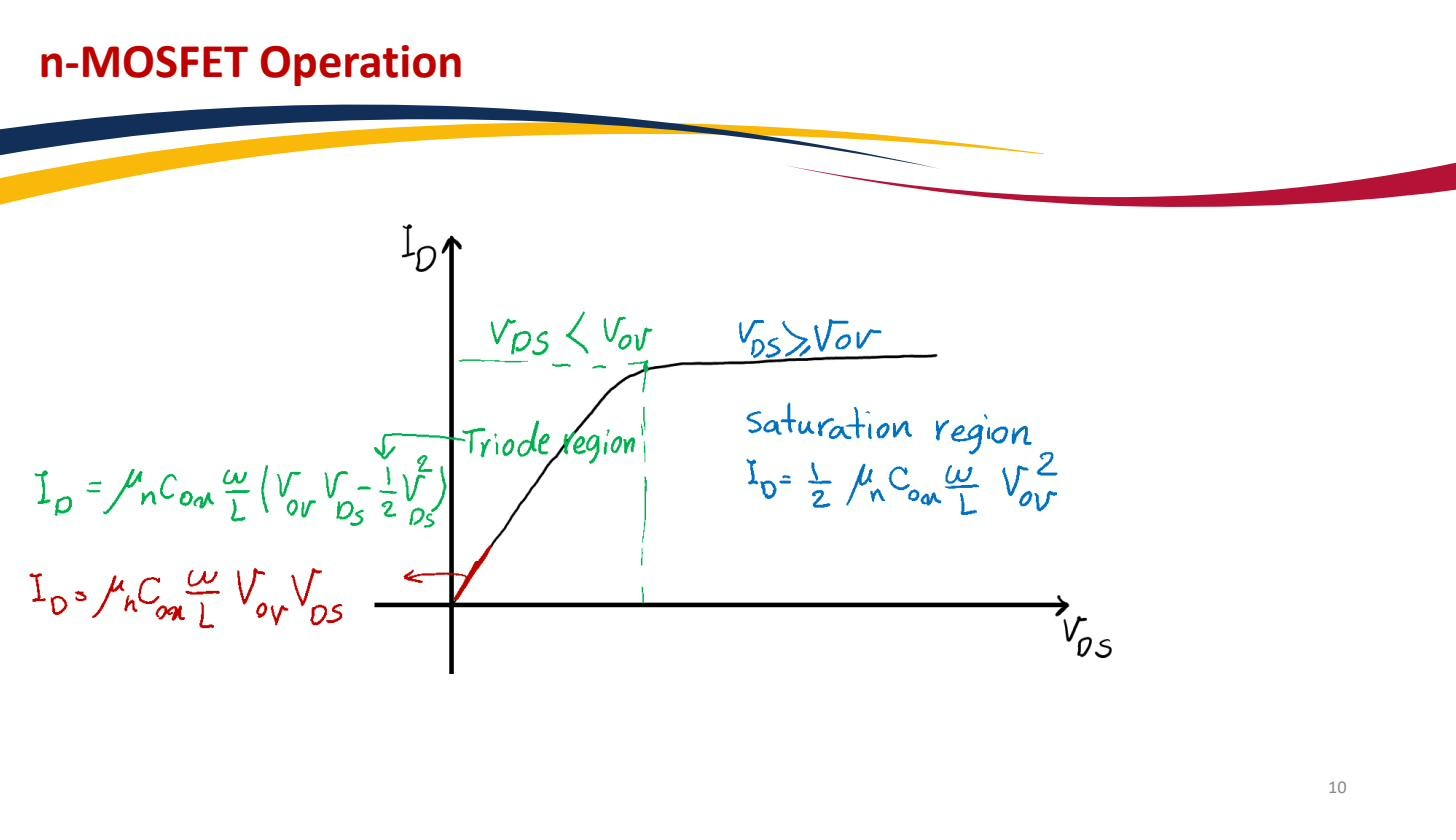 vs for one : triode below , saturation above.
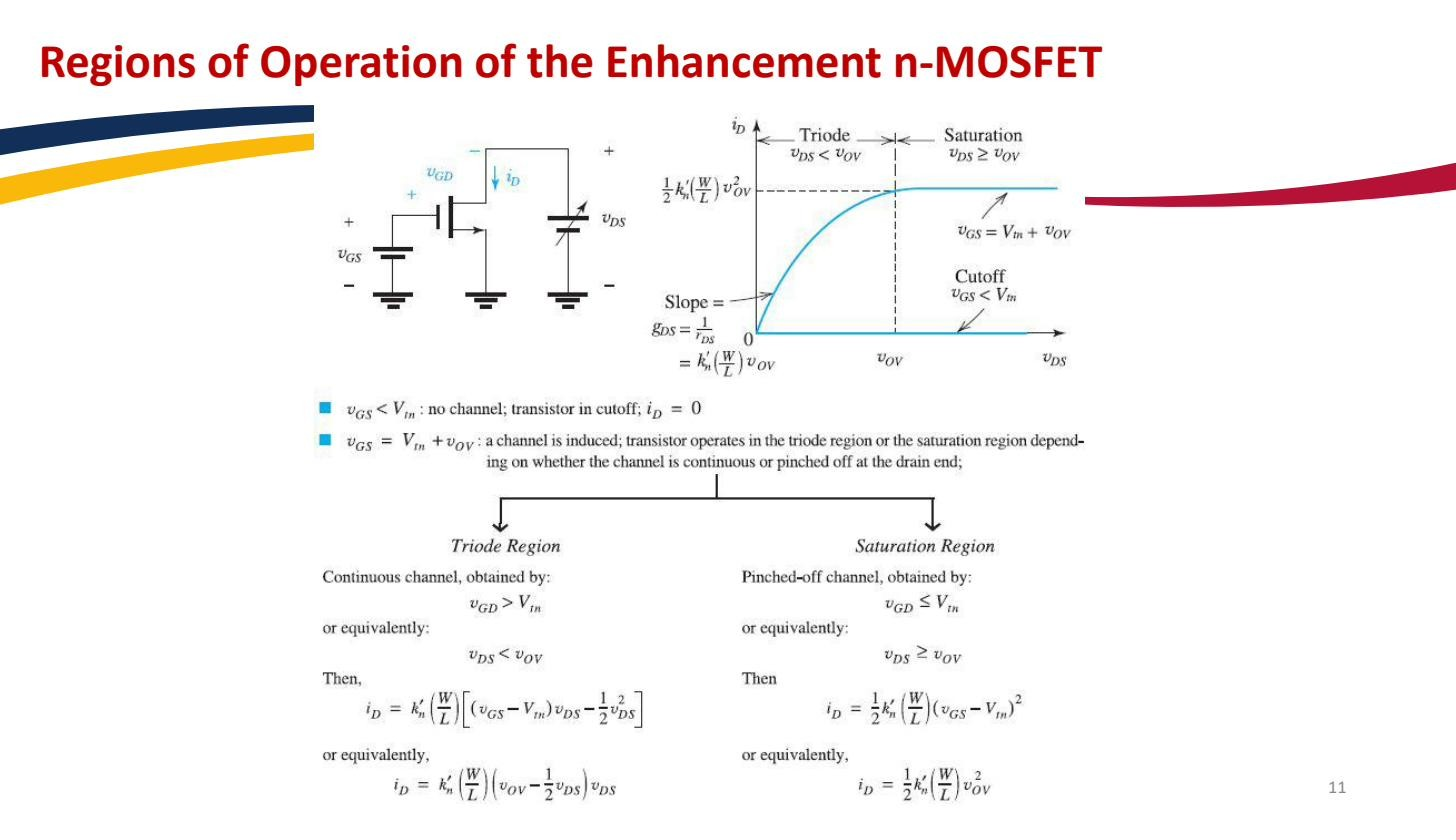 Regions of the enhancement n-MOSFET: cut-off, triode, saturation.
The p-MOSFET: same three regions, via magnitudes
A p-MOSFET has the same three regions, but all the controlling voltages (, , ) are negative. Rather than juggle signs, work in magnitudes:
- Cut-off: .
- Triode: and .
- Saturation: and .
with the p-MOSFET threshold and . The physics mirrors the n-MOSFET: holes instead of electrons, n-substrate instead of p, and a negative gate voltage to turn it on.
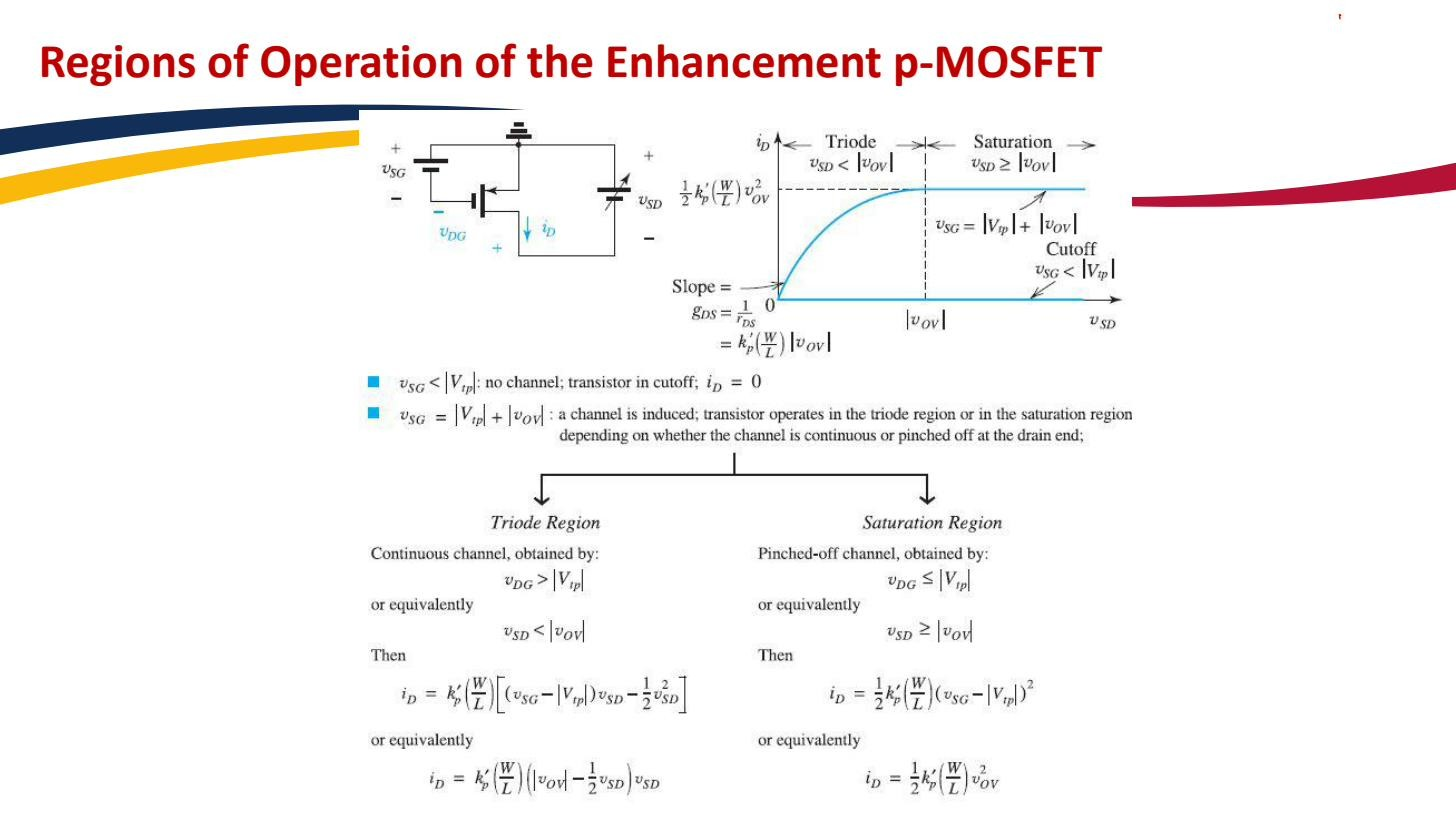 p-MOSFET regions: same three, inverted polarities ( negative).