A field-effect transistor (FET) is a Transistor where a voltage on the gate sets up an electric field that controls the conductivity of a current-carrying channel between the other two terminals. Control is by field, not by current: the gate ideally draws no steady current at all.
How this differs from the BJT
The contrast with the BJT is the thing to internalise. A BJT is current-controlled: you push a small base current in to get a large collector current out, and that base current is a real, non-zero current the driving circuit has to supply. A FET is voltage-controlled: the gate is (in the MOSFET case) electrically insulated from the channel, so steady-state gate current is near zero. You spend no DC power steering the device, and the input looks like an almost infinite resistance. Only one carrier type carries the channel current, electrons in an n-channel device or holes in a p-channel device, which is why FETs are “unipolar” versus the “bipolar” BJT where both electrons and holes participate.
The family
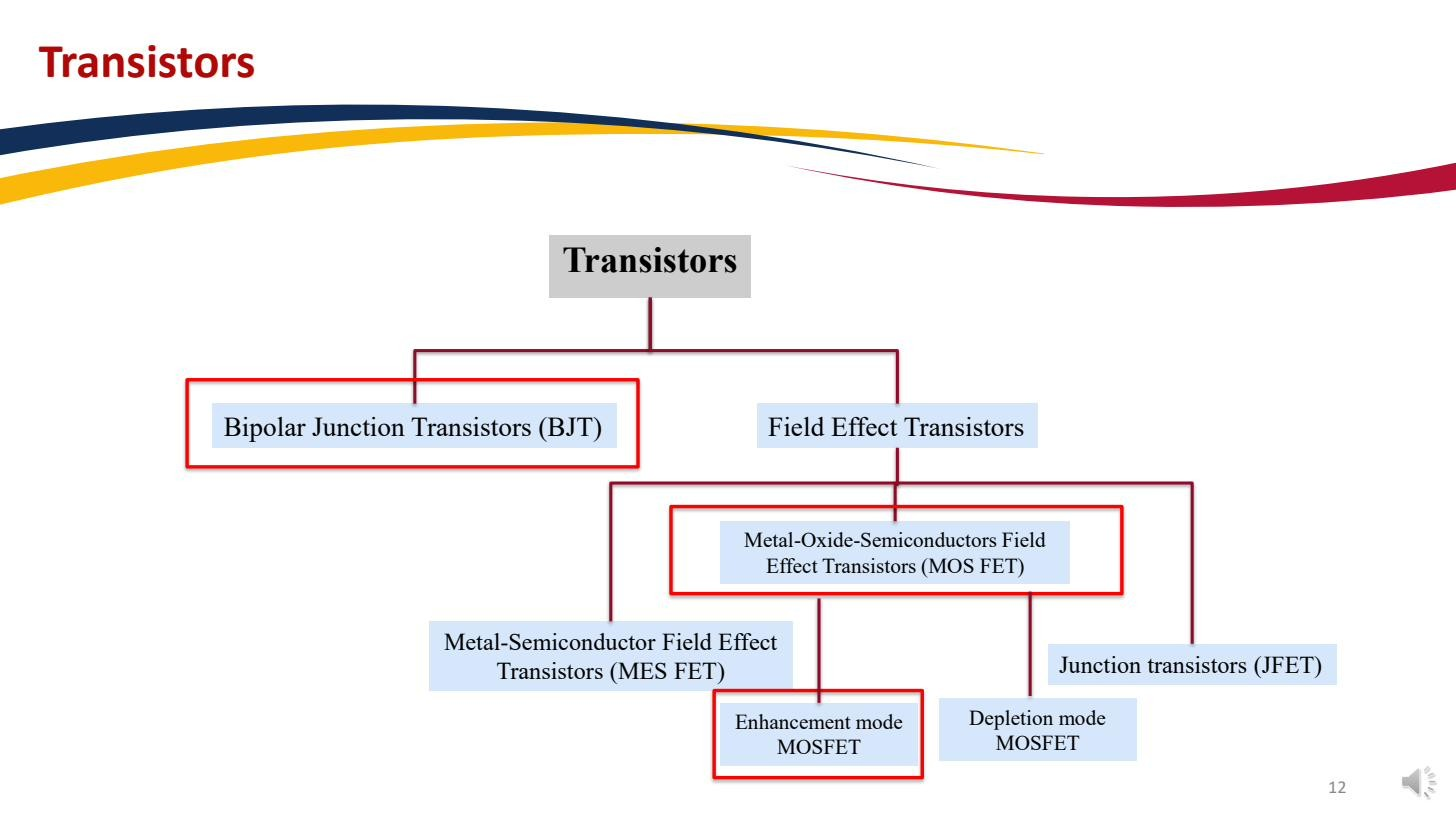 BJTs vs FETs; the MOSFET is the most important FET.
Several FET types exist:
- JFET (junction FET): the channel is squeezed by a reverse-biased pn junction acting as the gate.
- MESFET (metal-semiconductor FET): a Schottky metal-semiconductor gate, common in compound semiconductors like GaAs for microwave work.
- HEMT (high-electron-mobility transistor): a heterostructure FET prized for very high speed and low noise.
- MOSFET (metal-oxide-semiconductor FET): the gate is a conductor separated from the silicon by a thin insulating oxide. By far the most important FET, and the only one studied in detail here.
The MOSFET dominates because it is small, manufacturable in enormous quantities, and draws no DC gate current, which makes it good both for dense digital logic and for high-input-impedance analogue stages. The MOSFET chapters cover this one FET: MOSFET regions of operation, the MOSFET square-law, the MOSFET small-signal model, and the Common-source amplifier.