The saturation region is the MOSFET operating mode where the channel is pinched off at the drain and the drain current is set by the gate alone, nearly independent of . Conditions:
i.e. there is a channel (gate above Threshold voltage) and the drain-source voltage is at least the Overdrive voltage , so the channel is pinched off at the drain (see Channel pinch-off).
The MOSFET as a voltage-controlled current source
Past pinch-off the channel is still fully formed near the source, and the current is set there. Adding more just drops across the small depletion region at the drain and does not change the current much. So in saturation depends on (through ) but barely on :
This is the MOSFET square-law, obtained by setting in the triode equation (the largest for which that equation still applies). Here is the process MOSFET transconductance parameter and the device value.
This is what an amplifier needs: a small change produces a proportional change in , independent of the voltage across the device. Feed that controlled current into a resistor and you get a voltage swing. Every MOSFET voltage amplifier, the Common-source amplifier in particular, runs the transistor in saturation.
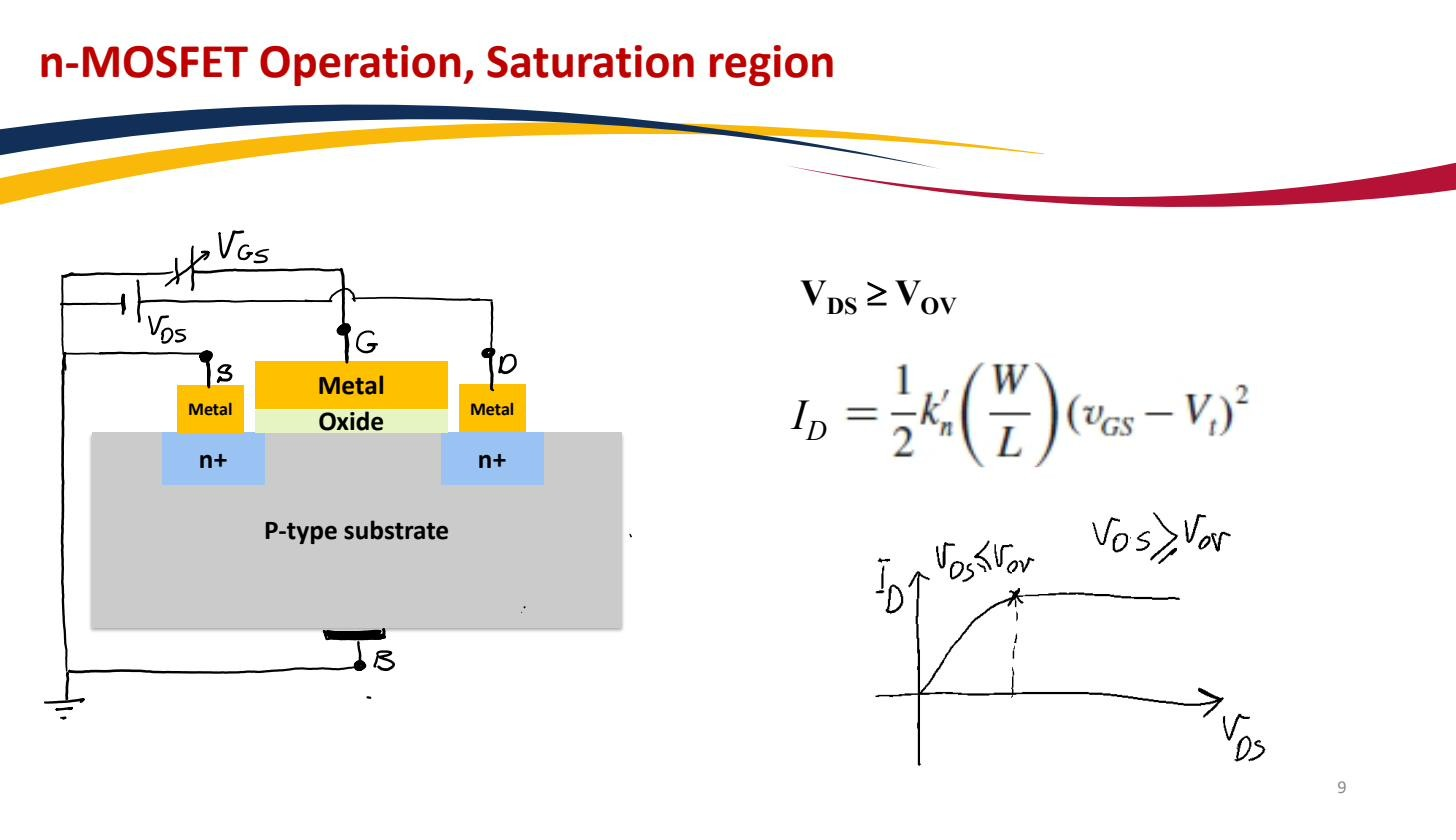 Channel pinched at the drain; current set near the source, ~constant with . A -controlled current source.
Warning: MOSFET saturation ≠ BJT saturation
The naming trips everyone up. A MOSFET in saturation is in its amplifying region, behaving as a clean controlled current source. The analogous region for a BJT is the BJT’s active region, not the BJT’s saturation. A BJT in saturation is the opposite situation: driven hard on with both junctions forward biased, a switch-closed state, not used for linear amplification. So “saturation” means amplify for a MOSFET and switched-fully-on for a BJT. Crossing between the MOSFET and BJT chapters, keep this straight.
Saturation is one of three modes; the others are the MOSFET triode region (, channel continuous, acts as a controlled resistor) and the MOSFET cut-off region (, no channel, off). The full set with identification conditions is collected in MOSFET regions of operation. The small residual dependence in real devices is Channel-length modulation.