The DC network around a MOSFET has one job: set a stable, well-defined Operating point (a specific and , device in saturation) so the small-signal amplifier on top of it works as designed. All small-signal analysis assumes a known bias point. Biasing is what makes that assumption true in a real, mass-produced circuit.
Why fixing fails
The naive idea: apply a fixed gate-source voltage and read off the drain current from the MOSFET square-law . It fails badly in practice. Both the Threshold voltage and the MOSFET transconductance parameter vary widely between nominally identical transistors, with temperature, and across the manufacturing process. The current goes as the square of , so a small spread in or produces a huge spread in . A fixed giving in one transistor can give in another or in a third. The operating point is uncontrolled, and the amplifier built on it is worthless.
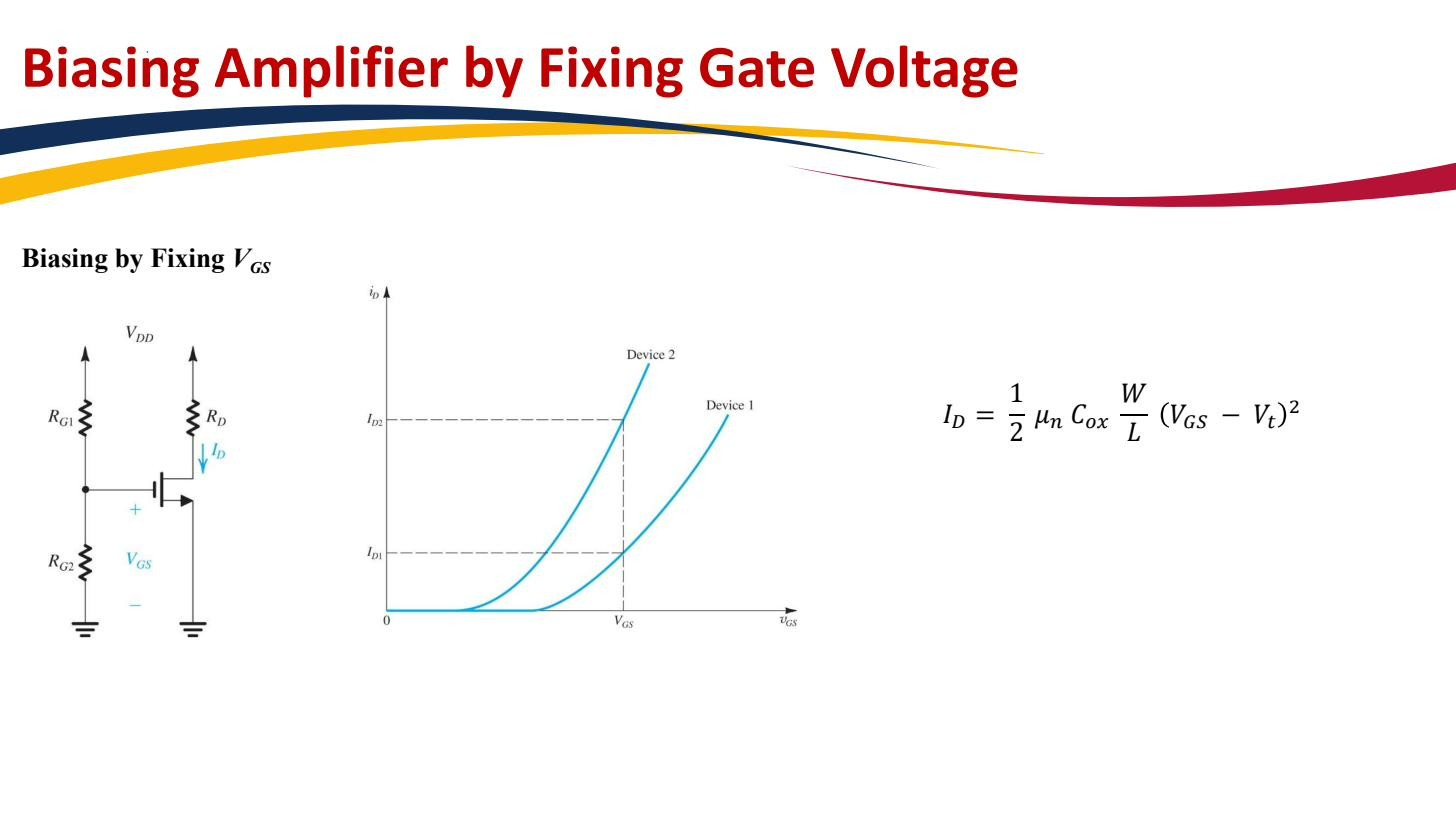 Fixing : the simplest and worst scheme. spread maps straight to spread.
The fix: source resistor + fixed gate reference
Insert a resistor between source and ground and hold the gate at a fixed reference . The gate draws no current (Gate oxide), so KVL around gate → source → ground gives
Read it as feedback: if tries to rise (because happened to be low, say), the drop across grows, which forces down, which pulls back down. The source resistor closes a Negative feedback loop on the bias. If the term is a small part of the equation and
so the operating point is set almost entirely by stable external components ( and ), with only weak dependence on the transistor’s wandering parameters. That’s the whole strategy: use negative feedback to make depend on resistors, not on and .
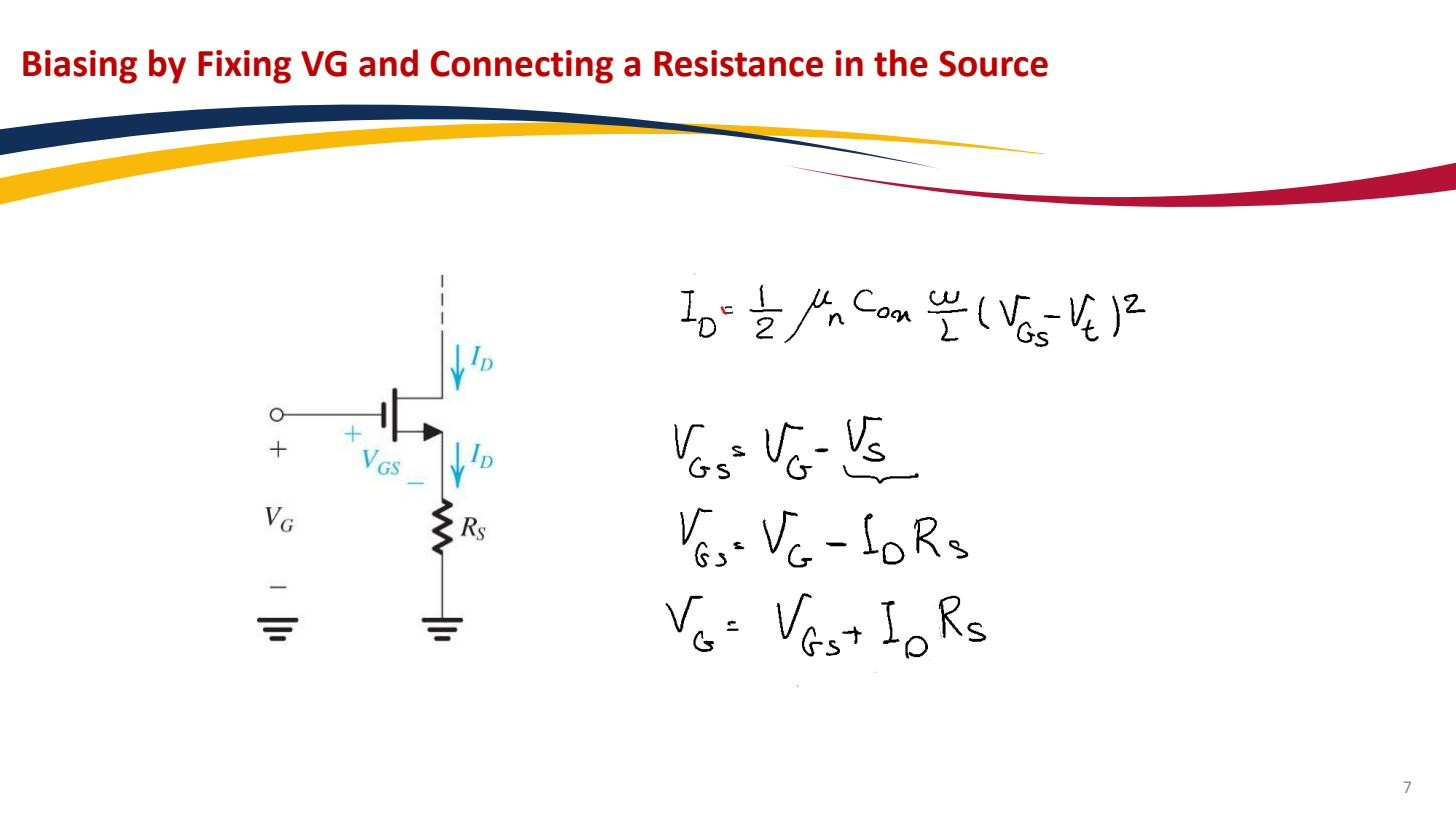 Fix , add . stabilises the operating point.
Practical schemes
The fixed usually comes from a Voltage-divider bias (for a MOSFET the divider resistors can be enormous, since no gate current is drawn). A single-resistor alternative is Drain-to-gate feedback bias, which also guarantees saturation. Both rely on the same negative-feedback principle. The full board-level amplifier that puts these together with coupling and bypass capacitors is the Discrete-circuit MOSFET amplifier.