Channel-length modulation is the slight rise in saturation drain current with caused by the pinch-off point moving back toward the source as increases. It is the reason a real MOSFET in saturation is not a perfect current source but has a finite MOSFET output resistance.
The mechanism
The MOSFET square-law says the saturation current is independent of . That is almost true, not quite. Past Channel pinch-off the channel is pinched at the drain end, and the leftover voltage drops across a small depletion region between the pinch-off point and the drain. Raise further and that depletion region widens, which pushes the pinch-off point a little way back toward the source. The part of the channel that actually carries current, from the source to the pinch-off point, is now slightly shorter: the effective channel length is , with growing as grows.
Drain current is inversely proportional to channel length (a shorter resistive channel passes more current for the same overdrive). So as rises, shrinks and creeps up instead of staying perfectly flat.
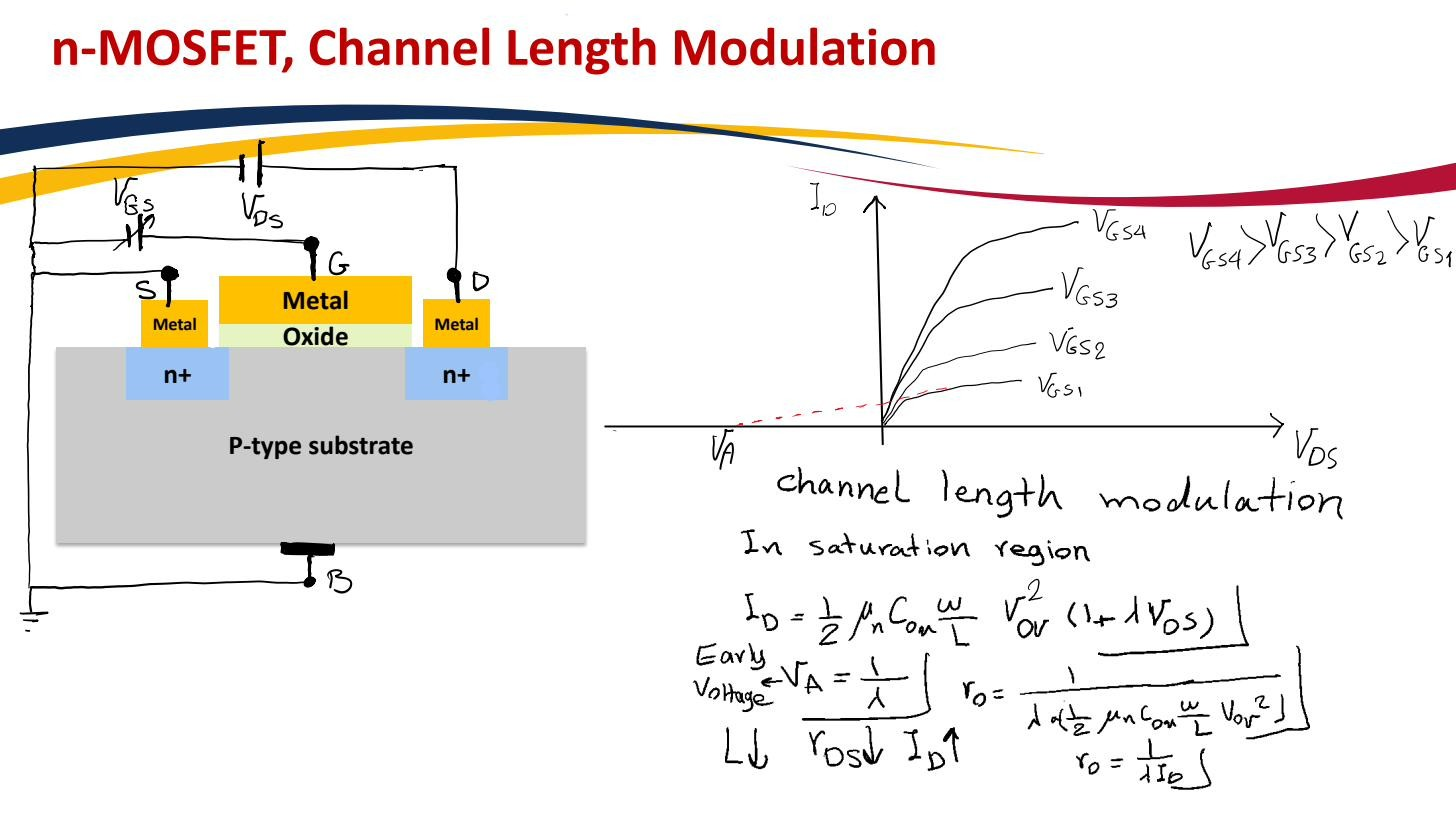 As rises in saturation, pinch-off recedes, , rises slightly.
The modified square-law
To a good approximation the effect is captured by a linear factor in :
where is the channel-length modulation parameter, a process constant with units of , and is the Overdrive voltage. Without the factor this is the ideal square-law; the factor tilts the otherwise-flat saturation curves slightly upward with .
The reciprocal of defines the Early voltage:
named by direct analogy to the BJT’s Early effect. Channel-length modulation is the MOSFET’s Early effect: same idea (effective base/channel width shrinks with the output voltage, output current rises), same finite-output-resistance consequence.
Why it matters: finite output resistance
A tilted saturation curve means the device has a finite slope in saturation, i.e. a finite output resistance
(see MOSFET output resistance). This sits in parallel with the drain load in the MOSFET small-signal model, so it directly caps the gain of a Common-source amplifier: . Typical values: –, so –, giving in the hundreds of kΩ at usual bias currents. Smaller (larger ) means flatter curves, larger , and higher achievable gain.